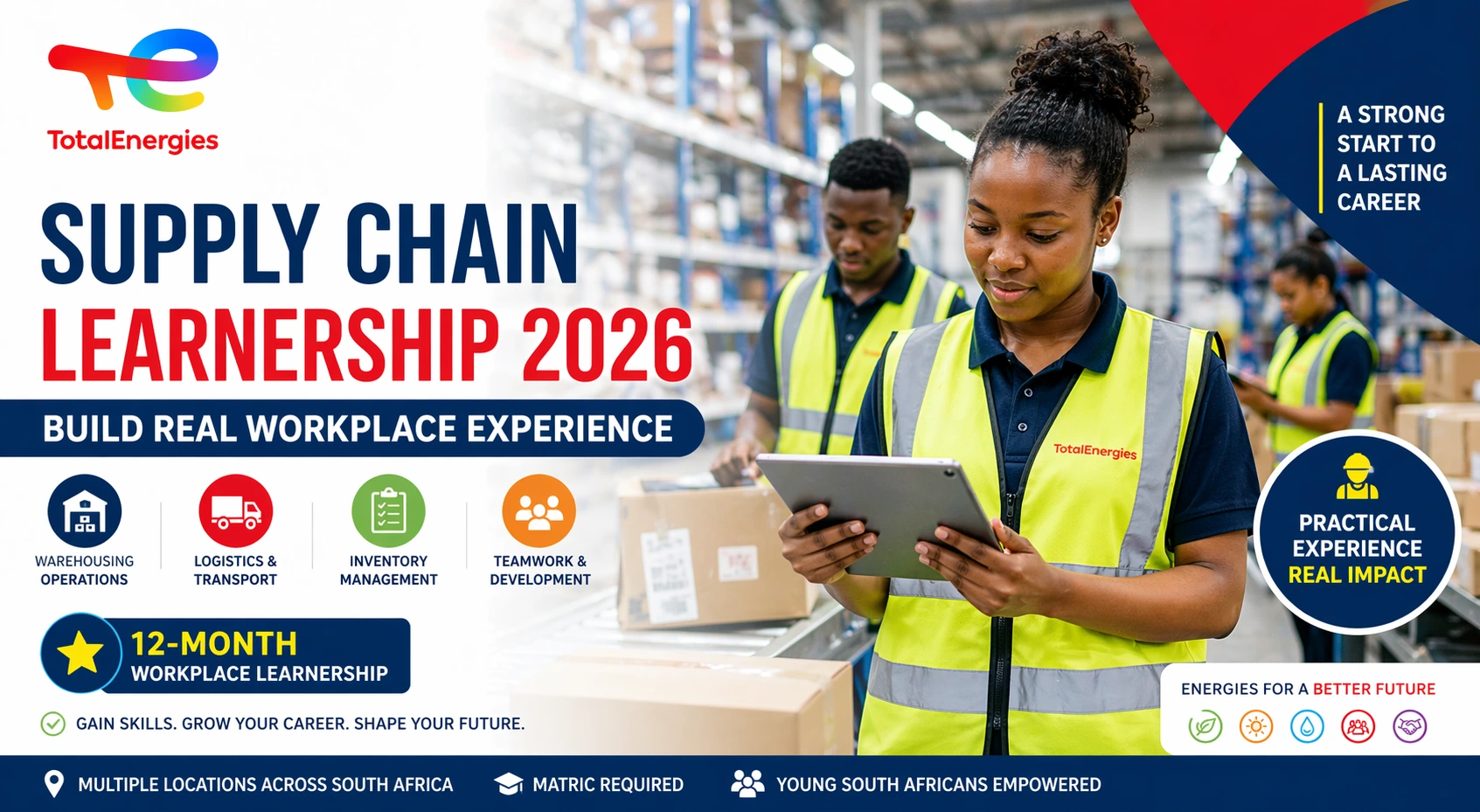
The TotalEnergies Supply Chain Learnership Programme 2026 offers Matric graduates a practical path into logistics and operations careers. Explore requirements, locations, and long-term career impact.
Introduction: Why the TotalEnergies Supply Chain Learnership Programme 2026 Matters Now
South Africa’s youth unemployment crisis continues to place pressure on both job seekers and the broader economy. While thousands of young people complete Matric each year, only a fraction successfully transition into meaningful employment. In this context, the TotalEnergies Supply Chain Learnership Programme 2026 emerges as more than just another opportunity—it represents a structured pathway into one of the country’s most essential economic sectors.
Unlike many entry-level opportunities that lack depth or progression, this programme is designed to provide real workplace exposure within a functioning operational environment. For candidates seeking more than theoretical training, the value lies in its ability to convert potential into practical capability.
The timing is particularly relevant. As logistics, warehousing, and supply chain systems continue to underpin industries such as retail, manufacturing, and energy, the demand for operationally skilled workers is steadily increasing. This learnership aligns directly with that demand.
ALSO APPLY FOR SARB Graduate Development Programme 2027: Why This Elite Opportunity Could Redefine Your Finance Career
Quick Facts: TotalEnergies Supply Chain Learnership Programme 2026
- Company: TotalEnergies
- Closing Date: Not stated in the official advert
- Location: Multiple locations across South Africa
- Duration: 12 months
- Positions Available: Not stated in the official advert
- Reference Number: Not stated in the official advert
- Stipend: Not stated in the official advert
- Required Gender: Not stated in the official advert
Understanding the Role of Supply Chain in South Africa’s Economy || TotalEnergies Supply Chain Learnership
The TotalEnergies Supply Chain Learnership Programme 2026 sits at the intersection of several critical economic systems. Supply chain operations are not isolated functions—they are the backbone of industries that drive South Africa’s GDP.
From fuel distribution networks to retail logistics and industrial manufacturing, the efficiency of supply chains determines whether goods move smoothly or bottlenecks occur. This has direct implications for pricing, availability, and overall economic stability.
What makes supply chain careers particularly valuable is their transferability. Skills developed in logistics environments—such as inventory control, process coordination, and operational planning—can be applied across multiple sectors. This makes the learnership strategically important for candidates looking for long-term employability rather than short-term income.
In this context, TotalEnergies is not simply offering training. It is introducing candidates to a system that influences national productivity.
Accessibility vs Opportunity: Why Matric-Level Entry Matters
One of the defining features of the TotalEnergies Supply Chain Learnership Programme 2026 is its accessibility. By making Matric the primary requirement, the programme opens doors for candidates who might otherwise be excluded from formal employment pathways.
However, accessibility alone does not guarantee opportunity. Many programmes advertise low entry requirements but fail to provide meaningful development. The distinction here lies in the structure of the learnership itself.
Workplace-based training allows participants to develop:
- Practical understanding of operational workflows
- Exposure to real-time problem-solving
- Familiarity with professional standards and expectations
This type of exposure is often more valuable than classroom-based learning, particularly in industries where execution matters as much as knowledge.
For many candidates, the real challenge is not qualification—it is credibility. This learnership directly addresses that gap.
Geographic Distribution and Its Strategic Importance
The multi-location structure of the programme is another critical factor worth analysing. Opportunities are available in:
- Waltloo
- Island View Terminal
- Ladysmith
- Cape Town
- Alrode
- Nelspruit
This distribution is not random. These locations are closely linked to transport routes, industrial zones, and energy infrastructure. By placing learners in these environments, the programme ensures exposure to high-volume operational activity.
From an economic perspective, this approach decentralises opportunity while still aligning with areas of high industrial demand. For applicants, it increases accessibility. For the employer, it ensures that training takes place in relevant, high-impact settings.
Workplace Exposure vs Theoretical Learning: A Critical Advantage
A recurring issue in youth employment programmes is the disconnect between theory and practice. Many candidates complete training programmes without ever experiencing the realities of a working environment.
The TotalEnergies Supply Chain Learnership Programme 2026 addresses this by prioritising workplace exposure. This includes:
- Participation in daily operational tasks
- Interaction with experienced professionals
- Exposure to performance expectations and accountability
These elements contribute to what employers often describe as “work readiness.” It is not just about knowing what to do—it is about understanding how to function within a professional system.
This distinction is critical. Employers consistently prioritise candidates who demonstrate reliability, teamwork, and attention to detail—qualities that are best developed in real environments rather than simulated ones.
Skills Development and Long-Term Career Positioning
The skills developed through this learnership extend beyond immediate job functions. Participants are likely to build competencies in:
- Communication and teamwork
- Time management and organisation
- Accuracy and accountability
- Problem-solving in operational contexts
These are foundational skills that influence long-term career progression.
Importantly, the programme also positions learners for entry-level roles such as:
- Logistics Assistant
- Warehouse Support
- Supply Chain Administrator
- Operations Clerk
From there, progression into supervisory or specialised roles becomes possible with experience and further training.
This layered approach to skill development is what differentiates meaningful opportunities from temporary placements.
The Role of Employer Reputation in Career Trajectories || TotalEnergies Supply Chain Learnership
The involvement of TotalEnergies adds a significant layer of credibility to the programme. Employer reputation plays a crucial role in how candidates are perceived in future job applications.
Experience gained within a structured, globally recognised organisation often signals:
- Exposure to established systems and standards
- Familiarity with professional environments
- Ability to meet organisational expectations
For candidates entering the job market, this can significantly improve employability.
It also reflects a broader trend in recruitment, where employers increasingly value demonstrated experience over purely academic qualifications.
What This Means Going Forward-TotalEnergies Supply Chain Learnership
The TotalEnergies Supply Chain Learnership Programme 2026 reflects a broader shift in how entry-level opportunities are being structured in South Africa.
As industries continue to prioritise efficiency and operational excellence, the demand for skilled workers in logistics and supply chain management is expected to grow. Programmes that combine accessibility with practical training are likely to become more important.
For job seekers, this signals a need to focus on opportunities that offer:
- Real workplace exposure
- Transferable skill development
- Credible employer experience
For employers, it highlights the importance of investing in structured training pipelines that address both skills shortages and youth unemployment.
In the long term, initiatives like this could contribute to a more stable and skilled workforce—provided they are scaled and replicated effectively.
How can candidates submit their applications?
Applications must be submitted through the relevant TotalEnergies online application portal for each location.
- Applications must be submitted through the official Waltloo online application portal.
- Applications must be submitted through the official Island View Terminal online application portal.
- Applications must be submitted through the official Ladysmith online application portal.
- Applications must be submitted through the official Cape Town online application portal.
- Applications must be submitted through the official Alrode online application portal.
- Applications must be submitted through the official Nelspruit online application portal.
FAQs-TotalEnergies Supply Chain Learnership
1. Who qualifies for the TotalEnergies Supply Chain Learnership Programme 2026?
Candidates must have Matric as a minimum requirement. Additional qualifications in logistics or supply chain may improve selection chances but are not mandatory.
2. Does the programme guarantee employment after completion?
No, employment is not guaranteed. However, the experience gained significantly improves a candidate’s chances of securing future roles in logistics and operations.
Conclusion-TotalEnergies Supply Chain Learnership
The TotalEnergies Supply Chain Learnership Programme 2026 stands out not because it promises immediate employment, but because it offers something more valuable—credible, structured entry into a critical sector of the economy.
For young South Africans navigating a competitive job market, this type of opportunity provides a realistic foundation for long-term career growth. It bridges the gap between education and employment, offering both experience and exposure in an industry that continues to expand.
While it may not solve broader employment challenges on its own, it represents a meaningful step in the right direction—for both individuals and the economy.