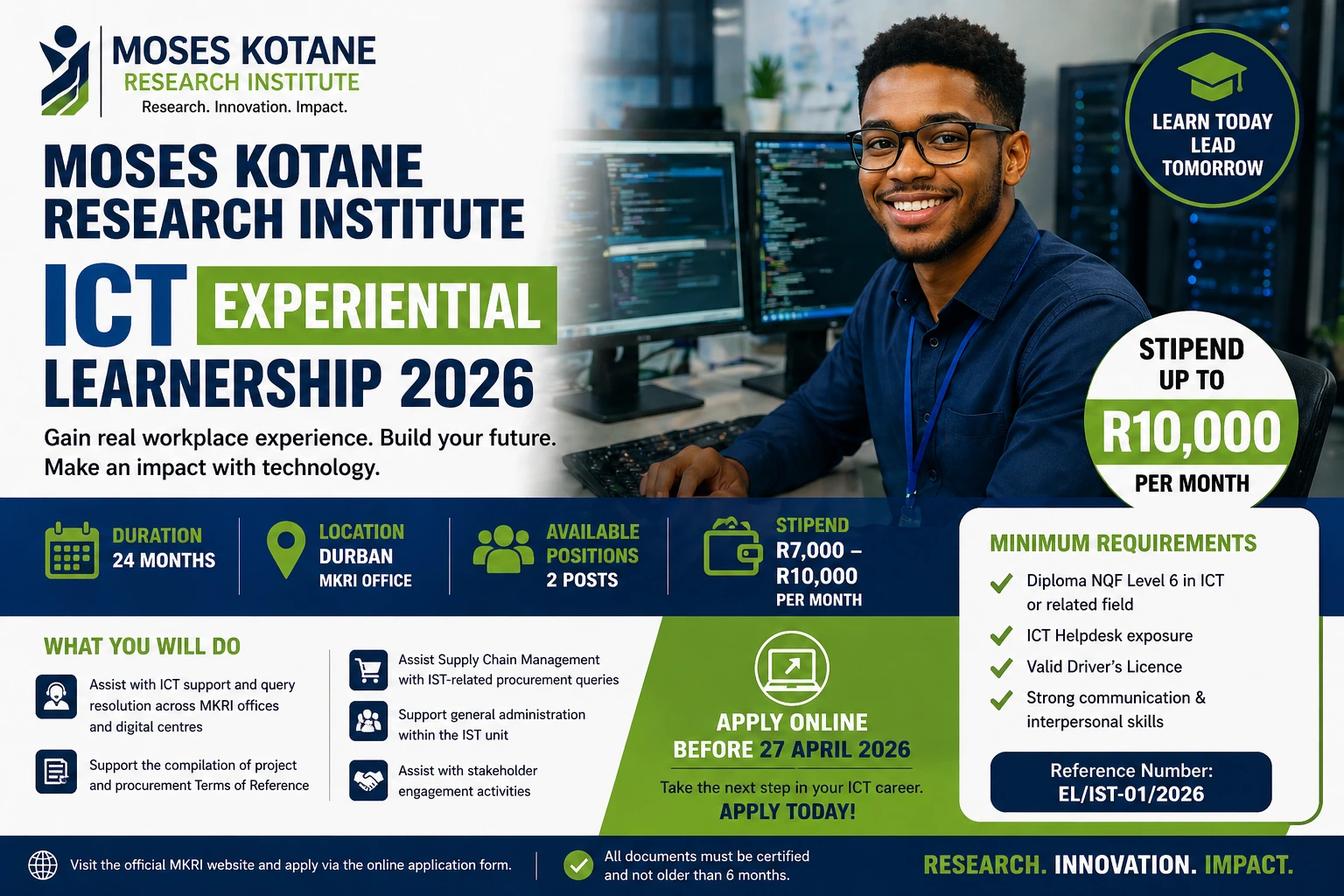
Apply for the Moses Kotane Research Institute ICT Experiential Learnership 2026 in Durban. 24-month programme with up to R10,000 stipend.
At a modest office in Durban, a graduate sits in front of a support dashboard, watching incoming queries populate the screen. A system error in one department. A login issue at a digital centre. A procurement request needing clarification.
This is not a classroom exercise. It’s real-time problem-solving, with real users depending on accurate, timely responses.
For many ICT graduates, this moment—where theory meets responsibility—is the hardest to reach. And it’s exactly what the Moses Kotane Research Institute ICT Experiential Learnership 2026 is designed to provide.
What You Should Know First
The Moses Kotane Research Institute ICT Experiential Learnership 2026 is a 24-month workplace training programme aimed at ICT graduates who need practical experience in a structured, professional environment.
Hosted by the Moses Kotane Research Institute, the programme offers hands-on exposure to ICT support, project documentation, procurement processes, and stakeholder engagement—skills that are increasingly essential in both public and private sector roles.
With only two positions available, competition is expected to be high.
A Closer Look at the MKRI ICT Experiential Learnership 2026
Unlike short-term internships, this programme stretches over two years. That duration matters.
It allows learners to move beyond basic tasks and actually understand how systems operate within an organisation. Participants will assist with:
- ICT support across MKRI offices and digital centres
- Resolving technical queries from users
- Supporting procurement processes related to ICT
- Assisting with Terms of Reference (TOR) documentation
- General administrative support within the IST unit
This combination of technical and administrative exposure reflects the reality of modern ICT roles, where communication and coordination are just as important as technical knowledge.
Why the Moses Kotane Research Institute ICT Experiential Learnership 2026 Matters
South Africa produces thousands of ICT graduates every year. Yet many struggle to secure employment—not because they lack knowledge, but because they lack experience.
Employers are increasingly looking for candidates who can:
- Work with real users
- Understand organisational systems
- Communicate effectively across departments
The Moses Kotane Research Institute ICT Experiential Learnership 2026 addresses this gap directly.
By placing learners in a working environment, it gives them the kind of exposure that transforms a qualification into employability.
Beyond Technical Skills: The Role of Communication
One of the most overlooked aspects of ICT careers is communication.
In the MKRI environment, learners won’t just fix issues—they’ll need to explain solutions, document processes, and engage with stakeholders who may not have technical backgrounds.
This is particularly important in public-sector environments, where systems often serve diverse communities and departments.
In cities like Pretoria or Durban, where government and public institutions play a major role, these skills are highly transferable.
Quick Facts: Moses Kotane Research Institute ICT Experiential Learnership 2026
- Closing Date: 27 April 2026
- Location: Durban (MKRI Office)
- Duration: 24 months
- Positions Available: 2
- Reference Number: EL/IST-01/2026
- Stipend: R7,000 – R10,000 per month
Who Should Apply—and Why It’s Competitive
The programme is designed for ICT graduates with a Diploma (NQF Level 6) or higher.
Additional certifications like A+, N+, or MCSE can strengthen an application, but they are not mandatory.
However, the limited number of positions means applicants need to stand out.
This isn’t just about having qualifications—it’s about demonstrating readiness for a professional environment.
Expert Insight: The Hidden Value of Procurement and TOR Experience
One of the most distinctive aspects of the Moses Kotane Research Institute ICT Experiential Learnership 2026 is its focus on procurement and Terms of Reference (TOR) documentation.
For many graduates, this is unfamiliar territory.
But in structured organisations—especially in government and public-sector environments—ICT projects don’t begin with coding or installation. They begin with documentation, planning, and approval processes.
Understanding how to:
- Draft or support TOR documents
- Work with supply chain management
- Align technical needs with organisational requirements
gives candidates a significant advantage.
It signals that they can operate within complex systems—not just solve isolated technical problems.
Application Preparation: Where Many Candidates Go Wrong
Even strong candidates can lose out due to avoidable mistakes.
Before applying for the Moses Kotane Research Institute ICT Experiential Learnership 2026, ensure:
- All documents are certified and not older than 6 months
- The reference number (EL/IST-01/2026) is correctly included
- Your CV clearly outlines relevant skills and any helpdesk exposure
A missing document or incorrect detail can lead to disqualification—regardless of your qualifications.
see also: Paralegal Learnership Facilitator NQF Level 5 in Johannesburg (R20,000/month)
Where to Apply
Applications for the Moses Kotane Research Institute ICT Experiential Learnership 2026 must be submitted through the official online application platform.
Candidates should:
- Complete the online form
- Upload all required documents (CV, ID, qualifications, driver’s licence)
- Double-check all information before submission
apply here: Moses Kotane Research Institute ICT Experiential Learnership 2026
Applications close on 27 April 2026, and late submissions are unlikely to be considered.
Frequently Asked Questions
1. Do I need work experience to apply?
Some exposure to ICT helpdesk environments is required, but extensive experience is not necessary.
2. Is the stipend guaranteed at R10,000?
No, the stipend ranges between R7,000 and R10,000 depending on qualifying criteria.
3. What career paths can this programme lead to?
Graduates may pursue roles such as ICT support technician, systems administrator, or public-sector ICT officer.
A Two-Year Investment in Long-Term Employability
The Moses Kotane Research Institute ICT Experiential Learnership 2026 is not a quick fix for unemployment. It’s a structured, demanding programme that requires commitment, adaptability, and attention to detail.
But for those who complete it, the payoff can be significant.
In a job market where experience often outweighs qualifications, two years of real-world exposure can change how employers see you.
And for a graduate sitting in Durban, responding to their first real support ticket, that shift—from theory to practice—is where a career truly begins.