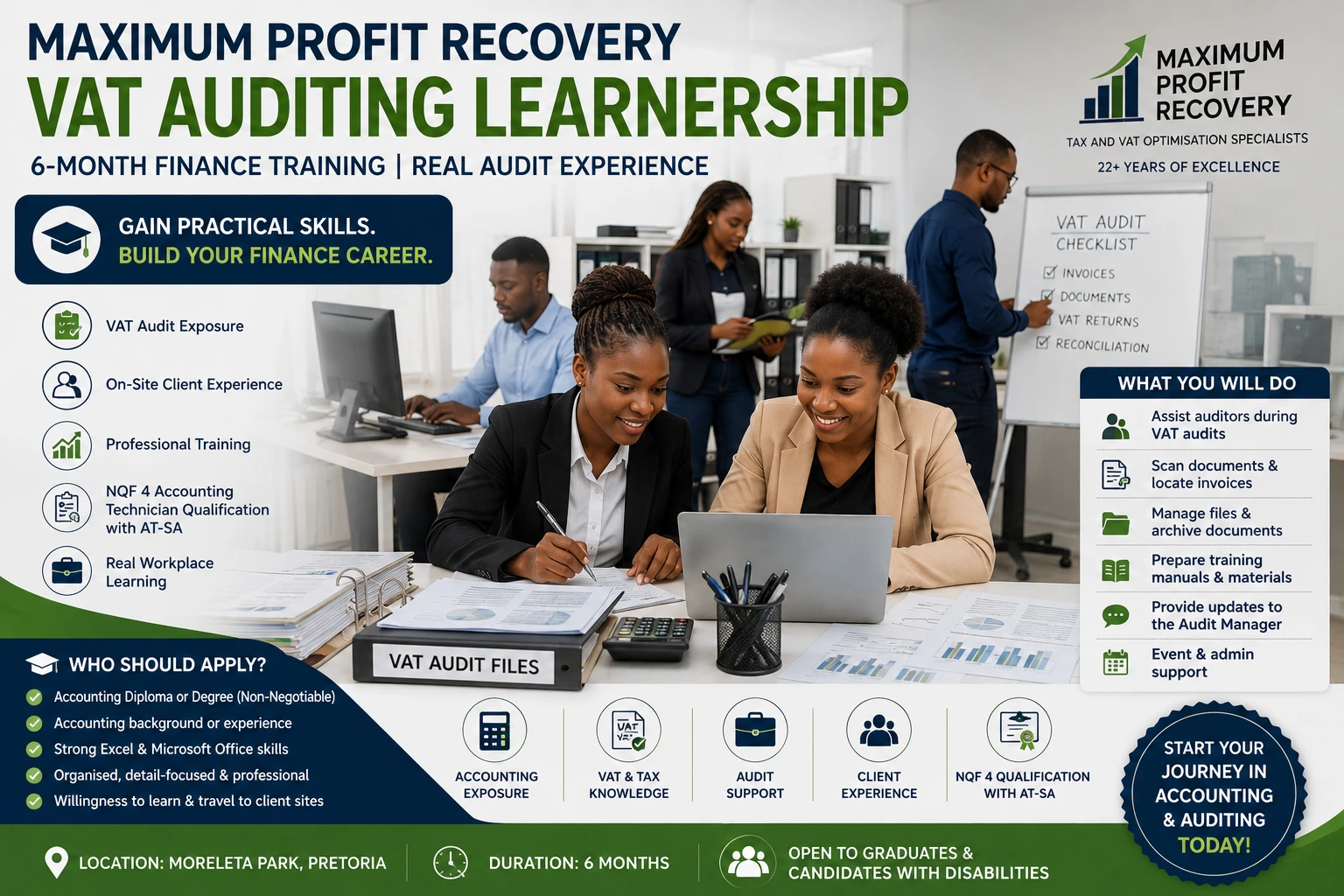
Looking to build a finance or auditing career? Explore how the Maximum Profit Recovery VAT Auditing Learnership offers real audit experience, VAT training and an NQF 4 Accounting Technician qualification in 2026.
Maximum Profit Recovery VAT Auditing Learnership: Why This 6-Month Finance Training Opportunity Matters in 2026
Breaking into South Africa’s finance sector can be difficult, especially for graduates and diploma holders trying to move from academic knowledge into practical work experience. While many accounting and finance candidates complete qualifications, fewer find opportunities that provide direct exposure to real financial processes, audit environments and professional client work.
That challenge helps explain why the Maximum Profit Recovery VAT Auditing Learnership deserves attention in 2026.
Rather than limiting learners to administrative observation, the programme places candidates inside a working VAT audit environment where compliance, documentation, client reporting and financial processes play an everyday role. More importantly, it offers practical training while learners work toward an NQF 4 Accounting Technician qualification with AT-SA, creating a combination of workplace exposure and structured professional development.
At a time when employers increasingly prioritise practical skills alongside qualifications, this learnership may represent more than temporary experience. For candidates interested in accounting, tax compliance, auditing or finance operations, it could become a meaningful stepping stone into long-term professional work.
ALSO APPLY FOR Nutri Feeds Grain Handling Learnership 2026 Opens Doors for Young South Africans Seeking Manufacturing Experience
Quick Facts: Maximum Profit Recovery VAT Auditing Learnership 2026
| Information | Details |
|---|---|
| Name of Company | Maximum Profit Recovery |
| Programme | VAT Auditing Learnership |
| Closing Date | Not stated in the official advert |
| Location | Moreleta Park |
| Duration | 6 Months |
| Positions Available | Not stated in the official advert |
| Reference Number | Not stated in the official advert |
| Stipend | Not stated in the official advert |
| Required Gender | Not stated in the official advert |
Why the Maximum Profit Recovery VAT Auditing Learnership Matters Right Now
South Africa’s accounting and compliance landscape continues evolving. Businesses face increasing pressure to maintain accurate financial records, comply with tax regulations and manage VAT documentation correctly.
That shift has quietly increased demand for professionals who understand both accounting fundamentals and compliance-related finance work.
The Maximum Profit Recovery VAT Auditing Learnership arrives during a period when many employers want candidates who can move beyond theory and contribute in practical workplace settings.
Accounting graduates frequently face a frustrating reality: qualifications alone do not always guarantee employability.
Many junior roles now expect: Maximum Profit Recovery VAT Auditing Learnership
- Practical financial administration skills
- Excel competency
- Document management ability
- Client communication exposure
- Compliance awareness
- Professional reporting knowledge
The challenge is obvious. How does someone gain experience without first receiving an opportunity?
Learnerships help bridge that gap.
Unlike purely classroom-based training, this programme combines workplace learning with direct involvement in audit-related functions. That practical element may be one of the strongest reasons finance-focused candidates should pay attention.
Understanding What VAT Auditing Actually Involves-Maximum Profit Recovery VAT Auditing Learnership 2026
One of the reasons many applicants hesitate around VAT-related opportunities is uncertainty about what VAT auditing actually means.
At its core, VAT auditing focuses on reviewing financial records, invoices and tax-related documentation to ensure compliance and identify possible discrepancies or recoveries.
In practical terms, professionals working in VAT auditing often deal with: Maximum Profit Recovery VAT Auditing Learnership
- Invoice verification
- Financial document review
- Tax-related record checking
- Compliance processes
- Reporting and administration
- Client-facing communication
The Maximum Profit Recovery VAT Auditing Learnership places candidates directly inside this environment.
Learners will reportedly support auditors during on-site VAT audits while helping manage office administration and audit-related processes.
This matters because finance work increasingly requires precision.
A missing invoice, incorrect calculation or incomplete document trail can have major financial implications for businesses.
That is why companies operating in tax and VAT optimisation often value employees who are organised, detail-oriented and comfortable working with structured systems.
For candidates who naturally enjoy organisation, spreadsheets, documentation and analytical work, VAT auditing can become an unexpectedly strong career fit.
Why Practical Audit Exposure Matters More Than Many Candidates Realise
A recurring problem in South Africa’s finance job market is the “experience gap.”
Candidates finish qualifications but struggle to demonstrate workplace readiness.
This is where the Maximum Profit Recovery VAT Auditing Learnership potentially stands out.
The programme appears designed around real workplace immersion rather than passive observation.
Learners may assist with:
- Supporting auditors during VAT audits
- Locating invoices and financial documents
- Scanning and managing records
- Preparing training materials
- Reporting updates to audit managers
- Supporting office and event coordination tasks
Although some responsibilities may sound administrative, they reflect the realities of professional finance environments.
Accounting careers often begin with detailed operational work.
Junior professionals frequently learn financial discipline through document verification, reporting structures and compliance-related support before progressing into more advanced responsibilities.
The inclusion of client-site exposure may also strengthen the experience.
Many graduates only encounter financial theory during studies. Exposure to real business operations can significantly improve workplace confidence and professional understanding.
In practical terms, candidates who complete six months inside an audit environment may leave with stronger employability than applicants who only possess academic credentials.
The Skills Employers Are Quietly Prioritising in Finance Recruitment
The minimum requirements for this opportunity reveal something important about broader hiring trends.
The advert requires:
- An Accounting Diploma or Degree
- Microsoft Office skills
- Strong Excel competency
- Time management
- Organisational ability
- Professional behaviour
- Independent work capability
These requirements highlight a growing shift inside finance recruitment.
Technical qualifications matter — but they are rarely enough on their own.
Employers increasingly want candidates who can function effectively inside operational environments.
That includes:
Excel Proficiency
Finance professionals regularly work with spreadsheets, reporting tools and structured financial data. Candidates with stronger Excel ability often become more competitive.
Attention to Detail
VAT auditing depends on accuracy. Minor documentation errors can influence outcomes significantly.
Communication Skills
Even technical finance roles require communication with managers, clients and internal teams.
Professional Reliability
Meeting deadlines, organising information and following procedures remain highly valued traits.
This is one reason the Maximum Profit Recovery VAT Auditing Learnership could appeal to organised, detail-focused applicants rather than candidates seeking loosely structured work environments.
Why the NQF 4 Accounting Technician Qualification Could Add Long-Term Value
One of the most overlooked parts of this opportunity is the inclusion of an NQF 4 Accounting Technician qualification through AT-SA.
For many candidates, professional qualifications help improve long-term career progression.
Finance and accounting sectors often reward candidates who continuously strengthen technical competence.
Adding an accounting technician qualification can potentially improve pathways into:
- Accounting support roles
- Audit administration
- Tax administration
- Financial operations
- Junior bookkeeping roles
- Compliance support positions
In an increasingly competitive market, combining workplace experience with recognised credentials may improve employability.
Candidates who complete the learnership may leave with both professional exposure and additional certification — an advantage that many entry-level applicants do not yet have.
What Strong Applicants Will Likely Do Differently
Recruiters reviewing finance-related applications often notice one common problem: generic CVs.
Candidates frequently describe themselves as “hardworking” or “fast learners” without providing evidence.
For a role like the Maximum Profit Recovery VAT Auditing Learnership, stronger candidates will probably make their finance background easier to assess.
Good examples include clearly highlighting:
- Accounting qualifications
- Excel proficiency
- Audit or tax exposure
- Administrative responsibilities
- Financial document handling
- Reporting responsibilities
- Client service experience
Even small examples can matter.
A candidate who helped reconcile records, organised documents, assisted with finance admin or supported reporting during studies already demonstrates useful exposure.
Practical proof tends to stand out more than vague descriptions.
Recruiters usually ask themselves one question:
Can this candidate contribute effectively in a professional finance environment?
A focused CV helps answer that question quickly.
Common Mistakes Candidates Should Avoid
Competition for finance-related learnerships continues increasing, making presentation more important.
Applicants should avoid several common errors:
Hiding Key Qualifications
Accounting qualifications should appear near the top of the CV.
Underplaying Excel Skills
Excel competency matters in finance roles and should be clearly stated.
Using One Generic CV
Finance applications benefit from tailoring content to audit and VAT-related responsibilities.
Leaving Out Relevant Experience
Even small examples involving documents, reporting or office administration can strengthen an application.
Forgetting Updated Contact Information
Incorrect details can lead to missed opportunities.
Professional formatting also matters.
Recruiters typically prefer CVs that are clear, concise and easy to scan rather than long, cluttered documents.
What This Means Going Forward-Maximum Profit Recovery VAT Auditing Learnership
The finance industry is becoming increasingly data-driven, compliance-focused and process-oriented.
As businesses face tighter financial oversight, demand for professionals who understand documentation, tax compliance and reporting may continue growing.
That creates opportunity for candidates willing to gain specialised experience early.
The Maximum Profit Recovery VAT Auditing Learnership reflects a broader employment trend: companies increasingly value candidates who combine qualifications with practical exposure.
For finance graduates and diploma holders, programmes like this may become an increasingly important bridge into long-term professional careers.
Even for candidates unsure whether VAT auditing is their final destination, the transferable skills remain valuable.
Accuracy, Excel proficiency, reporting, client interaction and document management are competencies used widely across accounting and financial services sectors.
How can candidates submit their details?
Candidates who meet the requirements should submit their details through the official online application portal.
Before submitting, review the full listing carefully and make sure your CV clearly shows your accounting qualification, Excel skills and relevant finance experience.
FAQs-Maximum Profit Recovery VAT Auditing Learnership
1. Do I need previous auditing experience to apply for the Maximum Profit Recovery VAT Auditing Learnership?
Not necessarily. However, applicants need an Accounting Diploma or Degree, and the advert states that accounting work experience or a strong accounting background is important.
2. Does the learnership include a stipend?
The official advert does not mention a stipend amount. Applicants should refer to the official application portal for updated details.
Conclusion-Maximum Profit Recovery VAT Auditing Learnership
The Maximum Profit Recovery VAT Auditing Learnership offers more than short-term workplace exposure. By combining real VAT audit support, office administration, client interaction and an NQF 4 Accounting Technician qualification, the programme provides finance-focused candidates with a structured introduction to professional audit environments.
For organised, detail-oriented applicants with accounting qualifications, this six-month opportunity may offer valuable practical experience at a time when employers increasingly prioritise workplace readiness. Candidates who present a strong finance-focused CV and demonstrate professionalism could position themselves competitively for future accounting and auditing opportunities.