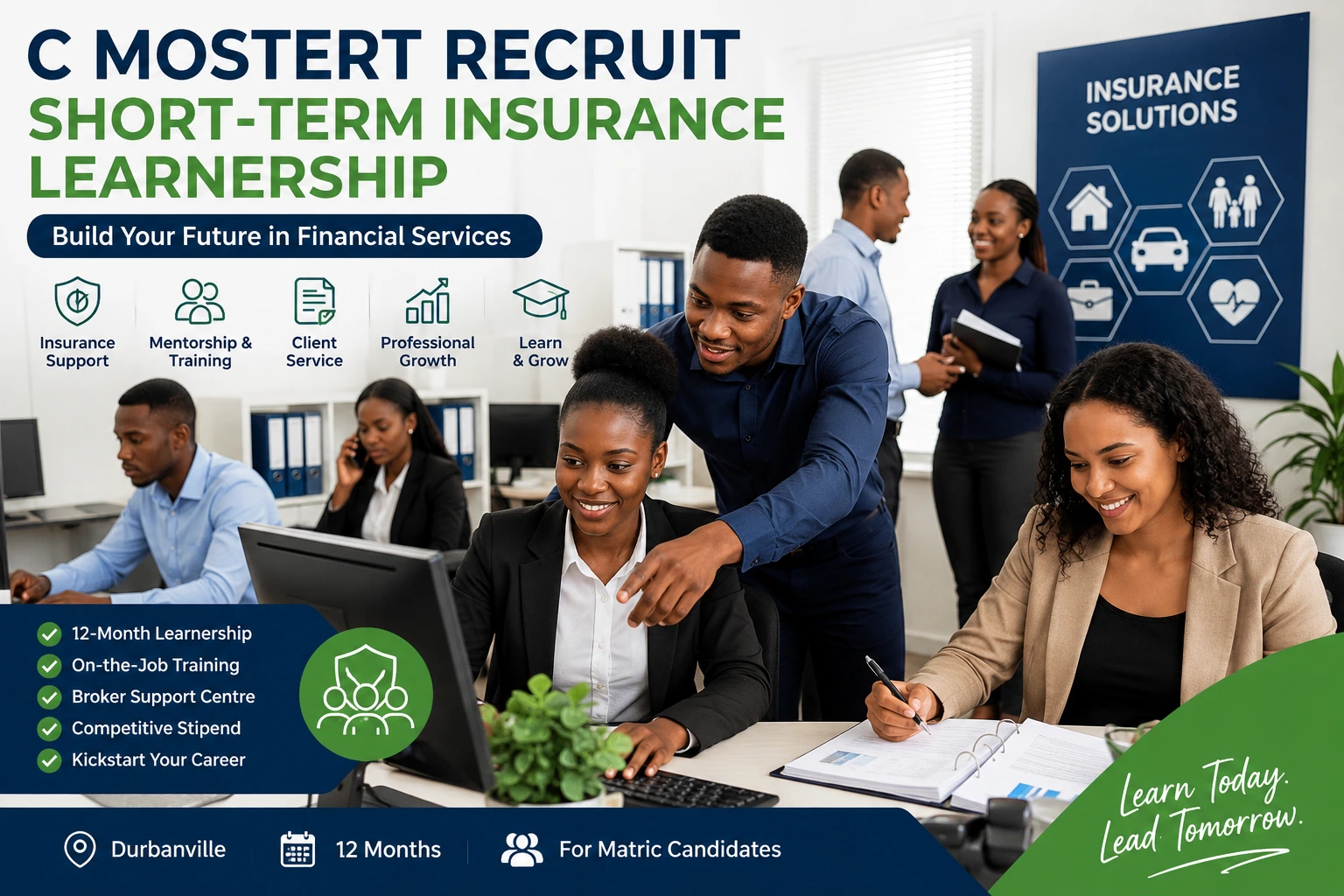
Looking for a way into financial services? Discover how the C Mostert Recruit Short-Term Insurance Learnership helps matric candidates gain insurance industry experience, training and mentorship in 2026.
C Mostert Recruit Short-Term Insurance Learnership: Why This Entry-Level Opportunity Matters in 2026
Breaking into the financial services sector can feel overwhelming for many young South Africans, especially when most entry-level roles ask for experience that first-time job seekers simply do not have. That challenge has become even more relevant in 2026 as unemployment remains a major concern among matriculants and young adults searching for practical ways to enter professional industries.
The C Mostert Recruit Short-Term Insurance Learnership arrives at an important moment. Instead of expecting applicants to already understand insurance systems or financial products, the programme focuses on structured workplace learning, mentorship and practical exposure inside a professional insurance environment.
For matric candidates who are uncertain about university, still exploring career options or looking for meaningful work experience, this learnership may represent more than temporary training. It could become an early stepping stone into one of South Africa’s most stable professional sectors.
The insurance industry is often overlooked by school leavers, yet it offers long-term career paths in administration, customer support, claims, underwriting, compliance and brokerage services. Understanding why this learnership matters requires looking beyond the advert itself and examining the broader opportunities it creates.
ALSO APPLY FOR Nutri Feeds Grain Handling Learnership 2026 Opens Doors for Young South Africans Seeking Manufacturing Experience
Quick Facts: C Mostert Recruit Short-Term Insurance Learnership 2026
| Information | Details |
|---|---|
| Name of Company | C Mostert Recruit |
| Programme | Short-Term Insurance Learnership |
| Closing Date | Not stated in the official advert |
| Location | Durbanville |
| Duration | 12 Months |
| Positions Available | Not stated in the official advert |
| Reference Number | Not stated in the official advert |
| Stipend | Competitive monthly stipend (exact amount not officially stated) |
| Required Gender | Not stated in the official advert |
Why the C Mostert Recruit Short-Term Insurance Learnership Matters Now
The insurance sector is becoming increasingly important in South Africa’s economy. Businesses, households and individuals rely heavily on short-term insurance products to manage risks ranging from vehicle damage to business interruption and property loss.
However, many young people still see insurance as inaccessible because they assume it requires finance degrees or specialised qualifications. In reality, many insurance careers begin through workplace-based learning opportunities like the C Mostert Recruit Short-Term Insurance Learnership.
What makes this programme particularly relevant in 2026 is its accessibility. Applicants only need a Matric qualification, strong English communication skills and a willingness to learn. Technical insurance knowledge is not mandatory.
That lowers one of the biggest barriers facing entry-level candidates: lack of experience.
In an employment market where graduates often compete for junior positions, learnerships increasingly function as a practical bridge between education and employment. Instead of waiting for ideal opportunities, candidates gain exposure while building transferable workplace skills.
Understanding What Short-Term Insurance Work Actually Involves
One reason many applicants overlook insurance opportunities is uncertainty about what the work actually includes.
Short-term insurance focuses on protecting assets such as cars, homes, businesses and equipment against risks and damages. Behind every insurance policy sits a support system involving broker services, customer communication, documentation and claims processing.
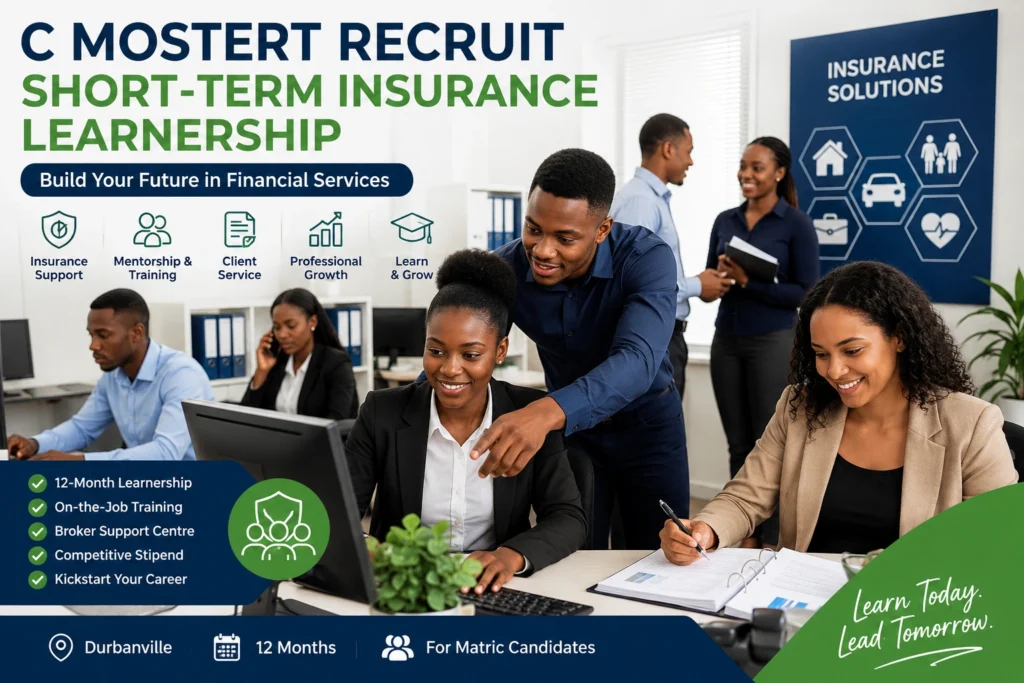
The C Mostert Recruit Short-Term Insurance Learnership places successful applicants inside a Broker Support Centre. That matters because support roles often provide one of the strongest foundations for understanding how the industry works.
Rather than immediately handling complex technical responsibilities, learners are likely to observe and assist with areas such as:
- Client communication
- Administrative support
- Documentation handling
- Policy-related processes
- Professional email communication
- Information management
- Deadline coordination
These responsibilities may appear administrative on the surface, but they help build professional habits that employers value across multiple industries.
For first-time workers, exposure to deadlines, workplace communication and structured reporting can be just as valuable as industry-specific knowledge.
Why Communication Skills Could Matter More Than Experience
One of the most revealing parts of this opportunity is its focus on communication rather than prior technical expertise.
The advert highlights strong English communication as a requirement while noting that Afrikaans fluency may be advantageous. That suggests the role prioritises interaction, clarity and professionalism.
This reflects a broader trend inside financial services.
Employers increasingly value “human skills” such as communication, professionalism and reliability because technical processes can often be taught during training.
Insurance environments require employees who can:
- Speak professionally to clients
- Explain information clearly
- Follow procedures carefully
- Maintain accuracy under pressure
- Handle sensitive information responsibly
For applicants worried about lacking experience, this should be encouraging.
Someone with strong interpersonal skills, computer literacy and a professional attitude may have a stronger application than someone with limited insurance exposure but poor communication habits.
This explains why the C Mostert Recruit Short-Term Insurance Learnership emphasises attitude and learning potential over technical knowledge.
The Hidden Career Value of Learnerships in Financial Services
Many candidates mistakenly treat learnerships as short-term opportunities with limited long-term impact.
In reality, workplace-based programmes inside professional sectors often create stronger employment foundations than temporary casual jobs.
The financial services industry rewards practical exposure.
A learner who spends 12 months inside an insurance support environment develops workplace understanding that can strengthen future applications for roles involving:
- Insurance administration
- Broker support
- Claims processing
- Client service
- Financial administration
- Office coordination
- Compliance support
Even if learners eventually move into different sectors, the transferable skills remain valuable.
Time management, document handling, communication and client interaction are competencies used across banking, retail finance, logistics and customer service industries.
In many cases, employers prefer candidates who have demonstrated reliability inside structured environments over applicants with no workplace exposure at all.
That is one reason opportunities like the C Mostert Recruit Short-Term Insurance Learnership continue attracting strong interest among young South Africans.
What Strong Applicants Will Probably Do Differently-C Mostert Recruit Short-Term Insurance Learnership
Recruiters often review large numbers of similar-looking CVs for learnerships.
This means small details can significantly influence application outcomes.
Candidates applying for the C Mostert Recruit Short-Term Insurance Learnership may improve their chances by focusing on practical examples rather than generic statements.
For example, simply writing “hardworking” rarely creates impact.
Instead, applicants can demonstrate workplace readiness through evidence.
Better examples include:
- Assisted customers in a school, retail or community setting
- Managed documents or organised records
- Helped coordinate events or projects
- Worked with email, calls or computer systems
- Met deadlines consistently during studies
Even unpaid responsibilities can demonstrate reliability.
A learner who helped manage a family business, volunteered in community activities or handled school administration tasks may already possess useful transferable experience.
Recruiters are often trying to answer one question: Can this person function responsibly in a professional environment?
A clear, focused CV makes that easier to assess.
Common Mistakes That Could Weaken Applications-C Mostert Recruit Short-Term Insurance Learnership
Another overlooked reality is that many applicants disqualify themselves through avoidable mistakes.
The most common problems often include incomplete information or poor presentation.
Candidates should avoid: C Mostert Recruit Short-Term Insurance Learnership
Leaving Out Important Qualification Details
Matric information should be clearly visible and easy to find.
Submitting Generic CVs
A one-size-fits-all CV often weakens learnership applications. Insurance-related opportunities benefit from highlighting administration, communication and customer service strengths.
Ignoring Language Skills
Applicants fluent in Afrikaans should include this clearly, as the advert specifically mentions it as an advantage.
Using Outdated Contact Information
Incorrect phone numbers or inactive email addresses can cost applicants opportunities.
Overcomplicating the CV
Simple formatting works best. Clear sections, concise examples and professional presentation improve readability.
Competition for learnerships continues increasing, meaning recruiters often prioritise clarity and professionalism from the beginning.
What This Means Going Forward-C Mostert Recruit Short-Term Insurance Learnership
The growing popularity of structured workplace programmes suggests that learnerships will continue becoming an important route into professional industries.
The insurance sector itself is also evolving.
Digital systems, compliance requirements and changing customer expectations mean companies increasingly need professionals who understand both administration and client communication.
For matric candidates, this creates opportunity.
Instead of waiting years to gain professional exposure, entry-level programmes like the C Mostert Recruit Short-Term Insurance Learnership offer a way to start building workplace experience immediately.
The long-term value may not only lie in insurance itself.
Candidates who successfully complete structured training often leave with stronger confidence, workplace discipline and clearer career direction.
As employers place more emphasis on practical readiness, learnerships could become one of the most effective stepping stones into formal employment.
How can candidates submit their details?
Candidates who meet the requirements should submit their details through the official online application portal.
Before submitting, applicants should check that their CV is updated, their contact details are correct and their communication skills are clearly shown.
FAQs-C Mostert Recruit Short-Term Insurance Learnership
1. Do I need insurance experience to apply for the C Mostert Recruit Short-Term Insurance Learnership?
No. The official advert states that little to no experience is required. Previous insurance exposure may strengthen an application but is not essential.
2. Does the learnership include a stipend?
Yes. The programme includes a competitive monthly stipend, but the exact amount has not been officially stated in the advert.
Conclusion-C Mostert Recruit Short-Term Insurance Learnership
The C Mostert Recruit Short-Term Insurance Learnership stands out as a practical entry point for matric candidates interested in building a career in financial services. While insurance may not always appear as the first career choice for school leavers, the sector offers structured growth opportunities and stable professional pathways.
For applicants willing to learn, communicate professionally and develop workplace discipline, this 12-month programme may provide more than temporary training. It can offer valuable industry exposure, transferable skills and a stronger foundation for future employment opportunities.