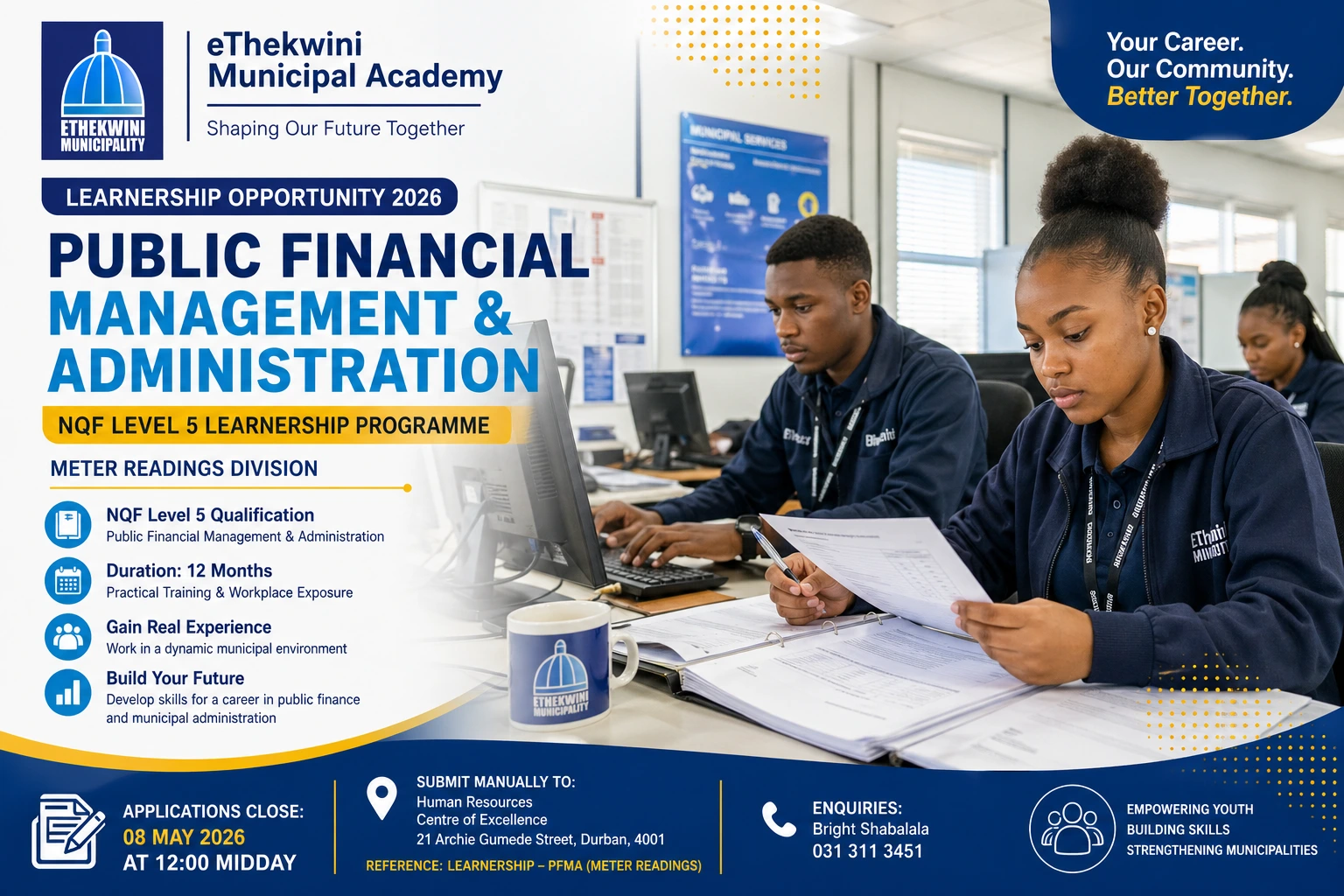
Discover how the Public Financial Management Learnership 2026 offers NQF Level 5 training, real municipal experience, and a pathway into government careers. Learn eligibility, benefits, and application insights.
Why the Public Financial Management Learnership 2026 Matters Now
South Africa’s youth unemployment crisis continues to shape the national conversation around skills development and job readiness. In this environment, structured workplace programmes like the Public Financial Management Learnership 2026 are becoming increasingly important—not just as training opportunities, but as strategic entry points into stable sectors like government and municipal administration.
With municipalities under pressure to improve service delivery, billing accuracy, and financial accountability, there is a growing need for trained individuals who understand both administration and finance within the public sector. This learnership, offered through the eThekwini Municipal Academy, responds directly to that demand.
By combining theoretical learning with practical exposure in the Meter Readings Division, the programme reflects a broader shift toward experiential learning models that align with real operational needs.
ALSO APPLY FOR FlySafair Graduate Internships 2026: How to Apply and What to Expect
ALSO READ Moses Kotane Research Institute ICT Experiential Learnership 2026: Apply Now
Quick Facts: Public Financial Management Learnership 2026
- Closing Date: 08 May 2026 at 12:00 midday
- Location: Durban
- Duration: 12 months
- Positions Available: Not stated in the official advert
- Reference Number: Not stated in the official advert
- Stipend: Not stated in the official advert
- Required Gender: Not stated in the official advert
- Name of the Company: eThekwini Municipal Academy
Understanding the Programme Structure and Its Strategic Design || Financial Management Learnership
The Public Financial Management Learnership 2026 is not just another entry-level training programme—it is deliberately structured to align with municipal operational realities.
At its core, the programme delivers an NQF Level 5 qualification in Public Financial Management and Administration, which sits at a higher level than many basic learnerships. This positions participants for more technical administrative roles rather than purely clerical tasks.
What makes this programme particularly noteworthy is its integration with the Meter Readings Division. This is not a random placement. Municipal revenue systems depend heavily on accurate meter data, billing processes, and customer account reconciliation. By embedding learners in this environment, the programme exposes them to:
- Real-time data verification processes
- Revenue collection systems
- Service delivery tracking
- Administrative compliance workflows
This reflects a growing trend in public sector training—moving away from abstract learning toward operational immersion.
Why the NQF Level 5 Qualification Matters in Today’s Job Market || Financial Management Learnership
The inclusion of an NQF Level 5 qualification significantly enhances the value of this learnership. In South Africa’s qualifications framework, Level 5 represents a post-matric certification that bridges the gap between basic schooling and higher education.
From a labour market perspective, this is critical.
Many entry-level government roles now require more than just a matric certificate. Employers increasingly look for candidates who demonstrate:
- Foundational financial literacy
- Administrative competence
- Understanding of public sector systems
This learnership addresses all three areas.
Additionally, candidates who complete the programme may find themselves better positioned for:
- Government internships
- Junior finance roles
- Municipal administrative posts
- Further studies in public administration or finance
In essence, the qualification acts as both a credential and a signal of readiness for structured work environments.
The Role of Mathematics, Accounting, and Driver’s Licence Requirements || Financial Management Learnership
At first glance, the requirements for Mathematics or Accounting—and a driver’s licence—may seem restrictive. However, they reflect the operational realities of municipal finance systems.
Mathematics and Accounting as Foundational Skills: Financial Management Learnership
Public financial management is inherently numerical. Even at entry level, tasks often involve:
- Interpreting billing data
- Reconciling accounts
- Processing revenue records
Requiring Mathematics or Accounting ensures that learners can engage with these responsibilities without needing extensive remedial training.
This also aligns with a broader trend: employers are increasingly filtering candidates based on demonstrated numerical competence.
Why a Driver’s Licence Is Non-Negotiable: Financial Management Learnership
The inclusion of a Code 8 or Code 10 driver’s licence is particularly significant. It signals that this learnership is not purely office-based.
The Meter Readings Division operates across different service areas, meaning learners may need to: Public Financial Management Learnership 2026
- Travel between locations
- Support field operations
- Engage with on-site data collection
This requirement reflects a hybrid role—part administrative, part operational. It also suggests that successful candidates will gain a more comprehensive understanding of municipal service delivery.
Skills Development: Beyond the Qualification-Financial Management Learnership 2026
While the qualification is important, the real long-term value of the Public Financial Management Learnership 2026 lies in the workplace skills it develops.
Participants are likely to build competencies that are highly transferable across sectors: Public Financial Management Learnership 2026
- Attention to detail: Critical for financial accuracy
- Professional communication: Essential in public-facing roles
- Time management: Needed in structured government environments
- Team collaboration: Especially within technical departments
- Administrative discipline: A core requirement in the public sector
These skills are often what differentiate successful job applicants from the rest.
Interestingly, many employers report that soft skills and workplace readiness are just as important—if not more important—than formal qualifications.
Manual Application Process: A Barrier or a Filter?
One of the most notable aspects of this opportunity is the requirement for manual application submission.
In an era dominated by online applications, this approach may seem outdated. However, it serves several strategic purposes:
- Filtering serious applicants:
Candidates must invest time and effort to submit in person. - Reducing application volume:
Manual submissions naturally limit the number of applicants. - Testing attention to detail:
Applicants must follow instructions precisely—an essential skill in administrative roles.
From an analytical perspective, this method acts as an early screening mechanism. It ensures that only committed and detail-oriented individuals progress further.
Selection Process and Competency Testing–Financial Management Learnership
Although not fully detailed, the mention of assessments—verbal, written, and medical—indicates a structured selection process.
This suggests that the programme is competitive and aims to identify candidates who are not only qualified but also capable of functioning in a demanding environment.
Such assessments typically evaluate: Public Financial Management Learnership 2026
- Communication ability
- Problem-solving skills
- Basic literacy and numeracy
- Physical readiness (for field-related tasks)
This aligns with best practices in public sector recruitment, where multiple evaluation layers are used to ensure suitability.
What This Means Going Forward–Financial Management Learnership
The Public Financial Management Learnership 2026 reflects broader shifts in South Africa’s approach to youth employment and skills development.
Several key implications stand out:
1. Increased Focus on Practical Training
Programmes are becoming more aligned with real workplace environments rather than theoretical learning alone.
2. Higher Entry Standards
Requirements like Mathematics, Accounting, and driver’s licences indicate a move toward more selective training programmes.
3. Integration of Finance and Operations
The link between finance and service delivery (e.g., meter readings) highlights how interconnected municipal functions are becoming.
4. Growing Importance of Public Sector Careers
With private sector opportunities limited, structured government programmes are emerging as viable career pathways.
5. Competition Will Likely Increase
As awareness grows, future learnership intakes may attract significantly higher application volumes.
For young South Africans, this means preparation is key. Meeting minimum requirements may no longer be enough—attention to detail, document quality, and readiness will play a major role.
How Do You Apply For The Public Financial Management Learnership 2026?
Applications must be submitted manually.
Deliver your application to:
Human Resources
Centre of Excellence
21 Archie Gumede Street
Durban
4001
Use the following application reference:
Learnership – PFMA (Meter Readings)
Applications must be submitted before 08 May 2026 at 12:00 midday.
FAQs–Public Financial Management Learnership 2026
1. Can I apply without a driver’s licence?
No. A valid Code 8 or Code 10 driver’s licence is a mandatory requirement for this learnership.
2. Does the learnership guarantee a permanent job?
No. The programme does not guarantee employment, but it significantly improves your chances of securing future roles in the public sector.
Conclusion–Public Financial Management Learnership 2026
The Public Financial Management Learnership 2026 offers more than just training—it provides a structured pathway into municipal finance and administration. With its NQF Level 5 qualification, practical exposure, and clear alignment with real-world operations, it stands out as a high-value opportunity for eligible youth.
However, the programme’s strict requirements and manual application process highlight the importance of preparation and attention to detail. Applicants who take the time to understand the expectations—and present themselves professionally—will be best positioned to succeed.