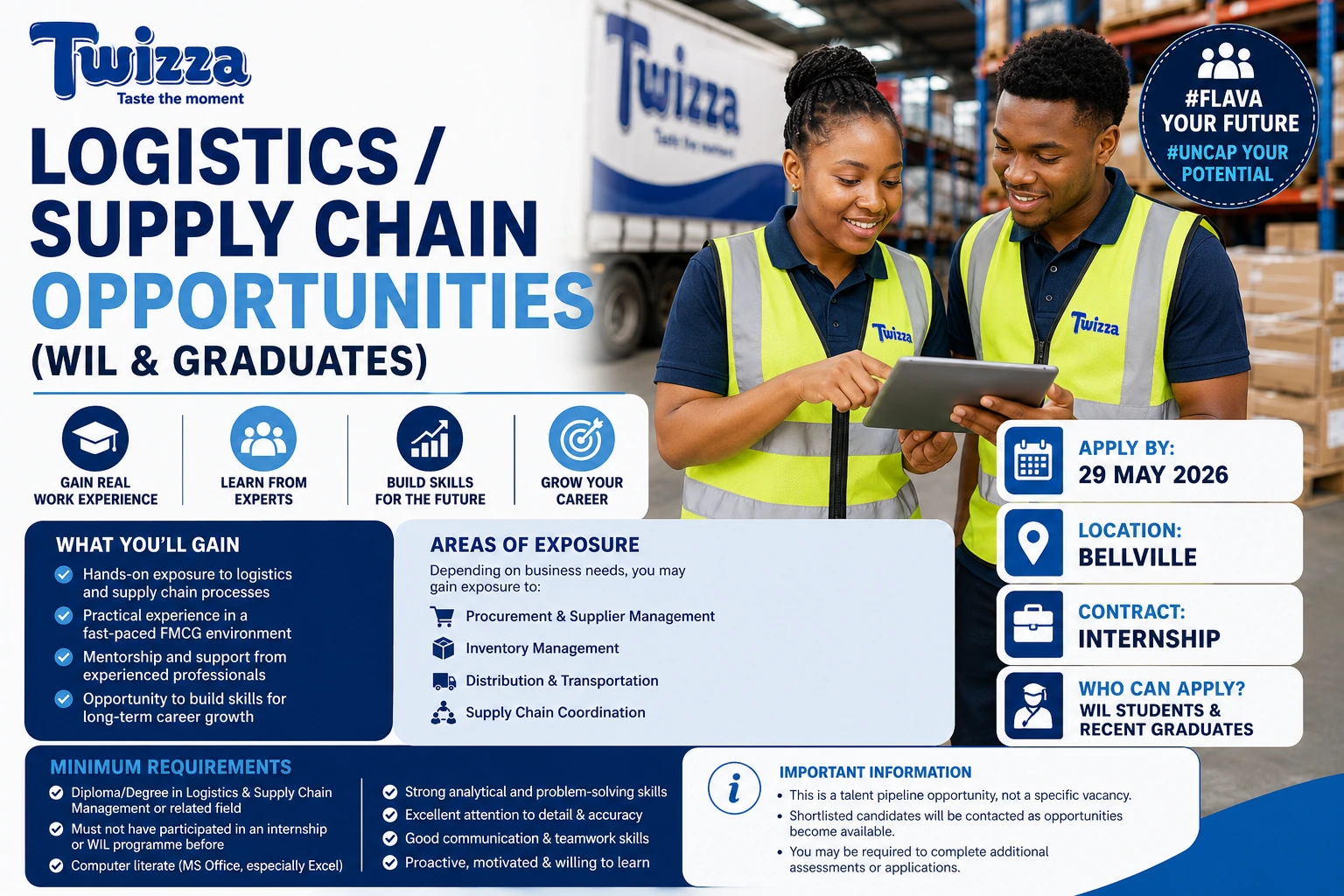
Apply for Twizza Logistics/Supply Chain Opportunities 2026 in Bellville. Learn about WIL placements, graduate exposure, requirements, and application details.
At a distribution centre in Bellville, forklifts move steadily between towering shelves stacked with beverages ready for delivery across South Africa. In one corner of the warehouse, a young graduate watches inventory data update in real time on a computer screen while a supervisor explains how a single delay in transportation can affect retailers hundreds of kilometres away.
For many students, this is the first moment logistics stops being theory.
It becomes visible. Immediate. Essential.
The Twizza Logistics/Supply Chain Opportunities 2026 programme is designed around exactly that transition—from classroom learning to operational reality. Offered by Twizza, the opportunity targets students requiring Work Integrated Learning (WIL) as well as graduates looking for practical workplace exposure inside one of South Africa’s fast-moving consumer goods environments.
At a time when thousands of graduates struggle to gain meaningful experience, programmes like this are quietly becoming some of the most valuable entry points into the country’s supply chain sector.
Understanding the Twizza Logistics/Supply Chain Opportunities 2026 Programme
The first thing applicants need to understand is that this is not a traditional vacancy.
The Twizza Logistics/Supply Chain Opportunities 2026 listing is a talent pipeline initiative. That distinction matters because it changes the purpose of the programme entirely.
Rather than recruiting for one immediate opening, Twizza is identifying and building relationships with emerging talent for future opportunities across logistics and supply chain functions.
In practice, this means shortlisted candidates may be contacted as operational needs arise.
For applicants, this creates both uncertainty and opportunity.
There is no guaranteed placement timeline, but there is direct visibility into an FMCG company actively investing in future talent.
Quick Facts: Twizza Logistics/Supply Chain Opportunities 2026
- Closing date: 29 May 2026
- Location: Bellville
- Duration: Not specified
- Positions available: Not specified
- Reference number: twizz_000767
- Stipend/Remuneration: Market related
Why Logistics Skills Matter More Than Ever in South Africa
In South Africa, supply chains are no longer operating quietly in the background.
They are increasingly central to economic stability.
Every supermarket shelf, warehouse operation, and delivery route depends on logistics systems functioning correctly. When disruptions occur—whether through fuel price increases, infrastructure strain, or transport delays—the impact spreads quickly across industries.
That reality is reshaping employer demand.
Companies now need graduates who understand:
- Inventory systems
- Distribution processes
- Procurement coordination
- Data-driven operational planning
The Twizza Logistics/Supply Chain Opportunities 2026 programme sits directly inside this growing demand.
Unlike highly theoretical graduate programmes, it exposes participants to operational systems where decisions have immediate consequences.
Inside the FMCG Environment: Fast, Pressured, and Constantly Moving
Working in FMCG logistics is very different from studying it.
In classrooms, supply chains are often presented as structured flowcharts and models. In reality, they are dynamic systems reacting to delays, demand spikes, staffing changes, and transport constraints in real time.
At a beverage company like Twizza, operations move continuously.
Deliveries must reach retailers on schedule.
Inventory levels must stay balanced.
Warehouses must operate efficiently.
This creates a fast-paced learning environment for interns and graduates entering the system.
The Twizza Logistics/Supply Chain Opportunities 2026 programme specifically highlights exposure to:
- Procurement and supplier management
- Inventory management
- Distribution and transportation
- Supply chain coordination
These are not isolated functions. They are interconnected systems that determine whether products move efficiently from production to consumers.
What Makes This Opportunity Different From Many Internships
One of the strongest aspects of the programme is its combination of mentorship and operational exposure.
Many entry-level opportunities place graduates in observational roles with limited responsibility. Twizza’s approach appears more immersive.
Participants are expected to engage with systems, processes, and teams inside a live operational environment.
That matters because logistics is learned best through participation.
A graduate can study transportation models academically, but understanding how delays affect warehouse scheduling requires real operational exposure.
The programme also targets individuals who have not previously completed a WIL or internship programme, creating access for first-time entrants into the industry.
In South Africa’s current labour market, that kind of accessibility is increasingly important.
The Human Side of Supply Chains
Logistics is often discussed in technical language—systems, procurement, transportation, inventory.
But behind those processes are people.
Warehouse coordinators managing pressure during peak periods.
Drivers navigating long-distance delivery schedules.
Procurement teams balancing supplier relationships.
Analysts monitoring stock movement.
The Twizza Logistics/Supply Chain Opportunities 2026 programme introduces candidates to this human dimension of operations.
That exposure can fundamentally change how young professionals view business.
Instead of seeing supply chains as abstract systems, they begin understanding them as interconnected networks driven by communication, timing, and accountability.
Expert Insight: Why FMCG Experience Carries Weight Across Industries
From a career development perspective, FMCG logistics experience is particularly valuable because of its intensity.
Fast-moving consumer goods environments operate under constant pressure:
- High delivery volumes
- Strict timelines
- Rapid inventory movement
- Continuous operational coordination
Graduates who succeed in these environments often develop transferable skills quickly, including:
- Time management
- Operational problem-solving
- Communication under pressure
- Data interpretation and reporting
This is why FMCG experience frequently becomes a strong foundation for broader supply chain careers.
The operational discipline developed in these environments tends to translate well across industries.
What Twizza Is Really Looking For
While qualifications are important, the programme’s language reveals a strong emphasis on behavioural traits.
Twizza is seeking candidates who demonstrate:
- Attention to detail
- Initiative
- Teamwork
- Analytical thinking
- Willingness to learn
This reflects a broader industry reality.
In logistics, small mistakes can create large operational consequences. An incorrect inventory entry or delayed communication can disrupt entire processes downstream.
That’s why employers often prioritise reliability and mindset alongside academic performance.
Minimum Requirements for the Twizza Logistics/Supply Chain Opportunities 2026 Programme
Applicants must meet the following requirements:
For graduates:
- Diploma, Advanced Diploma, or Bachelor’s Degree in Logistics and Supply Chain Management or a related field
For students requiring WIL:
- Diploma studies in a logistics or supply chain-related field
Additional requirements include:
- No previous internship or WIL participation
- Microsoft Office proficiency, especially Excel
- Strong analytical and organisational skills
- Effective communication skills
These requirements indicate that the programme expects candidates to enter with foundational knowledge while remaining open to workplace learning.
The Bellville Advantage
Location matters in logistics.
Bellville, situated within the broader Cape Town economic region, plays an important role in distribution and commercial operations within the Western Cape.
For participants, this environment offers exposure not just to one company, but to a broader logistics ecosystem connected to retail, warehousing, and transportation networks.
That regional context strengthens the value of the experience.
Graduates are not simply learning internal company systems—they are learning how logistics functions within a real commercial corridor.
Where to Apply for Twizza Logistics/Supply Chain Opportunities 2026
Applications for the Twizza Logistics/Supply Chain Opportunities 2026 programme must be submitted through Twizza’s official recruitment platform using the listing reference:
twizz_000767
Applicants should ensure their CVs are updated and that all academic information is accurate before submission.
As this is a talent pipeline opportunity, shortlisted candidates may be contacted as opportunities become available.
APPLY HERE: Twizza Logistics/Supply Chain Opportunities 2026
FAQ: Twizza Logistics/Supply Chain Opportunities 2026
1. Is this a guaranteed internship placement?
No. This is a talent pipeline initiative, meaning candidates may be contacted when suitable opportunities become available.
2. Can graduates apply if they already completed another internship?
No. Applicants must not have previously participated in an internship or WIL programme.
3. Is prior logistics work experience required?
No. The programme is designed for students and graduates entering the industry.
The Bigger Picture: Why Entry-Level Exposure Still Matters
The Twizza Logistics/Supply Chain Opportunities 2026 programme reflects a broader shift happening across South Africa’s employment landscape.
Employers are increasingly searching for candidates who can adapt quickly inside operational environments—not just those with academic qualifications.
For young professionals, this creates a challenge but also an opportunity.
The challenge is gaining experience in a market where experience is often required before employment.
The opportunity lies in programmes like this one, which create structured pathways into industries that continue to grow despite economic uncertainty.
Supply chains remain essential.
Distribution remains essential.
Operational talent remains essential.
And for students or graduates trying to move from education into employment, exposure inside a real FMCG environment can become more than temporary experience.
It can become the beginning of a long-term career direction.