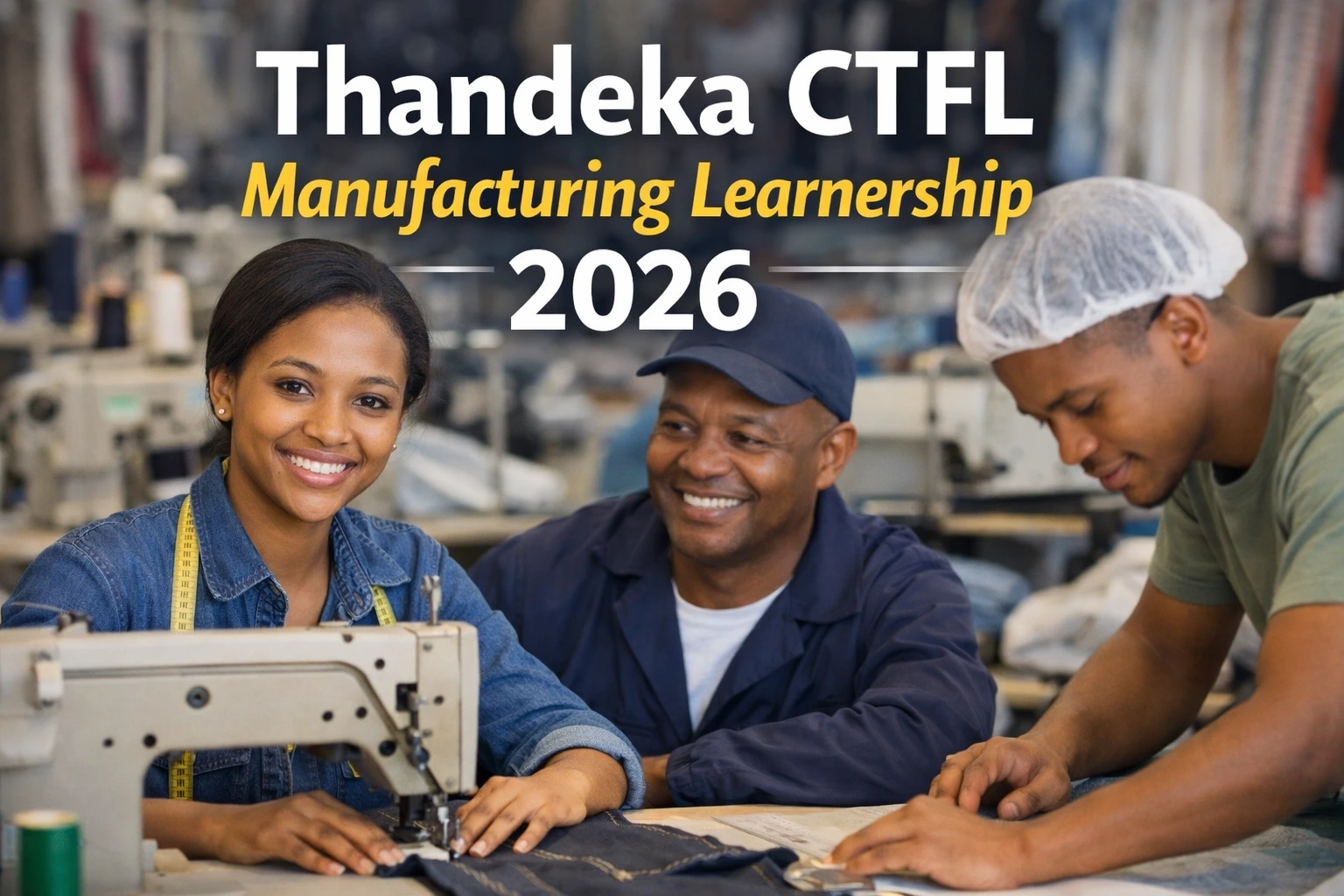
Explore the Thandeka CTFL Manufacturing Learnership 2026, a 12-month programme offering real skills, industry exposure, and a recognised qualification in South Africa.
The hum of sewing machines fills the room long before the supervisor walks in. Rows of fabric lie neatly stacked, waiting to be transformed into finished garments. For many young South Africans stepping into a factory floor for the first time, this environment is both intimidating and full of possibility.
That first day matters. It’s where theory meets reality — where learning shifts from textbooks to hands-on experience. And for those accepted into the Thandeka CTFL Manufacturing Learnership 2026, that moment could mark the beginning of something far more meaningful than just a training programme.
In a country where youth unemployment remains one of the most urgent challenges, opportunities that combine structured learning with real industry exposure are not just valuable — they are necessary.
A Learnership Built for Real-World Skills
The Thandeka CTFL Manufacturing Learnership 2026 is not designed as a quick course or a surface-level introduction. It is a 12-month, credit-bearing programme leading to a National Certificate in CTFL Manufacturing (NQF Level 2).
That distinction matters.
In South Africa’s competitive job market, short courses often fall short because they lack formal recognition. This learnership, however, offers 120 credits, meaning it is aligned with national education standards and recognised across the industry.
For participants, this translates into something tangible:
- A structured training journey
- Practical workplace exposure
- A qualification that strengthens a CV
But beyond credentials, the real value lies in what learners can actually do by the end of the programme.
Why the Clothing Sector Still Matters in South Africa
At first glance, clothing manufacturing may seem like a shrinking industry. Global competition and imports have reshaped the sector over the years. But locally, the story is more nuanced.
South Africa’s clothing and textile sector remains a key employer, particularly in regions where large-scale manufacturing still operates. Government support programmes and local production initiatives have also created renewed demand for skilled workers.
This is where the learnership becomes relevant.
Rather than focusing on theory alone, it prepares learners for specific roles within the production chain — roles that businesses still need to fill with capable, trained individuals.
Who This Opportunity Is Really For
Not every career path suits every person. The Thandeka learnership is especially suited for individuals who prefer hands-on, practical work over purely academic routes.
It is aimed at:
- New entrants looking to break into manufacturing
- Existing workers seeking formal recognition of their skills
But beyond eligibility, there’s a deeper question: Who thrives in this kind of environment?
People who succeed here often share certain traits:
- Attention to detail
- Patience and consistency
- Willingness to learn through repetition
- Comfort with structured processes
For someone who enjoys working with their hands and seeing a finished product take shape, this environment can be deeply rewarding.
Understanding the Training: More Than Just Sewing
While sewing is often the first thing people associate with clothing manufacturing, the learnership covers a much broader set of skills.
Participants are introduced to:
- Productivity standards in manufacturing
- Quality control procedures
- Materials and production workflows
- Occupational health and safety practices
- Communication and basic mathematical literacy
This combination is intentional.
Employers are not just looking for people who can operate machines — they want workers who understand how the entire production system functions.
Specialisation Paths That Shape Your Career Direction
One of the most valuable aspects of the programme is the opportunity to specialise. Learners must demonstrate competence in one of the following areas:
- Sewing Machine Operations
- Finishing Operations
- Manual Processes in the Cutting Room
- Pattern Making
Each path leads to a different type of role within the industry.
For example, sewing machine operations focus on garment construction, while pattern making leans more toward technical design and measurement. Finishing operations, on the other hand, emphasise quality and presentation — the final step before products reach the market. Thandeka CTFL Manufacturing Learnership 2026.
This structure allows learners to align their training with their strengths, rather than following a one-size-fits-all approach.
What Makes This Learnership Stand Out Today
In today’s job market, many young people face a frustrating cycle: you need experience to get a job, but you need a job to gain experience.
Learnerships like this help break that cycle.
The Thandeka programme stands out because it offers:
- A recognised qualification
- Hands-on industry exposure
- A clear connection between training and employment
More importantly, it reflects a shift in how skills development is being approached in South Africa — moving away from purely academic pathways toward practical, job-linked training models.
Expert Insight: The Bigger Impact of Skills-Based Learnerships
From a broader perspective, programmes like the Thandeka CTFL Manufacturing Learnership 2026 play a critical role beyond individual success stories.
They contribute to:
- Closing the skills gap in manufacturing
- Strengthening local industries
- Reducing youth unemployment through employable training
What makes them particularly effective is their dual focus — combining education with real-world application.
In the long term, this approach doesn’t just produce workers. It builds a workforce that understands industry demands, adapts to change, and contributes to productivity in meaningful ways. Thandeka CTFL Manufacturing Learnership 2026.
Quick Facts About the Thandeka CTFL Manufacturing Learnership 2026
Quick Facts Box:
- Duration: 12 months
- Location: Not specified
- Qualification: National Certificate in CTFL Manufacturing (NQF Level 2)
- Positions available: Not specified
- Closing date: Not specified
- Reference number: Not specified
- Stipend: Not specified
Preparing for the Application Process
Applying for a learnership might seem straightforward, but small details often make a big difference.
A strong application typically includes:
- A clear, well-structured CV
- Accurate personal information
- Properly named supporting documents
Simple habits can improve your chances:
- Double-check spelling and formatting
- Use professional file names (e.g., Name_Surname_CV)
- Submit early rather than waiting for deadlines
In competitive programmes, presentation often reflects seriousness — and that can influence how applications are perceived.
Where to Apply-Thandeka CTFL Manufacturing Learnership 2026
Applications for the Thandeka CTFL Manufacturing Learnership 2026 must be submitted through the official learner application platform.
Before applying:
- Ensure all documents are ready
- Confirm that you meet the minimum entry requirements
- Review your application carefully before submission
- APPLY HERE: Thandeka CTFL Manufacturing Learnership 2026
Submitting a complete and accurate application is the first step toward being considered.
(FAQ)-Thandeka CTFL Manufacturing Learnership 2026
1. Do I need prior experience in clothing manufacturing?
No. The programme is designed for both new entrants and existing workers. Prior experience can help, but it is not required.
2. What qualification will I receive after completion?
You will earn a National Certificate in CTFL Manufacturing at NQF Level 2, which is nationally recognised.
3. Can this learnership lead to a job?
While employment is not guaranteed, the practical skills and recognised qualification significantly improve your chances of finding work in the industry.
Final Thoughts: A Starting Point That Can Shape a Future
Opportunities like the Thandeka CTFL Manufacturing Learnership 2026 are often underestimated because they don’t promise instant success or high-paying positions overnight.
But that’s not their purpose.
Their value lies in something more foundational — building real, usable skills in an environment that reflects actual industry conditions. For many participants, this is not just about learning how to operate a machine or follow a process. It’s about gaining confidence, understanding workplace expectations, and developing a sense of direction.
In a time where many young people feel stuck between limited options, structured learnerships offer something rare: a clear starting point.
And sometimes, that’s all it takes to change a trajectory.
Approached with preparation and commitment, this learnership could be more than a one-year programme. It could be the first step into a long-term career — one built not just on qualifications, but on capability