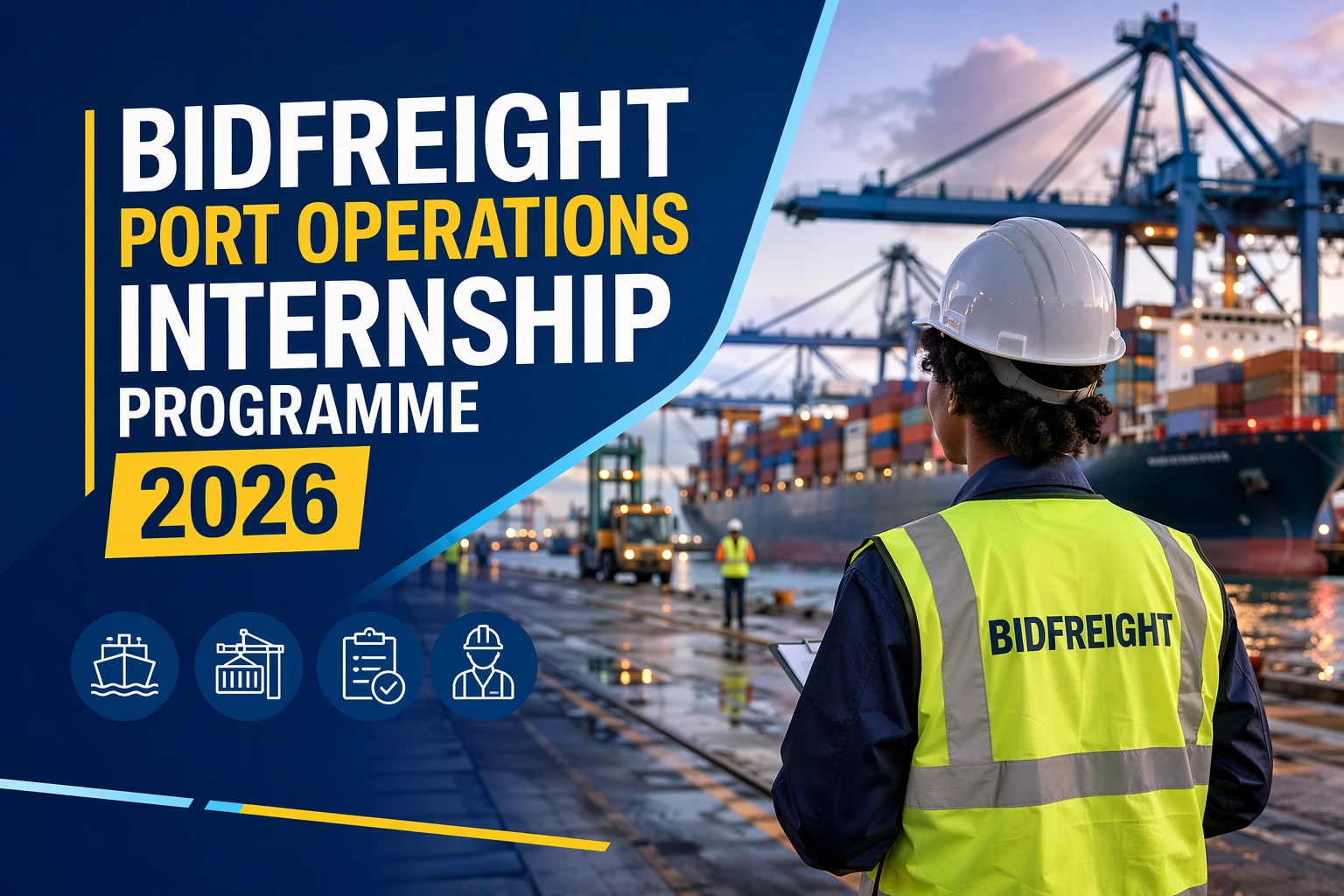
The Bidfreight Port Operations Internship Programme 2026 offers graduates hands-on experience in South Africa’s port logistics sector. Learn how to apply, requirements, and career impact.
The wind coming off the harbour carries a mix of salt, diesel, and urgency. At sunrise in Durban, cranes are already moving containers with quiet precision, and a new shift of workers steps into a system that rarely pauses. Among them, not long from now, could be a graduate who just months earlier was sitting at home refreshing job listings, unsure where their qualification would take them.
For many young South Africans, that transition—from theory to real work—is where momentum is either gained or lost. The Bidfreight Port Operations Internship Programme 2026 arrives at exactly that moment, offering something increasingly rare: structured, practical exposure inside one of the country’s most strategic industries.
Backed by Bidfreight Port Operations, part of the larger Bidvest Group, the programme is not just another graduate placement. It is an entry point into the complex world of maritime logistics—an industry that quietly powers South Africa’s economy.
Why the Bidfreight Port Operations Internship Programme 2026 Matters Now
South Africa’s ports are more than transit points—they are economic lifelines. From minerals shipped out of Saldanha Bay to vehicles exported through Gqeberha, the logistics ecosystem supports trade, jobs, and industrial growth.
Yet, despite this importance, access into the sector has traditionally been limited. Many graduates struggle to find opportunities that provide real operational exposure rather than administrative experience.
That’s where the Bidfreight Port Operations Internship Programme 2026 stands out. It is designed to bridge a persistent gap: graduates who are qualified on paper but lack industry experience.
This programme doesn’t just acknowledge that gap—it actively addresses it.
Quick Facts at a Glance
- Closing date: 30 April 2026
- Location: Durban, Richards Bay, Gqeberha, Saldanha Bay
- Duration: 12 months
- Positions available: Not specified
- Reference number: Not specified
- Stipend: Not confirmed (typically provided during recruitment stage)
Inside the Programme: What the Experience Really Looks Like
Unlike internships that revolve around observation, this programme places graduates directly into operational environments. That distinction matters.
A finance intern here isn’t just reconciling spreadsheets—they are tracking operational costs tied to cargo movement. An HR intern isn’t just filing documents—they are navigating labour relations in complex, unionised environments.
Across its four main streams—Finance, Human Resources, SHERQ, and Mechanical Engineering—the programme reflects the real structure of port operations.
In practical terms, participants can expect to:
- Work alongside experienced professionals
- Engage with real operational systems
- Understand compliance and safety frameworks
- Contribute to day-to-day business functions
It’s less about “learning by watching” and more about learning by doing.
From Classroom to Port: The Fields That Shape Careers
Finance in Motion, Not Just Theory
Finance graduates entering the programme step into environments where numbers directly influence operations. Budgeting isn’t abstract—it determines efficiency. Cost tracking isn’t academic—it impacts profitability.
Exposure to procurement systems and reporting structures within logistics gives interns a strong foundation for roles in infrastructure and transport sectors.
Human Resources in High-Pressure Environments
HR in port operations is unlike typical office-based HR roles. It involves managing large, diverse workforces where operational continuity depends on people.
Interns gain insight into:
- Labour relations
- Compliance frameworks
- Workforce coordination
This kind of exposure is particularly valuable in South Africa, where labour dynamics are often complex and highly regulated.
SHERQ: The Backbone of Safe Operations
Few fields are growing as quickly as SHERQ—Safety, Health, Environment, Risk, and Quality. In port environments, these are not optional considerations; they are operational necessities.
Interns in this stream engage with:
- Safety compliance systems
- Environmental monitoring
- Risk management processes
The relevance of SHERQ extends far beyond ports, opening pathways into construction, mining, and manufacturing.
Mechanical Engineering Where It Matters
Mechanical engineering interns encounter equipment that keeps ports functioning—cranes, lifting systems, and heavy-duty machinery.
This is not simulated training. It is exposure to real industrial systems, where maintenance and efficiency directly affect output.
Where You Could Be Placed—and Why It Matters
Each location in the programme offers a different perspective on South Africa’s logistics ecosystem.
- Durban: The busiest port in Africa, offering exposure to high-volume operations
- Richards Bay: A bulk cargo hub critical for mineral exports
- Gqeberha: A key player in automotive exports
- Saldanha Bay: Central to iron ore exports
Working in any of these environments doesn’t just build experience—it builds credibility.
Expert Insight: Why Port Experience Changes Career Trajectories
One of the less discussed realities of the job market is that not all experience carries equal weight. Experience gained in high-impact industries—like logistics and infrastructure—tends to accelerate career progression.
Port operations, in particular, sit at the intersection of multiple sectors:
- Trade
- Engineering
- Finance
- Compliance
This means graduates who complete the Bidfreight Port Operations Internship Programme 2026 often develop a systems-level understanding of how businesses operate.
That kind of perspective is difficult to teach in classrooms—and highly valued by employers.
Minimum Requirements and What They Signal
The eligibility criteria are straightforward:
- South African citizenship
- Age between 18 and 29
- Unemployed status
- Relevant tertiary qualification
- Minimum 60% academic average
On paper, these are standard requirements. But they also signal something deeper: the Bidfreight Port Operations Internship Programme 2026 is looking for candidates who are academically capable and ready to transition into structured environments.
This isn’t just about qualifications—it’s about readiness.
A Competitive Opportunity—How to Stand Out
Competition for internships within the Bidvest Group is typically strong. Applicants are not just evaluated on qualifications but on how well they present their potential.
A few practical ways to improve your chances:
- Highlight academic performance clearly
- Include any practical or project-based experience
- Show understanding of logistics or operational environments
- Demonstrate teamwork and adaptability
Small details in your application can make a significant difference.
Where to Apply
Applications must be submitted through the official online Google Form before the closing date.
Prepare the following documents:
- Updated CV
- Certified copy of ID
- Academic transcript
- Qualification certificate
APPLY HERE: Bidfreight Port Operations Internship Programme 2026
Closing Date: 30 April 2026
Late applications will not be considered, which makes early preparation essential.
Beyond the Internship: What Comes Next?
The real value of the Bidfreight Port Operations Internship Programme 2026 lies in what happens after it ends.
Graduates often move into roles such as:
- Accounts officer or cost analyst
- HR administrator or recruitment coordinator
- Safety officer assistant or compliance coordinator
- Junior mechanical engineer or maintenance technician
But perhaps more importantly, they enter the job market with something many others lack: relevant industry exposure.
Why Bidfreight Port Operations Internship Programme 2026 Programme Reflects a Bigger Shift
South Africa’s employment landscape is changing. Employers are increasingly prioritising practical experience over theoretical knowledge alone.
Internships like this one reflect a broader shift toward:
- Skills-based hiring
- Industry-specific training
- Workplace readiness
For graduates, this means opportunities are no longer just about degrees—they’re about demonstrated capability.
(FAQ) Bidfreight Port Operations Internship Programme 2026
1. Is the Bidfreight Port Operations Internship Programme 2026 paid?
Most programmes within the Bidvest Group include a stipend, but confirmation is usually provided during recruitment.
2. Can final-year students apply?
Typically, only graduates with completed qualifications are eligible unless otherwise specified.
3. Do I need prior logistics experience?
No. The programme is designed to provide workplace exposure from the ground up.
Conclusion: More Than an Internship
At first glance, the Bidfreight Port Operations Internship Programme 2026 may look like just another graduate opportunity. But in practice, it represents something more significant.
It offers access to an industry that quietly shapes the economy. It provides exposure that many graduates struggle to find. And it creates a pathway into careers that extend far beyond a single sector.
For those willing to step into complex, fast-moving environments, the Bidfreight Port Operations Internship Programme 2026 isn’t just a starting point—it’s a foundation.
And in a job market where experience increasingly defines opportunity, that foundation can make all the difference.