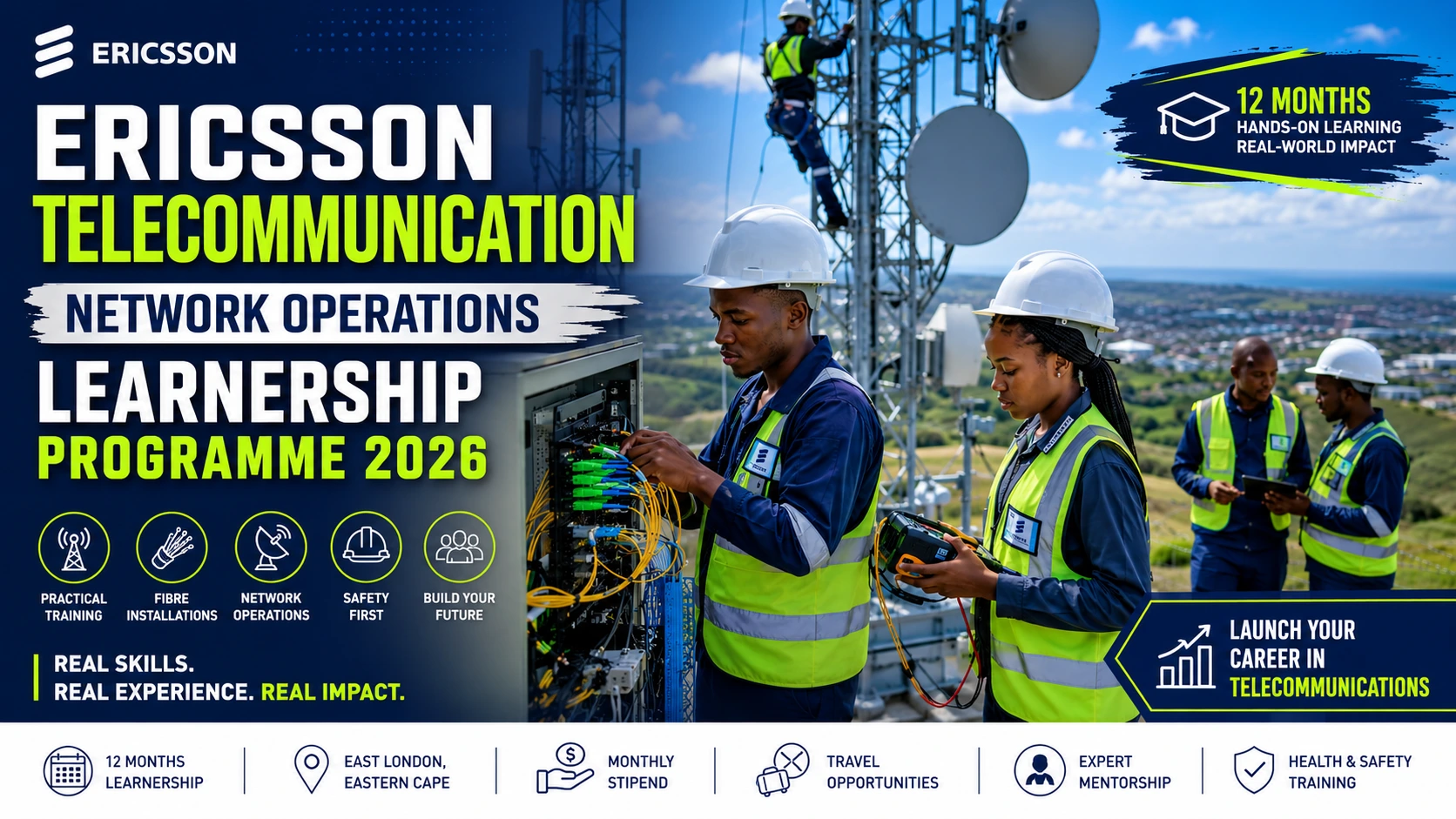
Discover everything about the Ericsson Telecommunication Network Operations Learnership 2026, including requirements, stipend, training exposure, travel expectations, and why this practical ICT programme could open doors in South Africa’s telecom sector.
Ericsson Telecommunication Network Operations Learnership 2026
South Africa’s telecommunications sector continues to evolve rapidly as fibre expansion, mobile connectivity, network upgrades, and digital infrastructure become increasingly important to the economy. As telecom companies expand coverage and modernise systems, there is growing demand for young people with practical technical skills who can support network operations on the ground.
The Ericsson Telecommunication Network Operations Learnership 2026 arrives at an important moment for unemployed youth and ICT graduates looking for meaningful workplace exposure rather than purely theoretical training. While many learnerships focus heavily on classroom learning, this programme places strong emphasis on real operational environments where telecommunications infrastructure is installed, maintained, repaired, and upgraded.
For candidates interested in telecommunications infrastructure, fibre systems, tower support, networking operations, and technical maintenance, this learnership offers more than a certificate. It introduces learners to the realities of field-based telecom work in one of the world’s most essential industries.
The programme may especially appeal to technically curious young South Africans who want to move beyond office-based computer work and gain practical exposure to how communication networks operate in real environments across the Eastern Cape.
ALSO APPLY FOR Lancet Laboratories Pre-Analytical Internship 2026 Opens Healthcare Career Opportunities
ALSO READ Learnership vs Internship vs Apprenticeship: Full Comparison 2026-2027
Quick Facts: Ericsson Telecommunication Network Operations Learnership 2026
| Programme Detail | Information |
|---|---|
| Programme Name | Ericsson Telecommunication Network Operations Learnership Programme 2026 |
| Company | Ericsson |
| Duration | 12 Months |
| SAQA ID | 59057 |
| NQF Level | 4 |
| Start Date | 1 June 2026 |
| End Date | 31 May 2027 |
| Primary Location | East London |
| Head Office Location | Woodmead |
| Reference Number | Req ID: 784797 |
| Monthly Stipend | Yes |
| Closing Date | Not stated in the official advert |
| Positions Available | Not stated in the official advert |
| Required Gender | Not stated in the official advert |
Why the Ericsson Telecommunication Network Operations Learnership 2026 Matters Right Now
South Africa’s digital economy increasingly depends on reliable telecommunications infrastructure. Fibre rollout projects, mobile network upgrades, cloud-based services, and growing internet usage have created pressure on telecom operators to maintain strong network performance across both urban and rural areas.
This has changed the type of skills employers value.
Instead of focusing only on academic qualifications, telecommunications companies increasingly need workers who can operate in practical technical environments — including fibre installations, tower maintenance, equipment testing, cable repairs, and network troubleshooting.
The Ericsson Telecommunication Network Operations Learnership 2026 reflects this shift clearly.
Rather than positioning learners only inside offices, the programme introduces them to field operations where real infrastructure work happens. This includes technical sites, outdoor environments, physical equipment handling, and operational maintenance tasks.
That distinction matters because many unemployed graduates struggle to gain practical experience after completing ICT-related qualifications. Employers often seek candidates who understand both theoretical networking concepts and real-world operational environments.
This programme attempts to bridge that gap.
Understanding What Telecom Network Operations Actually Involve
Many people hear the phrase “network operations” and immediately think of office-based IT support. In reality, telecommunications network operations often involve physically supporting communication infrastructure in the field.
That includes:
- Tower support work
- Fibre optic installations
- Microwave communication systems
- Equipment repairs
- Network testing
- Cable management
- Emergency maintenance operations
- Antenna support systems
Learners in the Ericsson Telecommunication Network Operations Learnership 2026 may therefore encounter a working environment that is far more physically active than traditional ICT office roles.
The programme specifically mentions: Ericsson Telecommunication Network Operations Learnership Programme 2026
- Working at heights
- Ladder and tower climbing
- Structural component installations
- Rope and pulley systems
- Travel across the province
- Weekend and shift duties
- Emergency repair responses
This signals that Ericsson is not simply recruiting trainees for administrative support. The company appears focused on developing operational telecom support skills that are directly linked to infrastructure reliability.
For learners who genuinely enjoy practical technical work, this could provide valuable exposure rarely available through classroom-only training.
Why Practical ICT Learnerships Are Becoming More Valuable-Ericsson Telecommunication Network Operations Learnership Programme 2026
One of the biggest challenges facing South African youth is the growing disconnect between qualifications and employability.
Thousands of graduates complete ICT-related studies every year, yet many struggle to enter technical industries because employers prioritise experience. Learnerships that provide genuine operational exposure therefore carry increasing value.
The Ericsson Telecommunication Network Operations Learnership 2026 stands out because it combines:
- Structured learning
- Workplace exposure
- Safety training
- Technical field operations
- Mentorship
- Infrastructure experience
This combination may improve long-term employability far more effectively than theory-focused programmes alone.
Telecommunications infrastructure work also exposes learners to multiple specialised areas simultaneously. A learner supporting network operations could gain experience in:
- Fibre technologies
- Wireless communication systems
- Tower maintenance
- Equipment testing
- Network fault response
- Technical compliance
- Safety procedures
That broad operational exposure may later help learners specialise in particular technical career paths within telecommunications or networking industries.
In South Africa’s increasingly digital economy, technical infrastructure skills remain important because communication systems underpin banking, remote work, e-commerce, education, logistics, and mobile services.
The Physical Demands and Realities Candidates Should Understand-Ericsson Telecommunication Network Operations Learnership Programme 2026
One of the most important aspects of this learnership is that it appears transparent about the realities of telecom field work.
Many applicants apply for ICT programmes expecting office-based work environments. However, telecommunications infrastructure maintenance often involves difficult working conditions.
The programme highlights several realities candidates should understand before applying:
Outdoor Operational Work
Learners may spend significant time outside rather than inside office buildings. Weather conditions can affect daily activities, especially when working on installations or repairs.
Height and Safety Requirements
Tower and ladder work can be physically demanding and mentally challenging for individuals uncomfortable with heights.
Safety procedures are therefore critical in telecommunications infrastructure environments. Companies operating in this sector place strong emphasis on compliance because network sites can involve electrical systems, elevated structures, and specialised equipment.
Travel Expectations
After the initial training phase, learners may travel across the Eastern Cape to telecommunications sites where maintenance or installations are required.
This mobility reflects how telecom infrastructure work operates in practice. Networks cover large geographic areas, meaning technical teams often travel to infrastructure locations rather than remaining at fixed offices.
Emergency Maintenance Situations
Telecommunications systems are considered essential infrastructure. When networks fail, technical teams may need to respond quickly to restore connectivity.
This means learners may experience operational pressure and irregular working schedules during certain periods.
For motivated candidates, however, these conditions may also provide valuable industry experience that strengthens future career prospects.
The Skills Ericsson Appears to Value Most
The Ericsson Telecommunication Network Operations Learnership 2026 does not focus exclusively on academic performance. The programme strongly suggests that personal reliability and operational discipline are equally important.
Some of the key qualities highlighted include: Ericsson Telecommunication Network Operations Learnership Programme 2026
- Teamwork
- Communication skills
- Organisational ability
- Flexibility
- Problem-solving
- Technical curiosity
- Safety awareness
- Willingness to learn
This reflects broader trends across technical industries.
Modern telecommunications environments require technicians who can communicate effectively, follow procedures accurately, adapt quickly during operational challenges, and maintain strong safety standards.
The programme also references technical knowledge areas such as: Ericsson Telecommunication Network Operations Learnership Programme 2026
- Ethernet standards
- Networking fundamentals
- Power systems
- Cable testing
- Fibre infrastructure
Candidates with prior exposure to ICT, telecommunications, or electronics may therefore have an advantage when adapting to operational training.
However, the programme also appears designed to accommodate learners who show strong learning potential and discipline even if they lack advanced industry experience.
Why East London and the Eastern Cape Matter in Telecom Infrastructure Development
The learnership’s primary location in East London is significant because telecommunications infrastructure development remains important across both urban and rural parts of the province.
The Eastern Cape continues to require ongoing investment in connectivity infrastructure, especially as digital services expand into more communities and industries.
Telecommunications companies operating in the province must maintain:
- Mobile communication networks
- Fibre connectivity systems
- Communication towers
- Network support infrastructure
- Equipment installations
Field-based training in this environment may expose learners to a wide range of operational conditions and infrastructure challenges.
Unlike highly centralised urban office roles, provincial telecom operations often involve direct interaction with physical infrastructure spread across large geographic regions.
This can provide learners with practical understanding of how telecommunications systems function outside purely theoretical settings.
How Applicants Can Strengthen Their Applications || Ericsson Telecommunication Network Operations Learnership Programme 2026
Competition for technical learnerships remains high in South Africa, particularly in ICT-related sectors.
Applicants hoping to improve their chances should focus on demonstrating both technical interest and workplace readiness.
A strong application may include:
- ICT-related coursework
- Networking exposure
- Computer literacy
- Technical school projects
- Volunteer technical experience
- Problem-solving activities
- Team-based projects
- Safety awareness
- Practical learning experiences
Candidates should also avoid generic CVs that simply list qualifications without explaining technical interests or exposure.
For field-based programmes like the Ericsson Telecommunication Network Operations Learnership 2026, employers often look for evidence that candidates understand the practical realities of operational work.
That includes demonstrating:
- Reliability
- Discipline
- Adaptability
- Technical curiosity
- Commitment to learning
Because the programme involves physical environments and travel, applicants should also ensure they are comfortable with operational field conditions before applying.
What This Means Going Forward-Ericsson Telecommunication Network Operations Learnership Programme 2026
The Ericsson Telecommunication Network Operations Learnership 2026 reflects broader changes taking place in South Africa’s labour market and digital economy.
As industries become increasingly dependent on telecommunications infrastructure, the demand for technically skilled operational workers may continue growing.
This creates opportunities for young people willing to enter practical technical fields rather than focusing only on traditional office-based employment.
Telecommunications infrastructure work may become increasingly important in areas such as:
- Fibre network expansion
- 5G deployment
- Rural connectivity
- Smart infrastructure
- Data communication systems
- Network maintenance services
Programmes like this also indicate that employers are placing greater value on workplace exposure and operational readiness alongside formal qualifications.
For learners who successfully complete practical telecom training, future pathways could potentially include roles in:
- Network operations
- Fibre installation
- Technical maintenance
- Infrastructure support
- Telecommunications field services
- Equipment testing
- Network optimisation
While completion of a learnership does not automatically guarantee permanent employment, practical experience in a specialised technical environment can strengthen employability significantly.
In an economy where experience often determines access to opportunities, structured field-based programmes may continue playing an important role in helping young South Africans enter technical industries.
How To Apply For Ericsson Telecommunication Network Operations Learnership Programme 2026
Applications for the Ericsson Telecommunication Network Operations Learnership Programme 2026 must be completed online.
Skills assessment tools
Applications must be submitted through the official Ericsson careers application portal.
Applicants should use the reference number Req ID: 784797 when checking the opportunity details.
No closing date is specified, so candidates should submit their applications as soon as possible while the listing remains available.
Frequently Asked Questions (FAQs)-Ericsson Telecommunication Network Operations Learnership Programme 2026
Does the Ericsson Telecommunication Network Operations Learnership 2026 require previous work experience?
No previous formal work experience is specifically stated as a requirement. However, applicants with ICT, networking, telecommunications, or technical exposure may have an advantage during the selection process.
Is the Ericsson Telecommunication Network Operations Learnership 2026 office-based?
No. The programme includes practical field exposure, outdoor technical work, travel to telecommunications sites, and physical operational activities such as tower support and equipment installations.
Conclusion-Ericsson Telecommunication Network Operations Learnership Programme 2026
The Ericsson Telecommunication Network Operations Learnership 2026 offers more than standard workplace training. It introduces learners to the operational side of South Africa’s telecommunications infrastructure industry through practical technical exposure and field-based experience.
For candidates interested in networking systems, fibre infrastructure, telecommunications maintenance, and technical operations, the programme may provide valuable early-career experience in a sector that continues evolving rapidly.
The learnership also highlights an important shift in the labour market: employers increasingly value practical operational skills alongside academic qualifications.
Although the programme may not suit candidates seeking purely office-based work, it could be highly beneficial for technically motivated individuals willing to work in real infrastructure environments where communication systems are installed, maintained, and repaired.
As South Africa’s digital infrastructure continues expanding, practical telecommunications experience may become increasingly valuable for young people pursuing technical careers.