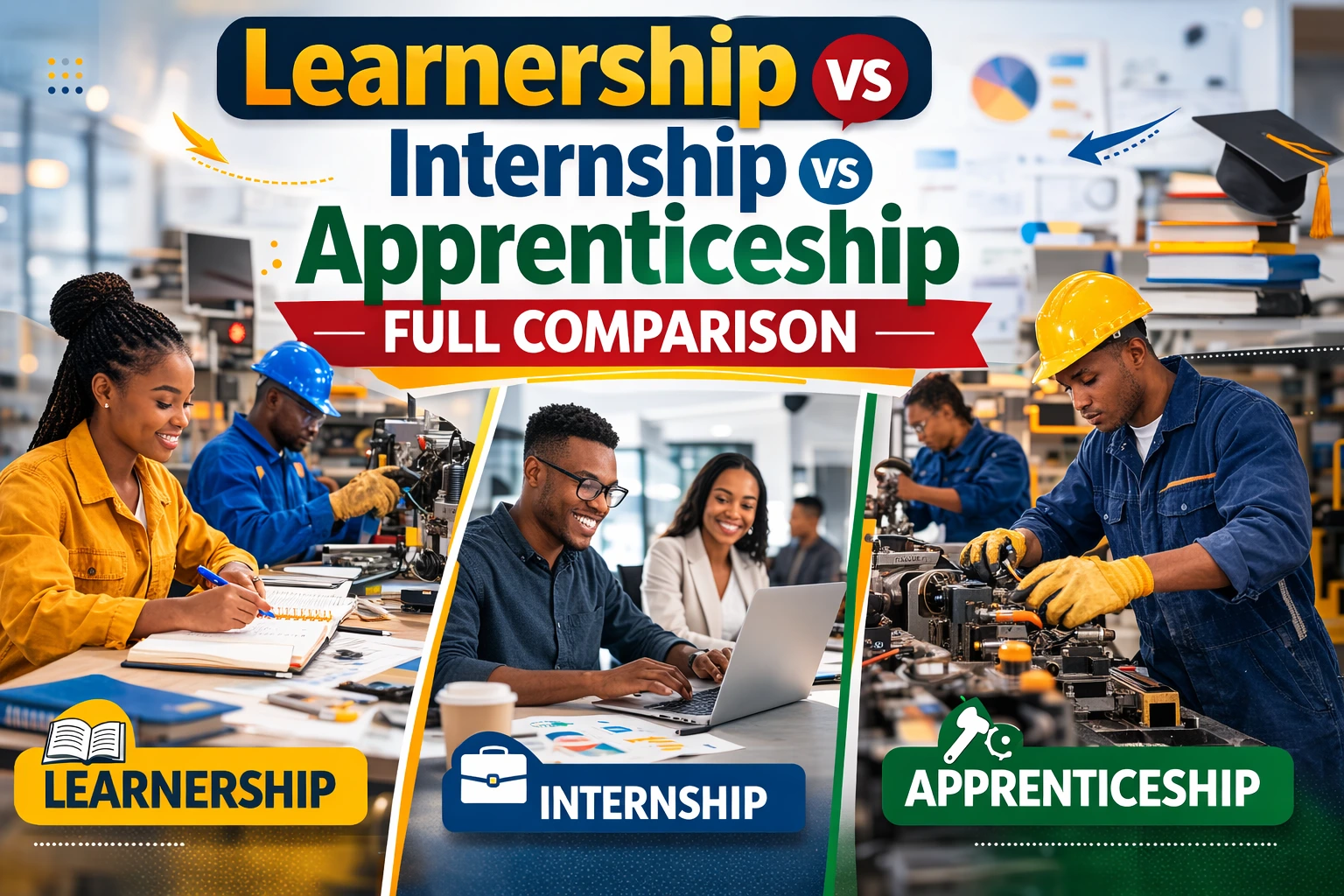
Learnership vs Internship vs Apprenticeship: Full Comparison explaining key differences, requirements, training structures, and what South African applicants should know.
Learnership vs Internship vs Apprenticeship: Full Comparison
Many South Africans searching for career opportunities come across three common types of entry-level programmes: learnerships, internships, and apprenticeships.
At first glance, they may appear similar. All three offer a way to gain workplace experience while building skills. However, they serve different purposes and are designed for different types of candidates.
Understanding the difference can help job seekers choose the right pathway and avoid applying for programmes that do not match their qualifications or career goals.
In simple terms:
- Learnerships combine structured training with a nationally recognised qualification.
- Internships focus mainly on practical workplace exposure for graduates or students.
- Apprenticeships train individuals in specialised technical trades through long-term mentorship and hands-on work.
Each pathway has its own structure, eligibility rules, and career outcomes. Knowing how they work can help applicants make more informed decisions when applying.
CHECK OUR PRIVACY POLICY
What These Programmes(Learnership vs Internship vs Apprenticeship) Are
Although they all involve workplace training, their core purpose differs.
Learnerships
A learnership is a structured training programme that combines classroom learning with practical work experience.
Learners complete a qualification registered on South Africa’s National Qualifications Framework (NQF) while working at an employer. These programmes are typically linked to Sector Education and Training Authorities (SETAs) like SSETA.
Learnerships often target unemployed youth and individuals seeking entry-level qualifications.
Internships
Internships provide short-term workplace experience, usually for students or graduates who already hold a qualification.
Instead of leading to a new qualification, internships focus on helping participants apply what they studied in a real workplace environment.
For example, a graduate in marketing may join an internship to gain experience with campaigns, social media planning, and reporting.
Apprenticeships
Apprenticeships are long-term training programmes for skilled trades such as plumbing, electrical work, welding, or mechanical trades.
These programmes involve intensive hands-on learning under the supervision of experienced artisans.
Apprentices usually work toward a trade test, which confirms their ability to perform the trade professionally.
What You’ll Actually Do in Each Programme || Learnership vs Internship vs Apprenticeship
Understanding daily responsibilities helps clarify the differences.
In a Learnership
Participants typically split their time between study and workplace training.
Real-world tasks may include:
- assisting with administrative duties
- learning workplace systems and procedures
- completing assignments linked to the qualification
- working through training modules and assessments
Learners usually maintain a logbook that tracks practical learning.
In an Internship
Interns often work in professional environments such as offices, laboratories, or corporate departments.
Typical activities may include:
- supporting project teams
- conducting research or preparing reports
- assisting with operational tasks
- learning industry-specific software or tools
Internships often provide exposure to professional work culture.
In an Apprenticeship
Apprentices spend most of their time doing hands-on work.
Examples of tasks include:
- assisting qualified artisans
- learning to operate tools and machinery
- performing maintenance or repairs
- following safety procedures on worksites
Training gradually becomes more advanced as the apprentice gains experience.
Who Qualifies (Typical Minimum Requirements)
Requirements vary depending on the programme and industry, but general patterns exist.
Learnerships
Common requirements may include:
✔ South African citizenship
✔ Minimum education level linked to the NQF qualification
✔ Willingness to complete training and assessments
Internships
Internships usually require:
✔ A completed diploma or degree
✔ Field of study related to the internship
✔ Basic professional skills such as communication or computer literacy
Apprenticeships
These programmes often require:
✔ Technical interest in a trade
✔ Basic mathematics and science knowledge
✔ Physical ability to perform manual work
Exact eligibility rules must always be confirmed in the official advertisement.
Why Applicants Get Disqualified From Learnership vs Internship vs Apprenticeship
Many candidates apply broadly without understanding programme requirements.
Common reasons for rejection include:
Applying for the wrong programme type
For example, graduates applying for learnerships designed for school leavers.
Missing required qualifications
If an internship requires a degree in a specific field, unrelated qualifications may lead to rejection.
Incomplete applications
Missing documents often result in automatic disqualification.
Failure to follow instructions
Some applications require specific formats or reference numbers.
✅ Who Should Apply
Learnership vs Internship vs Apprenticeship
Choosing the right pathway depends on your current education and career goals.
Learnerships are ideal for:
- school leavers needing qualifications and experience
- individuals wanting to enter new industries
- job seekers who prefer structured training programmes
Internships are suitable for:
- graduates needing professional experience
- students completing practical training requirements
- candidates preparing for corporate careers
Apprenticeships are best for:
- individuals interested in skilled trades
- people who prefer hands-on work
- candidates seeking artisan qualifications
Each pathway leads to different career outcomes, so selecting the right one is important.
Competition Level
Competition level: High
Training opportunities attract large numbers of applicants across South Africa.
Competition is particularly strong because:
- many programmes target unemployed youth
- qualifications and experience are highly valued
- some programmes offer stipends or allowances
Applicants who understand programme requirements and prepare strong applications tend to stand out.
Tips to Improve Selection Chances
Job seekers can improve their chances with a few practical steps.
Tailor your CV
Highlight skills and experiences relevant to the specific programme.
Understand the industry
Research the employer or sector before applying.
Prepare for assessments
Some programmes include aptitude tests or interviews.
Apply consistently
Many applicants succeed by applying to multiple opportunities over time.
Common Applicant Mistakes
Certain errors appear frequently in applications.
Examples include:
Sending the same CV to every opportunity without adjusting it.
Ignoring required subject criteria.
Submitting documents that are not certified when certification is required.
Applying through unofficial sources rather than employer career portals.
Avoiding these mistakes can significantly improve success rates.
Application Strategy (Step-by-Step) || Learnership vs Internship vs Apprenticeship
A careful application strategy helps job seekers avoid scams and improve their chances.
Step 1: Identify the programme type
Confirm whether the opportunity is a learnership, internship, or apprenticeship.
Step 2: Check eligibility
Review the educational requirements and experience criteria.
Step 3: Verify the employer
Ensure the organisation offering the programme is legitimate.
Step 4: Prepare documents
Collect all required documentation before applying.
Step 5: Submit through official channels
Use the employer’s official careers portal whenever possible.
Where to Apply || Learnership vs Internship vs Apprenticeship
This article explains programme types rather than a specific opportunity.
Applicants interested in these programmes can usually apply through:
- official employer career websites
- training provider portals
- public sector recruitment platforms
To find relevant opportunities safely, search using the programme title or qualification name on official employer career pages.
Avoid relying solely on social media posts or unofficial application links.
Documents Checklist
Learnership vs Internship vs Apprenticeship
Advertisements may require different documents, but common requirements include:
- Certified copy of South African ID
- Updated CV
- Certified academic certificates
- Academic transcripts (if applicable)
- Proof of residence
If an advertisement does not specify required documents, applicants should confirm directly with the employer before submitting their application.
Safety & Scam Check
Job seekers should stay alert for potential recruitment scams.
Follow these safety guidelines when applying.
Never pay application or placement fees
Legitimate learnerships, internships, and apprenticeships do not require payment.
Verify the employer’s official domain
Applications should normally be submitted through recognised company websites.
Confirm reference numbers where possible
This helps ensure the opportunity is genuine.
Be cautious of WhatsApp-only recruitment
Professional recruitment processes rarely happen entirely on messaging platforms.
Apply via official careers portals whenever possible
This reduces the risk of fraud.
Frequently Asked Questions || Learnership vs Internship vs Apprenticeship
1. Which programme leads to a qualification?
Learnerships and apprenticeships usually lead to recognised qualifications, while internships focus on work experience.
2. Are internships always paid?
Some internships offer stipends, but this varies depending on the employer.
3. Do apprenticeships guarantee employment?
Completion of training improves job prospects but does not guarantee permanent employment.
4. Can graduates apply for learnerships?
Some programmes accept graduates, but many target candidates with lower NQF levels.
5. How long do apprenticeships usually last?
Duration varies by trade and training requirements.
6. Can I apply for more than one programme type?
Yes. Many applicants apply for multiple opportunities simultaneously.
7. Which option is best for someone without work experience?
Learnerships often provide the most structured entry point for beginners.
8. Are these programmes available in all industries?
Many industries offer training pathways, but availability varies.
9. Do internships require interviews?
Some employers conduct interviews or assessments during the selection process.
10. Are these programmes recognised internationally?
Recognition depends on the qualification or trade certification obtained.
Final Assessment || Learnership vs Internship vs Apprenticeship
Learnerships, internships, and apprenticeships all play important roles in helping South Africans build skills and gain work experience. While they share similarities, each pathway is designed for different career stages and industries.
Understanding these differences can help applicants choose programmes that match their qualifications and career goals.
For many job seekers, these opportunities serve as stepping stones into long-term employment. However, success often depends on preparation, careful application, and verifying opportunities through trusted sources.
Approaching each programme with clear expectations and proper research can make a significant difference in building a sustainable career path.
Last verified: 10 March 2026