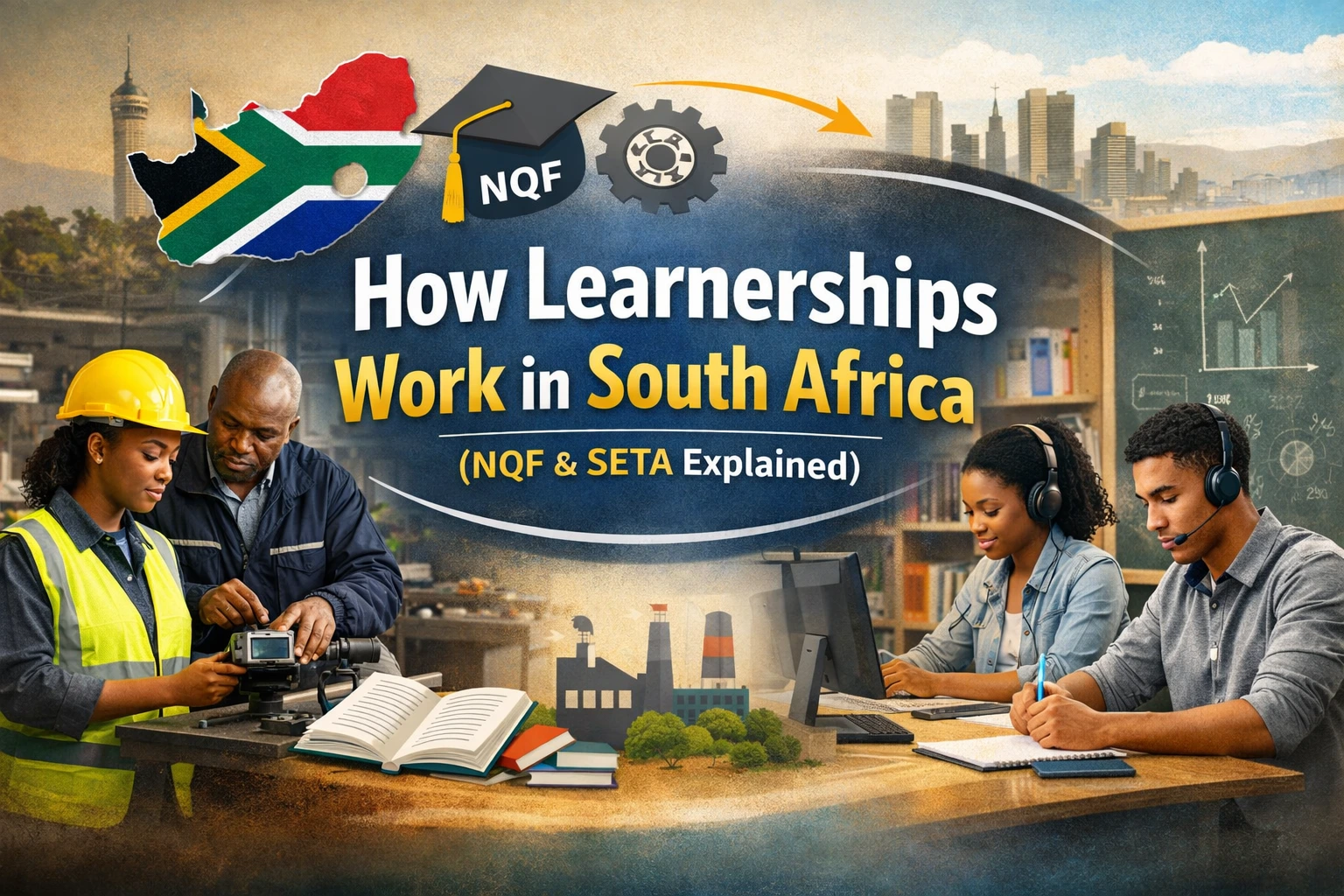
A clear guide to How Learnerships Work in South Africa (NQF & SETA Explained), including NQF levels, SETA roles, requirements, and how applicants can apply safely.
How Learnerships Work in South Africa (NQF & SETA Explained)
Learnerships are one of the most common ways for South Africans to gain practical work experience while studying toward a recognised qualification. If you regularly browse job and internship platforms, you have probably seen many learnership programmes advertised — especially for fields like business administration, retail, banking, IT, logistics, and engineering.
But many applicants still ask an important question: how do learnerships actually work?
Understanding how the National Qualifications Framework (NQF) and Sector Education and Training Authorities (SETAs) operate is key to knowing what a learnership really offers, how employers structure them, and how you can improve your chances of being selected.
This guide breaks down the system in plain English so that job seekers, students, and school leavers can better understand what they are applying for.
CHECK OUR PRIVACY POLICY
What This Programme Structure Is || How Learnerships Work in South Africa
A learnership is a structured training programme that combines classroom learning with real workplace experience.
Instead of studying only at a college or training centre, learners divide their time between:
- Theoretical training through an accredited training provider
- Practical workplace experience with an employer
When the programme is completed successfully, the learner receives a nationally recognised qualification registered on the NQF.
In South Africa, learnerships are designed to help close the gap between education and employment. Many young people struggle to find jobs because employers want experience. Learnerships help solve this problem by allowing people to earn experience while studying toward a qualification.
Most learnerships are funded through skills development programmes supported by government policy.
Understanding the NQF (National Qualifications Framework) || How Learnerships Work in South Africa
The National Qualifications Framework (NQF) is the system used in South Africa to organise and recognise all educational qualifications.
It ensures that qualifications from different institutions follow national standards and are comparable.
The NQF is structured into 10 levels, which represent increasing complexity and knowledge.
Here is a simplified overview:
NQF Level 1–4
Equivalent to basic education and matric-level qualifications.
NQF Level 5–6
Higher certificates and diplomas, often offered through learnerships or TVET colleges.
NQF Level 7–10
University degrees, honours, master’s, and doctoral qualifications.
Most learnerships fall within NQF Levels 2 to 5, depending on the field.
For example:
- Retail learnerships may be NQF Level 2 or 3
- Business administration learnerships are often Level 4
- Some specialised programmes reach Level 5
This matters because the NQF level determines:
- the complexity of the work
- the educational requirements
- the qualification awarded
What SETAs Do || How Learnerships Work in South Africa
South Africa’s Sector Education and Training Authorities (SETAs) play a major role in the learnership system.
Each SETA focuses on a specific industry sector, such as:
- finance
- construction
- manufacturing
- transport
- retail
- information technology
Their responsibilities typically include:
- approving learnership programmes
- accrediting training providers
- monitoring quality standards
- distributing training funding
- ensuring industry-relevant skills are taught
Employers who run learnerships usually work with the relevant SETA to ensure the programme meets national requirements.
For applicants, this means that learnerships registered with a SETA lead to officially recognised qualifications.
What You’ll Actually Do During a Learnership || How Learnerships Work in South Africa
While the exact duties vary by industry, most learnerships follow a similar structure.
Participants usually spend part of their time learning theory and part gaining practical experience.
In real terms, this may include:
Workplace training
You may assist staff members, observe operations, and complete supervised tasks related to the qualification.
Examples could include:
- helping process customer orders
- performing administrative tasks
- assisting technicians or supervisors
- learning software systems used by the company
Structured coursework
Learners usually complete:
- assignments
- workplace logbooks
- assessments
- practical evaluations
These assessments confirm that the learner has mastered both the theory and the practical skills.
Who Qualifies (Typical Minimum Requirements) || How Learnerships Work in South Africa
Requirements vary by programme, but most learnerships ask for a combination of the following:
✔ South African citizenship
✔ Age typically between 18 and 35
✔ Minimum education level matching the NQF requirement
✔ Not currently employed full-time in another role
✔ Willingness to complete training and assessments
Because requirements differ across industries, applicants must always verify the exact criteria in the official advertisement.
Why Applicants Get Disqualified || How Learnerships Work in South Africa
Many candidates lose opportunities not because they lack qualifications, but because of avoidable mistakes.
Common disqualification reasons include:
Incomplete applications
Missing documents or unsigned forms can lead to automatic rejection.
Applying without meeting minimum requirements
If the programme requires a matric certificate or specific subject, applications without it are usually removed early.
Incorrect information
Providing inaccurate details about education or work experience can lead to disqualification during verification.
Late submissions
Most programmes receive many applications, and late submissions are typically not considered.
✅ Who Should Apply || How Learnerships Work in South Africa
Learnerships are particularly suitable for:
School leavers who need experience
Many young people with matric struggle to enter the workforce. Learnerships offer a structured pathway.
TVET graduates seeking workplace exposure
Practical experience gained through learnerships can strengthen future job applications.
Career changers
Some programmes allow people to move into new industries by gaining foundational qualifications.
Job seekers with limited work history
Employers often value practical experience gained during learnerships.
Competition Level
Competition level: High
Learnerships are among the most widely applied-for opportunities in South Africa.
Several factors contribute to this:
- many programmes require only matric
- stipends are often offered
- qualifications are nationally recognised
- applicants gain workplace experience
Because of this, strong preparation and accurate applications are essential.
Tips to Improve Selection Chances || How Learnerships Work in South Africa
If you plan to apply for learnerships regularly, consider the following strategies.
Keep certified documents ready
Most programmes require:
- ID copy
- matric certificate
- CV
Having these prepared saves time.
Create a clear CV
Even if you have little work experience, include:
- school achievements
- volunteer work
- computer skills
Apply early
Some programmes close applications once enough candidates have applied.
Research the industry
Understanding the company’s sector shows genuine interest during interviews.
Common Applicant Mistakes
Many candidates unknowingly reduce their chances with simple mistakes.
Examples include:
Submitting a generic CV for every opportunity without tailoring it.
Ignoring instructions in the advertisement.
Applying through unofficial channels rather than the employer’s careers portal.
Using outdated contact details that prevent recruiters from reaching them.
Avoiding these mistakes can significantly improve application outcomes.
Application Strategy (Step-by-Step) || How Learnerships Work in South Africa
If you want to apply for learnerships effectively, follow this approach.
Step 1: Identify the programme
Look for verified postings on trusted websites or official employer career pages.
Step 2: Verify the employer
Confirm the company is legitimate and operates in the relevant industry sector.
Step 3: Review requirements carefully
Ensure you meet all minimum requirements before applying.
Step 4: Prepare documents
Gather all required documents in the format requested.
Step 5: Submit through official channels
Use the employer’s official application platform whenever possible.
Documents Checklist
How Learnerships Work in South Africa
Exact documents depend on the programme. If the advertisement does not specify them, the following are commonly requested.
Typical documents may include:
- Certified copy of South African ID
- Updated CV
- Certified copy of matric certificate
- Academic transcripts (if applicable)
- Proof of residence
If these are not listed in the advert, applicants should confirm directly with the employer or training provider.
Safety & Scam Check
Unfortunately, scams sometimes target job seekers. Always follow these safety rules when applying for learnerships.
Never pay application or placement fees
Legitimate learnerships funded through SETAs do not require payment from applicants.
Verify the employer’s official domain
Applications should usually happen through official career portals.
Confirm reference numbers where possible
This helps ensure the programme is legitimate.
Be cautious of WhatsApp-only recruitment
Most legitimate employers use email or official websites.
Avoid sharing sensitive information unnecessarily
Only submit personal documents through trusted channels.
Frequently Asked Questions
1. Do learnerships pay a salary?
Many programmes offer stipends, but the amount varies and is not always guaranteed.
2. How long do learnerships last?
Duration varies by programme and qualification level. This information is usually provided in the official advertisement.
3. Do learnerships guarantee permanent employment?
No. Some employers hire successful learners, but it is not guaranteed.
4. Are learnerships recognised qualifications?
Yes, if the programme is registered with the relevant SETA and aligned with the NQF.
5. Can unemployed graduates apply?
Some programmes target matric holders, while others are designed for graduates.
6. Are learnerships only for young people?
Many programmes prioritise youth but may not strictly exclude older applicants.
7. Where can I find legitimate learnership opportunities?
Look at employer career pages, training provider websites, and reputable job platforms.
8. Can I apply for multiple learnerships at once?
Yes, and many applicants do this to increase their chances.
9. Do learnerships require interviews?
Some programmes include interviews or assessments as part of the selection process.
10. Are learnerships available in every industry?
Most major industries in South Africa offer learnership programmes through SETA partnerships.
Final Assessment
Learnerships remain one of the most practical pathways for gaining recognised qualifications and workplace experience in South Africa. By combining structured education with real job exposure, they help bridge the gap between training and employment.
However, because these programmes attract large numbers of applicants, preparation matters. Understanding how NQF levels and SETA accreditation work can help you identify legitimate opportunities and choose programmes aligned with your career goals.
Approach each application carefully, verify programme details, and prioritise official sources when submitting your information.
With the right strategy and realistic expectations, learnerships can become a valuable stepping stone toward long-term employment and professional development.
Last verified: 10 March 2026
READY FOR PUBLICATION