Discover why many learnership applicants get rejected in South Africa and how to improve your chances in 2026. Expert insights, trends, and practical tips.
Why Many Learnership Applicants Get Rejected in South Africa
Introduction: Why This Topic Matters Now
Learnerships have become one of the most important entry points into the South African job market, especially for young people facing high unemployment rates. With thousands of applicants competing for limited positions, rejection has become the norm rather than the exception. Understanding why many learnership applicants get rejected is no longer just helpful—it is essential for anyone hoping to break into the workforce in 2026.
Recent shifts in recruitment processes, digital applications, and employer expectations have made the selection process more competitive and less forgiving. Many applicants assume that meeting basic requirements guarantees success, but the reality is far more complex. This article provides a deep analytical breakdown of the real reasons behind rejection, supported by trends, recruiter insights, and practical interpretation.
ALSO APPLY FOR Generic Management NQF Level 5 Learnership Pretoria 2026: Skills, Career Growth and Job Readiness
ALSO READ OUR PRIVACY POLICY
The Growing Demand–Supply Imbalance || Why Many Learnership Applicants Get Rejected in South Africa
One of the most fundamental reasons why many learnership applicants get rejected is the sheer imbalance between supply and demand. In provinces like Gauteng, a single learnership advert can attract thousands of applications within days.
From an analytical standpoint, this creates a filtering problem for employers. Even well-qualified candidates are often rejected—not because they are unsuitable, but because there are simply too many applicants.
Recruiters increasingly rely on quick elimination strategies:
- Automated filtering systems
- Shortlisting based on small details
- Preference for internal or referred candidates
This means that rejection is often structural, not personal. The system is designed to reduce volume quickly rather than evaluate every candidate deeply.
ALSO APPLY FOR HWSETA Internships 2026: A Complete Guide for South African Graduates
Misalignment Between Applicant Profiles and Employer Expectations
Another critical factor behind why many learnership applicants get rejected is the mismatch between what candidates present and what employers actually want.
Many applicants focus only on minimum requirements such as:
- Grade 10 or Matric
- Basic computer literacy
- Availability
However, employers are increasingly looking beyond these basics. They prioritize:
- Work readiness and attitude
- Communication skills
- Problem-solving ability
- Professional presentation
The gap emerges because applicants often submit generic CVs that fail to demonstrate these qualities. Even if they qualify on paper, they appear indistinguishable from hundreds of others.
This misalignment is especially visible in sectors like retail, security, and administration, where soft skills are just as important as technical qualifications.
Poor Application Quality and Documentation Errors
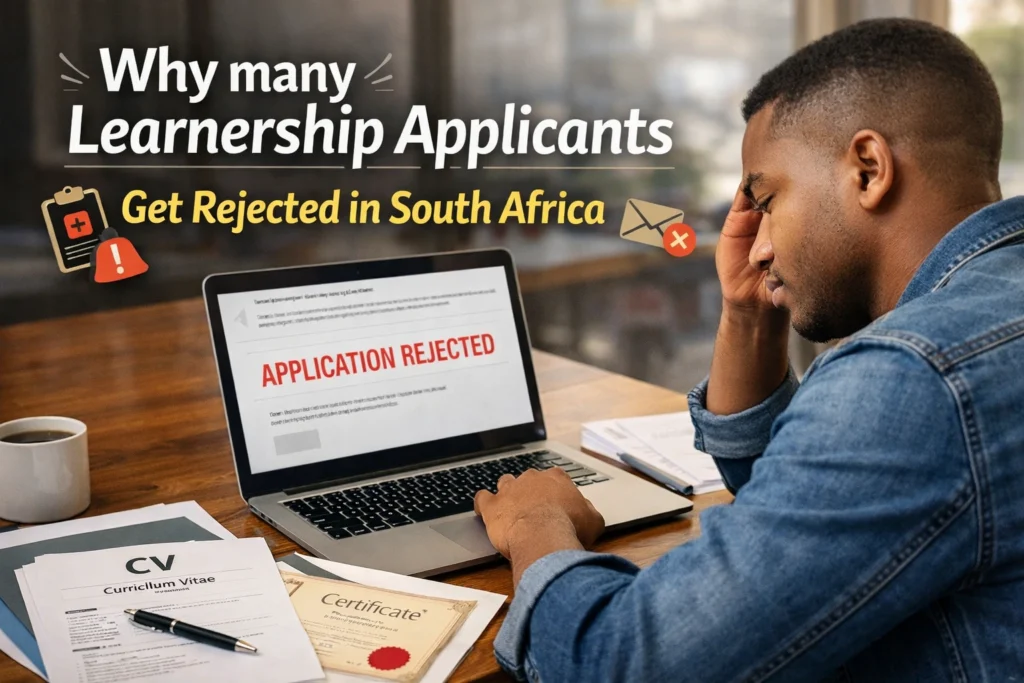
A major yet underestimated reason why many learnership applicants get rejected is the quality of their applications.
Common issues include:
- Incomplete documents
- Incorrect or outdated CVs
- Missing certifications
- Poor formatting or spelling mistakes
From a recruiter’s perspective, these errors signal a lack of attention to detail. In a high-volume environment, such applications are often discarded immediately.
There is also a growing trend of applicants using the same CV for every opportunity without customization. This reduces relevance and makes it difficult for recruiters to match candidates to specific roles.
In 2026, where digital applications dominate, presentation has become a key differentiator. A poorly structured application can eliminate a candidate before their qualifications are even considered.
Limited Understanding of the Learnership Purpose || Why Many Learnership Applicants Get Rejected in South Africa
Many applicants misunderstand what a learnership actually is. This misunderstanding contributes significantly to why many learnership applicants get rejected.
A learnership is not just a job—it is a structured training program that combines:
- Theoretical learning
- Practical workplace experience
Employers are therefore looking for candidates who show:
- Willingness to learn
- Long-term commitment
- Adaptability
Applicants who focus only on earning an income, without demonstrating interest in learning, often fail during screening or interviews.
Recruiters can usually detect this through:
- Generic motivation statements
- Lack of knowledge about the company
- Weak interview responses
This disconnect between expectation and reality leads to rejection even when candidates meet formal requirements.
Increased Use of Digital Screening and AI Filters || Why Many Learnership Applicants Get Rejected in South Africa
The recruitment landscape has changed significantly with the adoption of digital tools. Many organisations now use automated systems to manage applications, which directly impacts why many learnership applicants get rejected.
These systems scan for:
- Keywords
- Relevant qualifications
- Structured data
Applications that do not align with these criteria may never reach a human recruiter.
This creates a new challenge:
- Candidates must optimize their CVs for both humans and machines
For example:
- Using clear headings like “Education” and “Skills”
- Including relevant keywords from the job advert
- Avoiding overly complex formatting
Applicants who are unaware of these digital filters are at a disadvantage, even if they are otherwise suitable.
ALSO READ Complete Guide to Internships in South Africa: Opportunities, Requirements, and Career Impact
Lack of Preparation for Assessments and Interviews || Why Many Learnership Applicants Get Rejected in South Africa
Beyond the application stage, many candidates are rejected due to poor performance in assessments or interviews.
Employers increasingly use:
- Aptitude tests
- Scenario-based questions
- Behavioral interviews
These are designed to evaluate:
- Critical thinking
- Communication
- Cultural fit
Many applicants underestimate this stage and fail to prepare adequately. Common mistakes include:
- Giving vague or generic answers
- Showing lack of confidence
- Not researching the company
This stage often becomes the final barrier, where only the most prepared candidates succeed.
The Role of Experience and Exposure || Why Many Learnership Applicants Get Rejected in South Africa
Even though learnerships are designed for entry-level candidates, exposure still plays a role in selection.
Applicants with:
- Volunteer experience
- Short courses
- Part-time work
often stand out more than those with none.
This creates an indirect barrier. Candidates without any exposure may struggle to demonstrate:
- Workplace understanding
- Professional behavior
- Initiative
As a result, they are more likely to be rejected despite meeting formal criteria.
What This Means Going Forward || Why Many Learnership Applicants Get Rejected in South Africa
Understanding why many learnership applicants get rejected provides valuable insight into how the system is evolving.
Looking ahead, several trends are likely to shape the future:
- Increased competition due to rising youth unemployment
- Greater reliance on digital recruitment systems
- Higher expectations for soft skills and work readiness
- More emphasis on adaptability and continuous learning
For applicants, this means a shift in strategy is necessary. Success will depend on:
- Quality over quantity in applications
- Tailored and targeted CVs
- Preparation for assessments and interviews
- Building small but meaningful experiences
In essence, the learnership selection process is becoming more sophisticated. Applicants who adapt to these changes will significantly improve their chances.
FAQs-Why Many Learnership Applicants Get Rejected in South Africa
1. Why do I keep getting rejected for learnerships?
Most rejections happen due to high competition, poor application quality, or lack of alignment with employer expectations.
2. Do I need experience to get a learnership?
Not always, but having some exposure like volunteering or short courses can improve your chances.
3. How can I improve my learnership application?
Customize your CV, ensure all documents are complete, and highlight relevant skills clearly.
4. Are online applications harder to succeed in?
Yes, because automated systems filter candidates quickly. Proper formatting and keywords are essential.
5. What do employers look for in learnership candidates?
They look for attitude, willingness to learn, communication skills, and basic professionalism.
Conclusion-Why Many Learnership Applicants Get Rejected in South Africa
The reality is that rejection is a common part of the learnership application process in South Africa. However, it is rarely random. By understanding why many learnership applicants get rejected, candidates can identify gaps in their approach and take meaningful steps to improve.
The difference between rejection and success often lies in small but critical factors—attention to detail, preparation, and alignment with employer expectations. While competition will continue to intensify, those who adapt strategically will stand a far better chance of securing opportunities in the evolving job market.