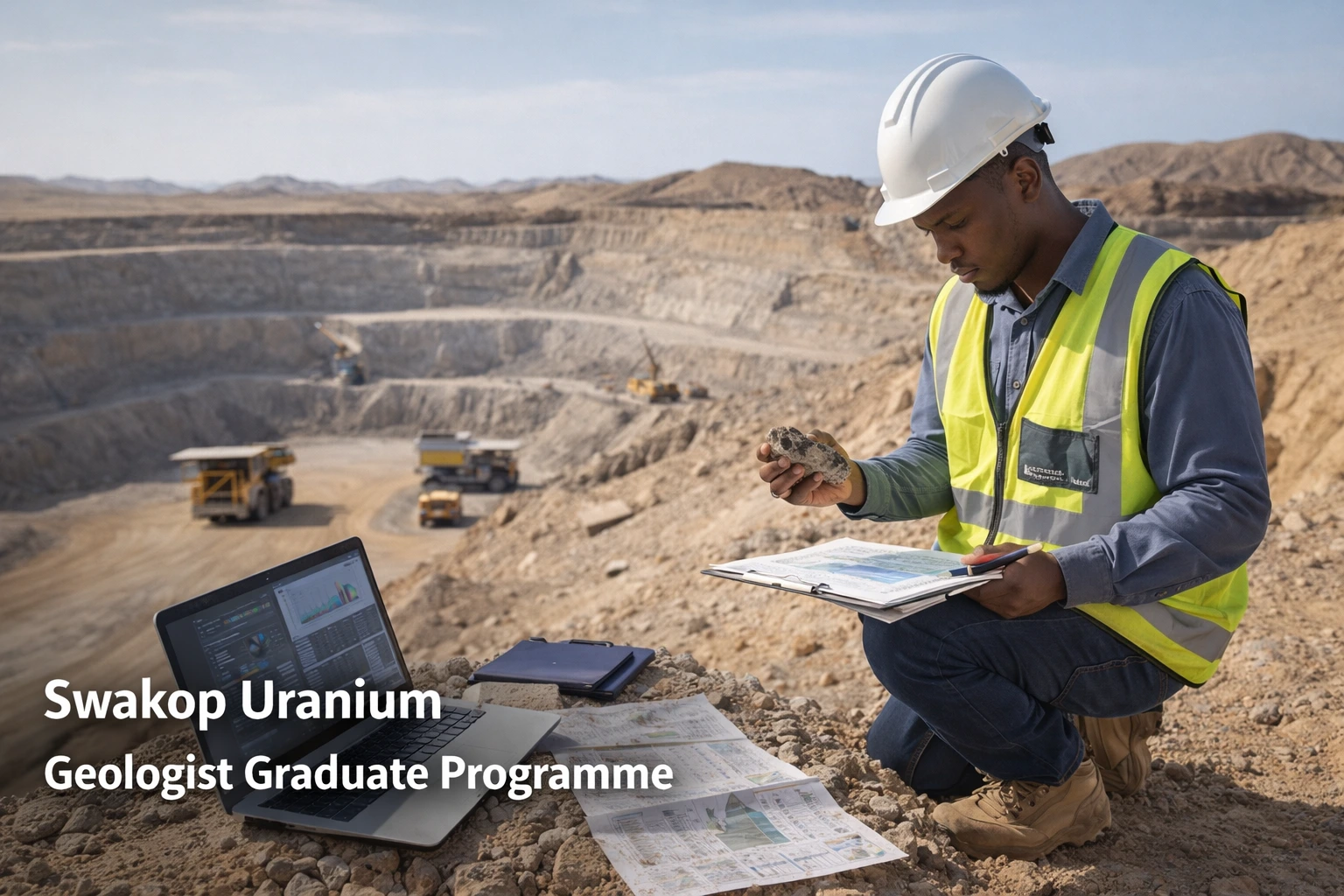
The Swakop Uranium Graduate Geologist Programme offers geology graduates structured mining experience at Husab Mine in Namibia. Learn about requirements and application steps.
The Swakop Uranium Graduate Geologist Programme offers geology graduates the opportunity to gain practical mining industry experience through a structured development programme at the Husab Mine in Namibia. The opportunity is offered by Swakop Uranium, a mining company operating one of the largest uranium mines in the world.
Based near Swakopmund, the programme forms part of the company’s Graduate Development Programme. Successful candidates will spend between 24 and 36 months gaining hands-on geological experience while working alongside experienced professionals in a mining environment.
The role is designed for young geology graduates who want to apply their academic knowledge in real operational settings such as mineral exploration, geological analysis, and resource management.
Only one position is available according to the advert, which means the selection process is likely to be competitive. Candidates who meet the academic requirements and demonstrate strong motivation for the mining sector may benefit most from this opportunity.
Quick Facts
Programme: Graduate Geologist Development Programme
Company: Swakop Uranium
Location: Husab Mine near Swakopmund
Closing date: Not stated in the official advert
Duration: 24–36 months
Positions available: 1
Reference number: 663
Stipend: Not stated in the official advert
If certain information such as the stipend or closing date is important to you, it is advisable to confirm directly with the employer through official recruitment channels.
What This Programme Is
The Swakop Uranium Graduate Geologist Programme is a structured training opportunity designed to help geology graduates transition from academic study to professional geological work within the mining industry.
Graduate development programmes typically combine practical work assignments with mentoring and professional exposure. In this case, participants will gain real experience working in geological operations related to uranium mining.
Mining companies often use these programmes to prepare young professionals for future roles in areas such as:
- Geological exploration
- Mineral resource evaluation
- Mine planning support
- Geological data analysis
Because the programme runs for up to three years, participants have time to develop technical skills and gain experience in multiple areas of mine geology.
What You’ll Actually Do
Although specific daily duties may vary depending on operational needs, geology graduates in mining environments typically perform tasks such as the following.
Geological data collection
Graduates may assist in gathering geological information from drilling activities or field surveys.
Rock and mineral analysis
This may involve examining samples collected during drilling or exploration to determine composition and mineralisation.
Geological mapping
You may help document the location and characteristics of rock formations and mineral deposits.
Data interpretation
Geologists analyse geological data to understand how mineral deposits are formed and how they can be mined safely.
Reporting and documentation
Mining operations rely heavily on accurate records. Graduates may assist in preparing geological reports or maintaining data systems.
Working with multidisciplinary teams
Geologists often collaborate with engineers, environmental specialists, and mine planners.
The aim of these tasks is to help graduates develop both technical geological knowledge and practical field experience.
Who Qualifies
According to the advert, applicants must meet the following minimum requirements.
✔ Grade 12 with at least 36 points across five subjects
✔ A 4-year undergraduate Bachelor’s Degree in Geology
✔ Minimum 65% overall academic average
✔ Maximum age of 26 years
✔ Must be a Namibian citizen
✔ Code B or BE driver’s licence
✔ Strong motivation and ability to work independently
✔ Good communication and networking skills
✔ Ability to work in a diverse multinational working environment
These requirements indicate that the programme is targeted specifically at young geology graduates from Namibia.
Why Applicants Get Disqualified
Even when candidates have strong academic backgrounds, several factors can lead to disqualification.
Not meeting academic thresholds
The advert specifies a minimum average of 65%, which means applicants below that mark may not qualify.
Citizenship requirements
Only Namibian citizens are eligible according to the requirements.
Missing driver’s licence
Fieldwork and travel are common in geology roles, which is why a Code B or BE driver’s licence is required.
Age limit
Applicants older than 26 years may not meet the programme criteria.
Incomplete applications
Missing documents or incorrect application details can lead to immediate rejection.
SEE ALSO: IMPLATS Engineering Learner Fitting 2026 – Springs Opportunity
Who Should Apply
This programme is best suited for candidates who are serious about building careers in the mining industry.
Ideal applicants may include:
Recent geology graduates in Namibia
Those who want structured industry experience after completing their degree.
Students interested in mineral exploration or mining geology
Mining environments provide unique exposure to geological processes.
Graduates who enjoy fieldwork and analytical tasks
Geology often combines outdoor work with data analysis.
Candidates willing to work in remote mining environments
Mining operations are often located outside major cities.
Because the programme provides extended training, it may particularly benefit graduates seeking long-term career development in mining geology.
Competition Level
Competition level: High
Several factors increase competition:
- Only one position is available
- The programme offers long-term structured development
- Mining graduate programmes often attract strong academic candidates
Applicants who meet all requirements and demonstrate a genuine interest in mining geology may have a better chance of being shortlisted. Swakop Uranium Graduate Geologist.
Tips to Improve Selection Chances
Highlight geological fieldwork experience
Mention any:
- Field mapping projects
- Geological surveys
- Research projects related to mineral resources
Demonstrate analytical ability
Explain how you analysed geological data during your studies.
Show interest in mining operations
Employers often look for candidates who understand the realities of working in mining environments.
Prepare strong academic documentation
Ensure your transcripts clearly show your academic performance.
Emphasise teamwork
Mining operations require close collaboration between different specialists.
Common Mistakes Applicants Make
Many geology graduates unintentionally weaken their applications.
Typical mistakes include:
- Submitting generic CVs not tailored to mining geology
- Forgetting to highlight fieldwork experience
- Failing to include academic transcripts
- Ignoring driver’s licence requirements
- Submitting applications without checking eligibility criteria
Attention to detail can make a difference when competition is strong.
Application Strategy
If you plan to apply for the programme, consider the following approach.
Step 1: Prepare a geology-focused CV
Highlight academic achievements, fieldwork experience, and research projects.
Step 2: Gather required documentation
Ensure all academic and identification documents are ready.
Step 3: Verify the job reference
Use Job Ref #: 663 when searching for the opportunity.
Step 4: Confirm the employer
Ensure the opportunity is listed under Swakop Uranium.
Step 5: Apply through official recruitment channels
Follow the instructions listed on the employer’s official careers platform.
Documents Checklist
Applicants should typically prepare the following:
- Updated CV
- Certified copy of Namibian ID
- Academic transcripts
- Copy of geology degree certificate
- Copy of driver’s licence
Some documents may not be explicitly listed in the advert but are commonly required for graduate programmes. Applicants should confirm requirements through official channels.
Where to Apply
APPLY HERE: Swakop Uranium Graduate Geologist
Safety & Scam Check
When applying for graduate programmes, keep these safety guidelines in mind.
- Never pay fees for graduate programme applications.
- Verify the employer through its official website.
- Confirm the job reference number (663) when searching for the listing.
- Be cautious if recruiters request applications through WhatsApp-only channels.
- Apply through official recruitment portals where possible.
Legitimate mining companies do not charge fees for graduate development programmes.
ALSO APPLY FOR: YES Learner Programme Motus Corporation Polokwane & Tzaneen – 12-Month Youth Opportunity
Frequently Asked Questions
Where is the programme located?
The programme is based near Swakopmund in Namibia’s Erongo Region.
How long does the programme last?
How long does the programme last?
How many positions are available?
The advert states that one position is available.
Is a stipend provided?
The stipend is not stated in the official advert.
What qualification is required?
Applicants must have a 4-year Bachelor’s Degree in Geology with a minimum average of 65%.
Is there an age requirement?
Yes, applicants must be 26 years or younger.
Do applicants need a driver’s licence?
Yes, a Code B or BE driver’s licence is required.
Can international candidates apply?
No. The advert specifies that applicants must be Namibian citizens.
What type of role is this?
It is a contract-based graduate development programme.
Is fieldwork part of the programme?
While not explicitly detailed, geology roles in mining typically involve fieldwork and geological analysis.
Final Assessment
The Swakop Uranium Graduate Geologist Programme offers a rare opportunity for Namibian geology graduates to gain structured experience within a large-scale mining operation.
With a development period of up to three years, the programme allows graduates to build real-world geological skills while working in a professional mining environment. Swakop Uranium Graduate Geologist.
However, with only one position available, competition may be strong. Candidates who demonstrate strong academic performance, fieldwork experience, and a genuine interest in mining geology are likely to stand out during the selection process.
For young geology graduates aiming to enter the mining sector, this programme could provide valuable early-career exposure.