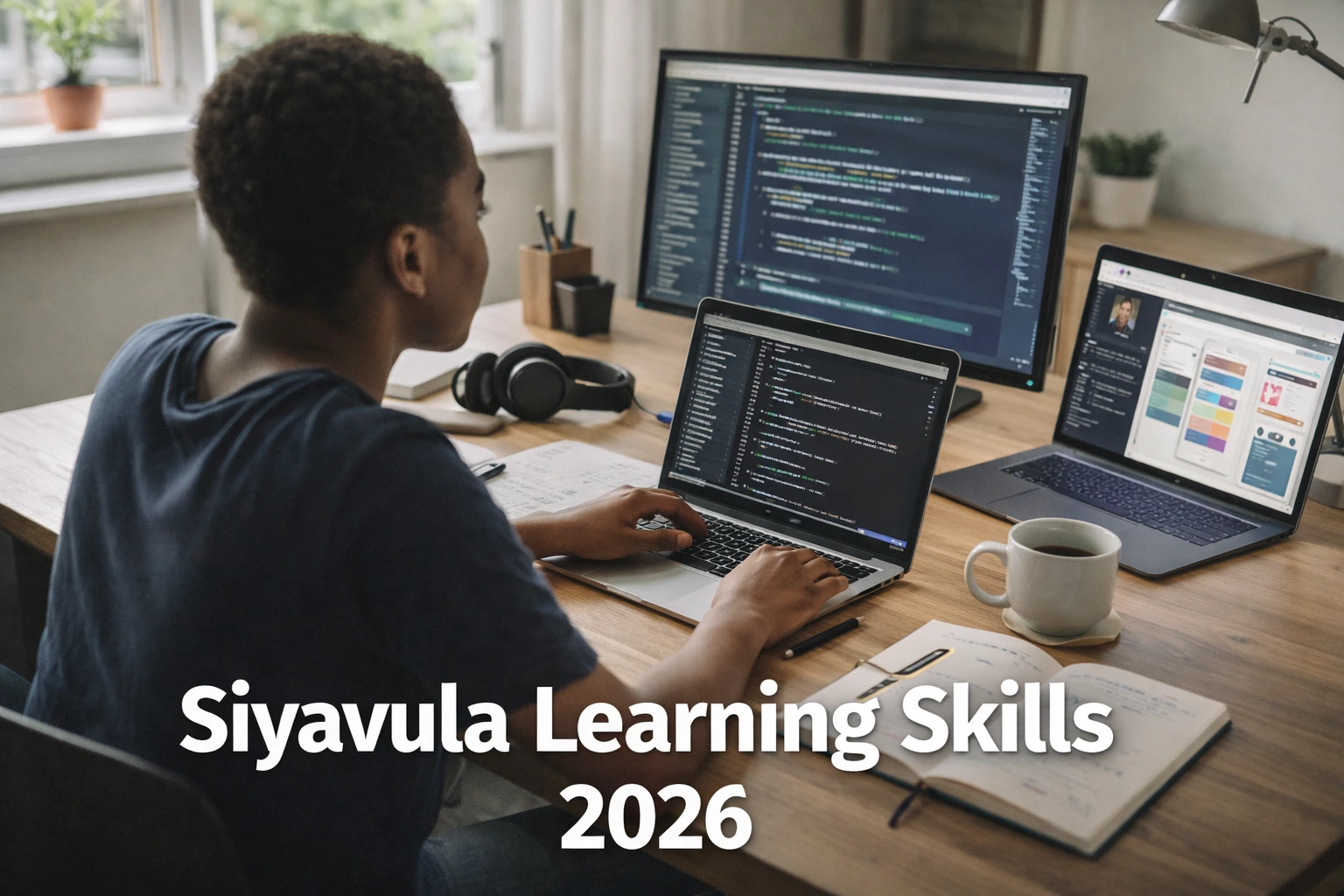
Siyavula Learning Skills 2026 Remote Programme offers a 12-month digital learnership with an NQF Level 5 qualification and remote training for South African youth.
The Siyavula Learning Skills 2026 Remote Programme is a 12-month digital learnership designed to help young South Africans gain practical technology skills while studying remotely. Delivered in partnership with Siyavula and Umuzi, the programme focuses on building job-ready capabilities in areas such as data science, web development, and user interface design.
Unlike traditional classroom courses, the programme emphasises project-based learning, meaning participants work on practical tasks and build a professional portfolio during the training period. This approach allows learners to demonstrate real work rather than relying only on theoretical qualifications.
The learnership is accredited by MICT SETA and leads to a National Qualifications Framework (NQF) Level 5 qualification. It is structured as a full-time remote programme, allowing applicants from across South Africa to participate as long as they have reliable internet access and a suitable device.
For many young people interested in entering the digital economy, programmes like this offer a pathway to gain both recognised certification and practical industry skills.
.
What This Programme Is
The Siyavula Learning Skills programme aims to address one of the biggest barriers facing young people entering the tech industry: lack of practical experience.
Many traditional education routes focus heavily on theory. However, employers in digital fields often prioritise candidates who can demonstrate their skills through completed projects or portfolios.
This programme attempts to bridge that gap by combining:
- Accredited digital skills training
- Real-world project work
- Portfolio development
- Remote learning accessibility
Participants spend a year learning technical skills and building evidence of their abilities through real assignments and tasks.
Because the programme is fully remote, learners do not need to relocate to major technology hubs such as Johannesburg or Cape Town. This can make participation more accessible for applicants living outside large cities.
What You’ll Actually Do
The programme focuses on hands-on digital learning, meaning participants are expected to work on projects rather than simply attend lectures.
Typical activities may include:
Completing practical digital projects
Participants work on real technical challenges that simulate industry tasks.
Building a professional portfolio
Learners compile a Portfolio of Evidence (PoE) demonstrating the work they completed during the programme. This portfolio can later be used when applying for jobs.
Learning modern tech tools
Depending on the track selected, learners may work with technologies such as:
- Coding languages
- Data analysis tools
- User interface design platforms
Participating in structured learning sessions
Even though the programme is remote, learners still receive structured guidance, mentoring, and assignments.
Preparing for the tech workplace
Participants gain exposure to problem-solving, teamwork, and digital collaboration — all skills commonly required in technology careers.
Career Tracks: Choose Your Specialisation
Applicants must select one of the available digital career paths during the application process.
Data Science
This path focuses on analysing large datasets and extracting useful insights. Skills may include programming, data visualisation, and problem solving.
Web Development
Learners build websites and applications from the ground up. This usually involves working with front-end and back-end technologies.
UI (User Interface) Design
This track focuses on how digital products look and function from a user perspective. It includes visual design, prototyping, and improving user experience.
Each track leads to slightly different career opportunities in the technology sector.
Who Qualifies
According to the programme information, applicants must meet the following criteria:
✔ South African citizen
✔ Age between 18 and 34 years
✔ Minimum Matric Certificate (NQF Level 4)
✔ Access to reliable internet and a digital device
✔ Available for a full-time 12-month commitment
Applicants should also be prepared to complete an aptitude challenge during the selection process.
Why Applicants Get Disqualified
Even when candidates meet the basic requirements, some applications are rejected due to avoidable mistakes.
Common reasons include:
Incomplete application submissions
Missing documents such as identification or certificates may prevent verification.
Failure to complete the online challenge
The selection process includes an aptitude test, which must be completed successfully.
Unreliable internet access
Because the programme is fully remote, learners must be able to participate consistently online.
Lack of commitment to full-time learning
The programme requires sustained participation over a full year.
Who Should Apply
The programme is particularly suitable for:
Young people interested in technology careers
Anyone considering web development, data analysis, or digital design.
Self-motivated learners
Remote programmes require discipline and time management.
Applicants who enjoy solving problems
Coding and data science often involve troubleshooting and logical thinking.
Creative thinkers interested in digital design
The UI design track may appeal to individuals who enjoy visual creativity.
This programme may not suit candidates who prefer traditional classroom learning or those unable to commit to a full-time remote schedule.
Competition Level: High
Competition for the programme is likely high for several reasons:
- Remote participation opens the opportunity to applicants nationwide
- The programme only requires a Matric certificate
- Technology training programmes are increasingly popular among young job seekers
- Accredited qualifications and stipends attract large applicant pools
Applicants should therefore ensure their submissions are well prepared.
Tips to Improve Your Selection Chances
Consider these strategies when applying:
Prepare for the aptitude challenge
The programme includes an online test designed to evaluate problem-solving ability.
Demonstrate curiosity and resourcefulness
Many technology roles require independent learning and research.
Highlight digital interest in your CV
Even personal projects, online courses, or coding practice can demonstrate interest.
Build basic digital familiarity
Before applying, explore introductory tutorials related to your chosen track.
Common Mistakes Applicants Make
Applicants sometimes weaken their chances by:
- Submitting rushed or incomplete applications
- Selecting a career track without understanding it
- Ignoring instructions during the online challenge
- Failing to provide accurate contact details
Taking time to review the application carefully can prevent these issues.
SEE ALSO: Engineering Learner Boilermaking Programme at Impala Platinum Refineries (Springs) 2026
Application Strategy (Step-by-Step)
A careful approach can help applicants navigate the selection process more effectively.
Step 1: Prepare your Siyavula Learner Report
Applicants who use Siyavula for Mathematics or Science may need to share their learner report link.
Step 2: Visit the official application portal
Applications are submitted through the programme partner’s online platform.
Step 3: Choose your learning track
Select the path that best matches your interests and abilities.
Step 4: Complete the aptitude challenge
This test assesses problem-solving and logical thinking.
Step 5: Upload verification documents
Applicants must submit identification and academic certificates.
Step 6: Wait for programme placement
Successful candidates may be added to a pool and matched with available cohorts when funding becomes available.
Where to Apply
APPLY HERE: Siyavula Learning Skills 2026
ALSO APPLY FOR: Sediba Scriptwriting Training Programme Matatiele: NFVF Opens Applications for 2026 Workshop
Documents Checklist
The advert does not list a full document checklist, but applicants typically need:
✔ Certified copy of South African ID
✔ Matric certificate
✔ Updated CV
✔ Siyavula learner report link (if applicable)
Applicants should confirm document requirements on the official application portal.
Safety & Scam Check
When applying for learnerships or training programmes, always follow basic safety checks:
- Never pay application or placement fees for learnership programmes
- Verify the official website domain before submitting information
- Check programme partners and accreditation
- Avoid applying through WhatsApp-only messages or unofficial social media posts
- Apply through recognised recruitment or training platforms
Legitimate learnership providers typically use formal application systems and transparent recruitment processes.
Frequently Asked Questions
Is the programme fully remote?
Yes. The programme is designed to be completed online.
What qualification will learners receive?
An NQF Level 5 qualification accredited by MICT SETA.
How long does the programme last?
The programme runs for 12 months.
Is a stipend provided?
The advert states that a monthly allowance is provided, but the exact amount is not officially confirmed.
Who can apply?
South African citizens aged 18–34 with at least a Matric certificate.
Do I need previous coding experience?
The advert does not state that prior coding experience is required.
What learning tracks are available?
Data Science, Web Development, and UI Design.
Can I apply from any province?
Yes. The programme is fully remote.
What is the aptitude challenge?
What is the aptitude challenge?
When does the programme start?
The advert states that intake occurs when partner funding becomes available, meaning start dates may vary.
.
Final Assessment
TheSiyavula Learning Skills 2026 Remote Programme offers an alternative route into the technology sector for young South Africans interested in digital careers. By combining accredited training with project-based learning, Siyavula Learning Skills 2026 programme aims to equip participants with both theoretical knowledge and practical experience.
The remote structure can make Siyavula Learning Skills 2026 programme more accessible for applicants who cannot relocate to major cities. However, success in remote training requires discipline, reliable internet access, and strong self-motivation.
For applicants willing to commit to a full year of structured digital learning, Siyavula Learning Skills 2026 programme may provide valuable skills and portfolio experience that can support entry into the tech industry.