Explore the SAB Sales & Marketing Learnership 2026 in Kimberley. Learn what the programme involves, requirements, and why it matters now.
SAB Sales & Marketing Learnership 2026: A Ground-Level Look at Breaking Into FMCG
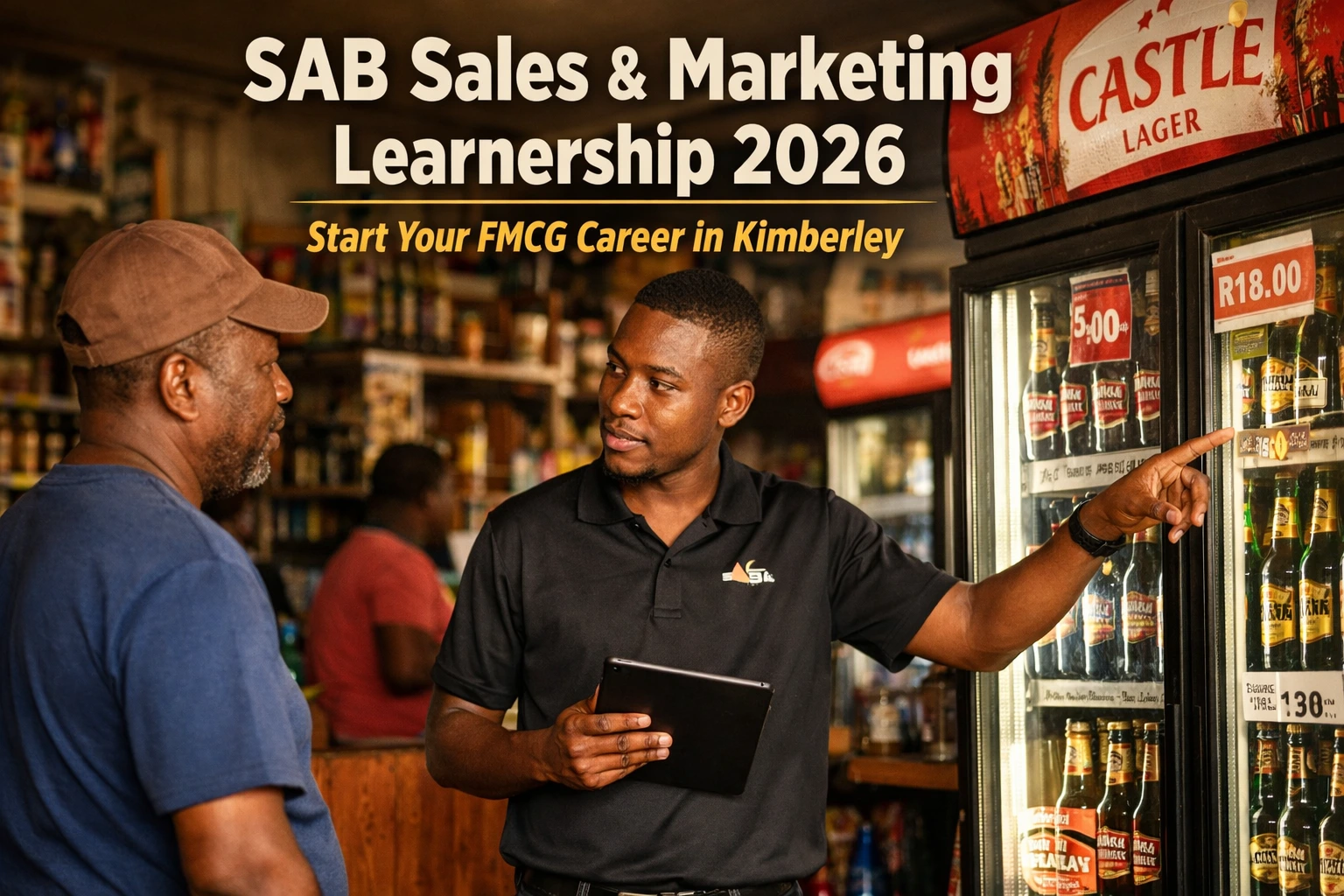
It’s a Friday afternoon in Kimberley. A tavern owner is preparing for a busy weekend — crates stacked, fridges humming, and regular customers already drifting in. Then a young sales trainee arrives, not just to drop off stock, but to talk strategy.
That moment captures what the SAB Sales & Marketing Learnership 2026 is really about.
This isn’t a classroom-based programme or a typical office internship. It’s a frontline introduction to one of the most competitive industries in South Africa — fast-moving consumer goods (FMCG) — where relationships, timing, and real-world decisions shape business outcomes every day.
For graduates trying to find their footing in a tough job market, opportunities like this carry weight right now.
Why the SAB Sales & Marketing Learnership 2026 Feels Different
At a glance, the SAB Sales & Marketing Learnership 2026 looks like many other graduate programmes: a 12-month structured opportunity, based in Kimberley, requiring a diploma or degree.
But the reality on the ground is more demanding — and more revealing.
Participants don’t sit behind desks analysing spreadsheets all day. Instead, they work directly with tavern owners and small business operators, helping them manage stock, improve product visibility, and ultimately increase sales.
This “in-trade” exposure is what sets the programme apart.
In South Africa, especially in regions like the Northern Cape, taverns are not just businesses — they are community hubs. Understanding how they operate requires more than theory. It requires presence, observation, and the ability to adapt quickly.
That’s where this learnership becomes less about learning concepts, and more about learning people.
Inside the Work: More Than Just Sales Calls
A typical week for someone in the SAB Sales & Marketing Learnership 2026 involves multiple outlet visits.
These are not casual check-ins. Each visit has a purpose:
- Ensuring products are available before peak demand
- Checking how items are displayed and priced
- Monitoring SAB-owned equipment like fridges
- Building trust with tavern owners
There’s also a strong commercial layer beneath these activities.
Learners are expected to make decisions that influence sales volume and brand presence. That could mean suggesting a different product mix or identifying missed opportunities during busy trading periods.
One of the central frameworks used in this environment is AMPPS — a retail strategy that measures performance across availability, merchandising, pricing, and promotion.
It may sound technical, but in practice, it often comes down to simple but critical questions:
Is the product in stock?
Is it visible?
Is it priced correctly for the customer?
If the answer to any of these is “no,” sales are lost.
Learning the Reality of the Tavern Economy
The tavern class of trade is a unique part of South Africa’s economy.
Unlike large retail chains, taverns operate with tighter margins, unpredictable demand, and limited storage capacity. A busy weekend can make or break a week’s income.
For learners, this creates a different kind of challenge.
You’re not just selling a product — you’re helping someone manage risk.
For example, overstocking can lead to losses, especially with perishable goods. Understocking means missed sales during peak periods. Getting that balance right requires both data awareness and local insight.
This is where knowledge of Kimberley becomes important.
Understanding which areas are busiest, when customers tend to buy, and how events or pay cycles affect demand can give learners an edge. It turns the role into something closer to micro-level market analysis, rather than just distribution.
What SAB Looks for Beyond Qualifications
On paper, the requirements for the SAB Sales & Marketing Learnership 2026 are straightforward:
A diploma or degree
A valid Code 8 driver’s license
Basic computer literacy
Knowledge of the Kimberley area
But the less visible requirements often matter more.
This is a role that demands resilience.
Working hours can stretch into weekends and public holidays, especially when supporting high-demand trading periods. Travel between outlets is part of the job, and conditions aren’t always predictable.
There’s also a strong emphasis on accountability.
Learners are expected to take ownership of their performance — whether it’s hitting sales targets or maintaining relationships with clients.
And then there’s people skills.
In environments where trust matters, the ability to communicate clearly and respectfully across different communities becomes essential.
Expert Insight: Why Programmes Like This Shape Long-Term Careers
What makes the SAB Sales & Marketing Learnership 2026 particularly valuable is not just the brand behind it, but the type of exposure it provides.
In the FMCG sector, success often depends on understanding how products move in real environments, not just how they are marketed in theory.
Programmes like this accelerate that understanding.
They expose learners to:
- Real-time decision-making
- Customer behaviour patterns
- Supply and demand dynamics at a local level
Over time, this builds a foundation that can translate into roles in sales management, brand strategy, or commercial operations.
It’s not guaranteed — not every learner will move into a permanent role — but the experience itself carries weight across the industry.
The Practical Demands That Many Overlook
There’s a tendency to view learnerships as stepping stones, but the day-to-day reality can be intense.
For this programme, one of the overlooked aspects is driving.
Having a Code 8 license is only the starting point. Learners must pass an internal driving assessment, ensuring they can safely navigate Kimberley’s roads while managing tight schedules.
Then there’s the pressure of performance.
Unlike purely academic environments, results here are visible. If stock isn’t available or displays aren’t executed properly, it shows immediately — in lost sales.
That level of accountability can be challenging, but it’s also what makes the experience valuable.
SEE ALSO: How to Find Legitimate Learnerships Online in South Africa
Why This Opportunity Matters Right Now
South Africa’s youth unemployment rate remains high, and many graduates struggle to find opportunities that offer both experience and structure.
The SAB Sales & Marketing Learnership 2026 sits at the intersection of those two needs.
It offers:
- Hands-on experience in a major industry
- Exposure to real customers and business environments
- A structured learning framework
At the same time, it reflects a broader shift in how companies develop talent.
Instead of relying only on academic qualifications, organisations are investing in practical, field-based learning that prepares candidates for real-world challenges.
APPLY HERE: SAB Sales & Marketing Learnership 2026
ALSO APPLY FOR: Learner Pharmacist’s Assistant 2026 Western Cape Programme (EPWP Training Opportunity)
Frequently Asked Questions
Where is the SAB Sales & Marketing Learnership 2026 based?
Where is the SAB Sales & Marketing Learnership 2026 based?
Do you need previous work experience to apply?
No formal experience is required, but a relevant diploma or degree is necessary.
Is the learnership likely to lead to permanent employment?
There is no guarantee, but the experience gained can improve your chances of securing roles within the FMCG sector.
Final Thoughts: A First Step That Demands More Than It Promises
The SAB Sales & Marketing Learnership 2026 is not an easy entry into the job market.
It requires adaptability, discipline, and a willingness to work in environments that are sometimes unpredictable.
But that’s also what makes it meaningful
For those willing to engage fully — to learn not just the systems, but the people and markets behind them — it can become more than a 12-month programme.
It can become a foundation for understanding how business really works in South Africa.
And in a competitive economy, that kind of understanding is often what sets careers apart.