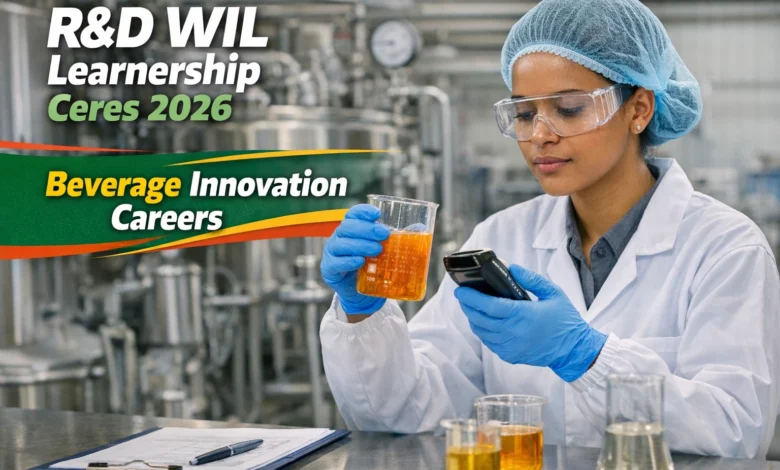
Explore the R&D WIL Learnership Ceres 2026 opportunity in beverages, Food, Bakeries, Productivity, Seasoning and Packaging. Learn about requirements, responsibilities, and career growth in food science and product development.
R&D WIL Learnership Ceres 2026: A Strategic Entry into South Africa’s Food Innovation Sector
The global food and beverage industry is evolving rapidly, driven by changing consumer preferences, sustainability pressures, and technological innovation. In South Africa, this shift is increasingly visible in the way companies invest in research and development (R&D) talent pipelines. The R&D WIL Learnership Ceres 2026 reflects this transformation—offering graduates a structured pathway into one of the most dynamic areas of the economy.
Ceres, located in the Western Cape, is already known as a key agricultural hub. The addition of R&D-focused opportunities within this region signals a growing alignment between primary production and product innovation. For aspiring scientists and engineers, this learnership is more than practical training—it is exposure to the full lifecycle of product development, from concept to commercialization.
At a time when innovation determines competitiveness, roles like this are becoming critical in shaping the future of the food industry.
ALSOAPPLY FOR AMPATH Phlebotomy Learnership 2027: Training Opportunity in South Africa
ALSO READ OUR PRIVACY POLICY
Quick Facts Box
- Closing Date: Not stated in the official advert
- Location: Ceres, Western Cape
- Duration: Not stated in the official advert
- Positions Available: 1
- Reference Number: 2026-444091
- Stipend/Salary: Not stated in the official advert
Understanding the R&D WIL Learnership Ceres 2026 Role
The R&D WIL Learnership Ceres 2026 is designed to bridge the gap between academic knowledge and real-world application. Work Integrated Learning (WIL) programmes are increasingly used by companies to develop job-ready graduates who can contribute immediately to business objectives.
In this role, the learner supports R&D Technologists and Managers in executing low-complexity projects within the beverages category. However, “low complexity” should not be misunderstood—these projects still require precision, analytical thinking, and adherence to strict quality standards.
Key responsibilities include:
- Assisting with trial protocols and pilot plant testing
- Supporting production trials and reporting results
- Conducting laboratory analyses such as moisture, salt, and oil testing
- Collaborating with cross-functional teams
- Supporting product development from prototype to scale-up
This level of involvement provides learners with hands-on exposure to industrial R&D processes, something that is often missing from purely academic training.
The R&D WIL Learnership Ceres 2026 Role of Pilot Plants in Product Development
One of the most valuable aspects of the R&D WIL Learnership Ceres 2026 is exposure to pilot plant operations. Pilot plants serve as a bridge between laboratory research and full-scale production.
In practical terms, this means that learners will:
- Test product formulations in controlled environments
- Evaluate scalability of recipes and processes
- Identify potential production challenges early
For example, a beverage formulation that works perfectly in a lab may behave differently when produced at scale. Factors such as temperature control, ingredient mixing, and equipment limitations can all impact the final product.
By participating in pilot plant trials, learners gain insight into real-world production constraints, making them more effective problem-solvers in future roles.
Data-Driven Decision Making in Food Science || R&D WIL Learnership Ceres 2026
Modern R&D is increasingly data-driven, and the R&D WIL Learnership Ceres 2026 reflects this trend. Learners are required to conduct various analytical tests, including:
- Salt analysis
- Oil analysis
- Moisture content measurement
- Bulk density and particle size analysis
These tests generate data that informs decisions about product quality, shelf life, and consumer acceptance.
For instance, moisture levels in a beverage product can affect both taste and preservation. Similarly, particle size can influence texture and consistency. By interpreting this data, R&D teams can refine formulations and optimize processes.
The inclusion of basic statistical knowledge in the requirements highlights the importance of analytical thinking and data interpretation in modern food science careers.
Cross-Functional Collaboration and Industry Integration || R&D WIL Learnership Ceres 2026
Another defining feature of the R&D WIL Learnership Ceres 2026 is its emphasis on collaboration. R&D does not operate in isolation—it intersects with multiple business functions, including:
- Supply Chain (SC/OPS)
- Commercialization teams
- Regulatory departments
- External partners and co-manufacturers
Learners are expected to communicate trial protocols, coordinate project timelines, and ensure that resources are available for production trials. This level of interaction provides valuable exposure to the business side of product development.
For example, a new beverage formulation must not only meet quality standards but also comply with regulatory requirements and align with market demands. Understanding these interdependencies is crucial for long-term career success.
Safety, Compliance, and Quality Standards || R&D WIL Learnership Ceres 2026
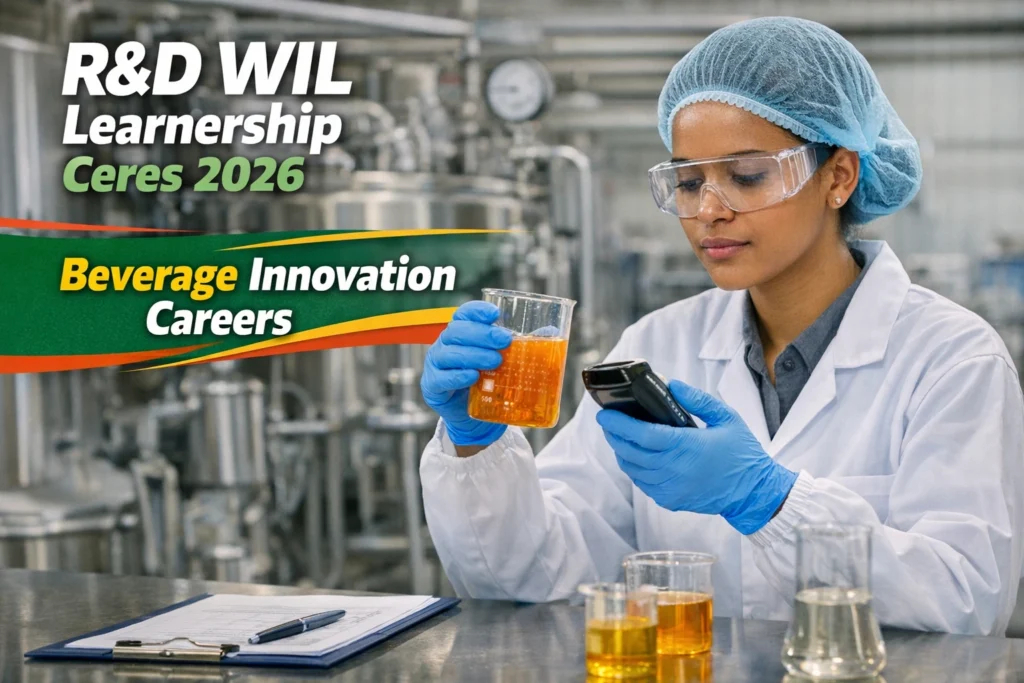
In food and beverage R&D, safety and compliance are non-negotiable. The R&D WIL Learnership Ceres 2026 includes responsibilities related to:
- Good Manufacturing Practices (GMP)
- Environmental Health and Safety (EHS) initiatives
- Regulatory compliance
Maintaining hygiene standards in pilot plants and production environments is essential to prevent contamination and ensure product safety.
Additionally, learners are involved in drafting technical documentation, such as:
- Artwork specifications
- Process specifications
- Finished product standards
This documentation ensures consistency across production batches and supports regulatory approval processes.
From an industry perspective, this focus on compliance reflects growing consumer expectations around food safety, transparency, and quality assurance.
Skills Development and Industry Readiness
The R&D WIL Learnership Ceres 2026 is structured to develop both technical and soft skills. Beyond laboratory work, learners are expected to demonstrate:
- Communication and teamwork
- Problem-solving and critical thinking
- Time management and organization
- Adaptability to change
The requirement for a strong academic background in fields such as Biochemistry, Food Technology, or Engineering ensures that candidates have a solid theoretical foundation. However, the programme goes further by emphasizing practical application and industry readiness.
This dual focus is particularly important in a competitive job market, where employers increasingly value candidates who can combine knowledge with hands-on experience.
What This Means Going Forward
The R&D WIL Learnership Ceres 2026 reflects broader trends shaping the food and beverage industry:
- Increased investment in innovation
Companies are prioritizing R&D to stay competitive in a rapidly changing market. - Integration of science and business
Product development now requires collaboration across multiple functions. - Growing importance of data analytics
Decisions are increasingly driven by measurable insights. - Focus on sustainability and compliance
Regulatory and environmental considerations are becoming more prominent. - Demand for industry-ready graduates
Work Integrated Learning programmes are bridging the gap between education and employment.
For job seekers, this means that developing a combination of technical expertise, analytical skills, and adaptability is essential. For the industry, it signals a move toward more structured and strategic talent development.
How to Apply for R&D WIL Learnership Ceres 2026
Apply for R&D WIL Learnership Ceres 2026
FAQs-R&D WIL Learnership Ceres 2026
1. What qualifications are required for this learnership?
You must have completed the theoretical part of a scientific degree (e.g., Biochemistry, Food Technology, or Engineering) with at least a 60% average.
2. Is prior work experience required?
No, but strong analytical and technical skills are essential.
3. What kind of work will I do?
You will assist with product development, laboratory testing, pilot plant trials, and project coordination.
4. Is this role suitable for final-year students?
Yes, it is specifically designed for students in their final year who have completed their theoretical studies.
5. Does the learnership lead to permanent employment?
This is not guaranteed, but it significantly improves your chances of securing a role in R&D or related fields.
Conclusion-R&D WIL Learnership Ceres 2026
The R&D WIL Learnership Ceres 2026 offers a compelling opportunity for aspiring scientists to gain practical experience in a highly competitive and innovation-driven industry. By combining laboratory work, pilot plant exposure, and cross-functional collaboration, the programme equips learners with the skills needed to succeed in modern food and beverage R&D.
While the requirements are demanding, the potential rewards—in terms of experience, knowledge, and career progression—are substantial. For candidates looking to enter the world of product development, this learnership represents a meaningful and strategic starting point.