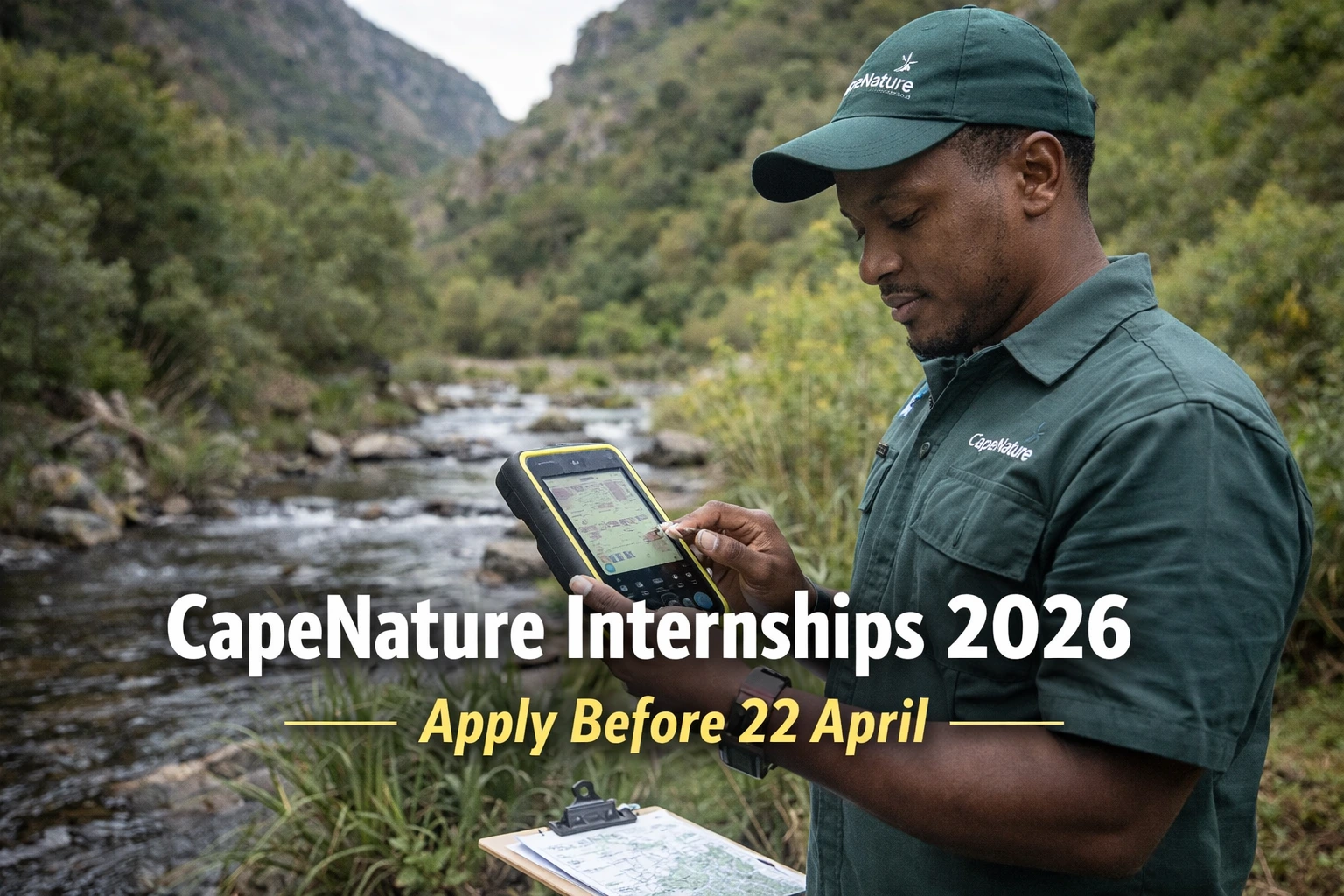
CapeNature Graduate Internships 2026 offer paid conservation and GIS experience. Learn about requirements, roles, salary, and why this opportunity matters before the 22 April deadline.
CapeNature Graduate Internships 2026: A Rare Entry Point Into Conservation and GIS Careers
The CapeNature Graduate Internships 2026 come at a critical moment for South Africa’s environmental sector—and for graduates struggling to convert academic qualifications into real employment.
Each year, thousands of environmental science and GIS graduates leave university with solid theoretical knowledge but limited access to practical roles. The result is a growing gap between qualification and employability. In a sector where fieldwork, data handling, and applied conservation skills are essential, this gap can delay careers by years.
That is why this internship programme stands out.
It offers something increasingly rare: paid, structured, and technically relevant experience inside a respected conservation institution. With a defined 18-month contract and a salary, the programme moves beyond symbolic internships and into meaningful workforce development.
ALSO APPLY FOR AMPATH Phlebotomy Technician Learnership 2027: Urgent Funded Healthcare Opportunity Closing 30 April
ALSO READ OUR PRIVACY POLICY
Quick Facts: CapeNature Graduate Internships 2026
- Closing Date: 22 April 2026
- Location: Jonkershoek Nature Reserve & Cape Town Office
- Duration: 18 months
- Positions Available: 2
- Reference Number: Not stated in the official advert
- Stipend: R120 000 per annum
- Required Gender: Not stated in the official advert
- Company Name: CapeNature
Understanding the CapeNature Graduate Internships 2026 Programme
The CapeNature Graduate Internships 2026 are hosted within the organisation’s Biodiversity Capabilities division, focusing on both ecological fieldwork and digital environmental management.
Two distinct roles are offered:
- Graduate Intern: Ecological Technician (Freshwater)
- Graduate Intern: GIS Technologist
This dual-structure design reflects a broader evolution in conservation careers. Modern environmental work no longer relies solely on field-based observation. Instead, it increasingly integrates data science, mapping technologies, and regulatory compliance.
By offering both a field-intensive and a data-driven role, CapeNature is effectively addressing two critical skill streams within the sector.
From an analytical standpoint, this approach strengthens the programme’s value. It ensures that graduates are not only gaining experience but also aligning with current industry demands.
Why Paid Environmental Internships Are So Rare—and Valuable
One of the most important aspects of the CapeNature Graduate Internships 2026 is the salary of R120 000 per annum.
In the environmental sector, many entry-level opportunities are either unpaid or offer minimal stipends. This creates a barrier for graduates who cannot afford to work without financial support.
Paid internships change this dynamic.
They allow candidates to:
- Focus fully on skill development
- Gain professional experience without financial strain
- Treat the opportunity as a serious career step rather than temporary exposure
From a labour market perspective, paid internships also signal institutional commitment. Organisations that invest financially in interns are more likely to provide structured training, mentorship, and meaningful work responsibilities.
In this case, the salary positions the programme as a professional development pathway, not just a learning experience.
Role Analysis: Field-Based Ecology vs Digital GIS Expertise
Freshwater Ecology Internship: Building Field Competence
The Ecological Technician role is deeply rooted in fieldwork and environmental compliance.
Responsibilities include:
- Monitoring freshwater ecosystems
- Supporting Water Use Licence (WUL) compliance
- Conducting ecological audits
- Collecting and managing environmental data
This role is particularly valuable because freshwater systems are among the most environmentally sensitive and regulated areas in South Africa.
Graduates entering this space gain exposure to:
- The National Water Act
- Biomonitoring techniques such as SASS5
- Real-world environmental reporting
These are highly specialized skills that can lead to careers in water management, environmental consulting, and conservation science.
GIS Technologist Internship: The Rise of Spatial Data in Conservation
The GIS role reflects the increasing importance of spatial data and digital mapping in environmental work.
Key responsibilities include:
- GIS data collection and verification
- Real-time mapping during fire management
- Spatial analysis and reporting
- Database development for environmental data
This aligns with global trends where GIS is becoming central to:
- Climate monitoring
- Disaster response
- Biodiversity tracking
For graduates, this role offers a pathway into a high-demand technical niche. GIS skills are not limited to conservation—they are also used in urban planning, mining, agriculture, and logistics.
The result is a more flexible career trajectory compared to traditional environmental roles.
Entry Requirements: Why This Programme Is Highly Selective
The CapeNature Graduate Internships 2026 are not entry-level in the traditional sense. They require:
- A relevant degree at NQF Level 7 or higher
- Graduation within the last two years
- A valid Code EB08 driver’s licence
- No criminal record
Additionally, each role has specific technical requirements.
For the freshwater role:
- Background in ecology or environmental science
- Knowledge of the National Water Act
- Experience with SASS5 biomonitoring
For the GIS role:
- Knowledge of ArcGIS and QGIS
- Understanding of cartography and GPS systems
These requirements indicate that CapeNature is not looking for generalists. Instead, the organisation is targeting graduates who already possess foundational technical skills.
This reflects a broader hiring trend where internships are becoming more specialized, narrowing the gap between “intern” and “junior professional.”
The Skills Gap Problem—and How This Internship Addresses It
South Africa’s environmental sector faces a paradox.
On one side, there is a growing need for skilled professionals in areas like conservation, water management, and GIS. On the other, graduates often struggle to gain the practical experience required to enter these roles.
The CapeNature Graduate Internships 2026 directly address this gap.
By placing graduates into:
- Field-based monitoring systems
- Real-time mapping operations
- Compliance and reporting frameworks
the programme ensures that participants develop applied competencies, not just theoretical understanding.
This kind of exposure is difficult to replicate in academic settings.
For example, understanding water legislation in a classroom is very different from applying it in a compliance audit. Similarly, learning GIS software academically does not fully prepare graduates for real-time fire mapping or spatial data verification under pressure.
This internship bridges that gap effectively.
Application Strategy: Why Tailoring Your CV Is Critical
Competition for the CapeNature Graduate Internships 2026 is expected to be high, particularly given the limited number of positions.
A generic application is unlikely to succeed.
Candidates should focus on:
- Aligning their CV with the specific internship stream
- Highlighting relevant technical skills early in the document
- Demonstrating practical exposure where possible
For example:
- GIS applicants should emphasize software proficiency and mapping projects
- Ecology applicants should highlight fieldwork, research, and environmental monitoring
This is not just about presentation—it is about signal clarity. Recruiters need to quickly identify whether a candidate meets the technical requirements.
In highly selective programmes, clarity often matters more than volume of information.
What This Means Going Forward
The CapeNature Graduate Internships 2026 reflect several broader shifts in South Africa’s employment and environmental sectors.
First, there is a clear move toward skills-based hiring. Employers are placing greater emphasis on practical competence rather than academic qualifications alone.
Second, the integration of technology into conservation work is accelerating. GIS, data analysis, and digital reporting are becoming core components of environmental careers.
Third, structured internships are increasingly being used as pipeline programmes for future employment. While not guaranteed, strong performance in such roles can significantly improve long-term career prospects.
For graduates, the implication is clear:
Opportunities that combine technical training, real-world exposure, and financial support will become more competitive—and more valuable.
How do you submit your CapeNature Graduate Internships 2026 application?
Applications must be submitted through the official CapeNature online careers portal.
Because these opportunities are competitive, it is worth preparing your documents and checking the job requirements carefully before submitting.
The closing date is 22 April 2026.
Frequently Asked Questions (FAQs)-CapeNature Graduate Internships 2026
Do I need work experience to apply for the CapeNature Graduate Internships 2026?
No formal work experience is required, but you must have relevant academic qualifications and technical knowledge aligned with the role.
Is the internship paid?
Yes. The programme offers a salary of R120 000 per annum, making it one of the more competitive graduate internships in the environmental sector.
Conclusion-CapeNature Graduate Internships 2026
The CapeNature Graduate Internships 2026 offer a rare and structured entry point into conservation and GIS careers. With only two positions available, the programme is highly selective, but it provides meaningful exposure to real environmental work.
For graduates who meet the requirements, this is more than just an internship. It is an opportunity to build practical skills, gain industry-relevant experience, and position themselves for long-term careers in a competitive sector.
As the demand for technically skilled environmental professionals continues to grow, programmes like this will play an increasingly important role in shaping the next generation of conservation and GIS specialists.