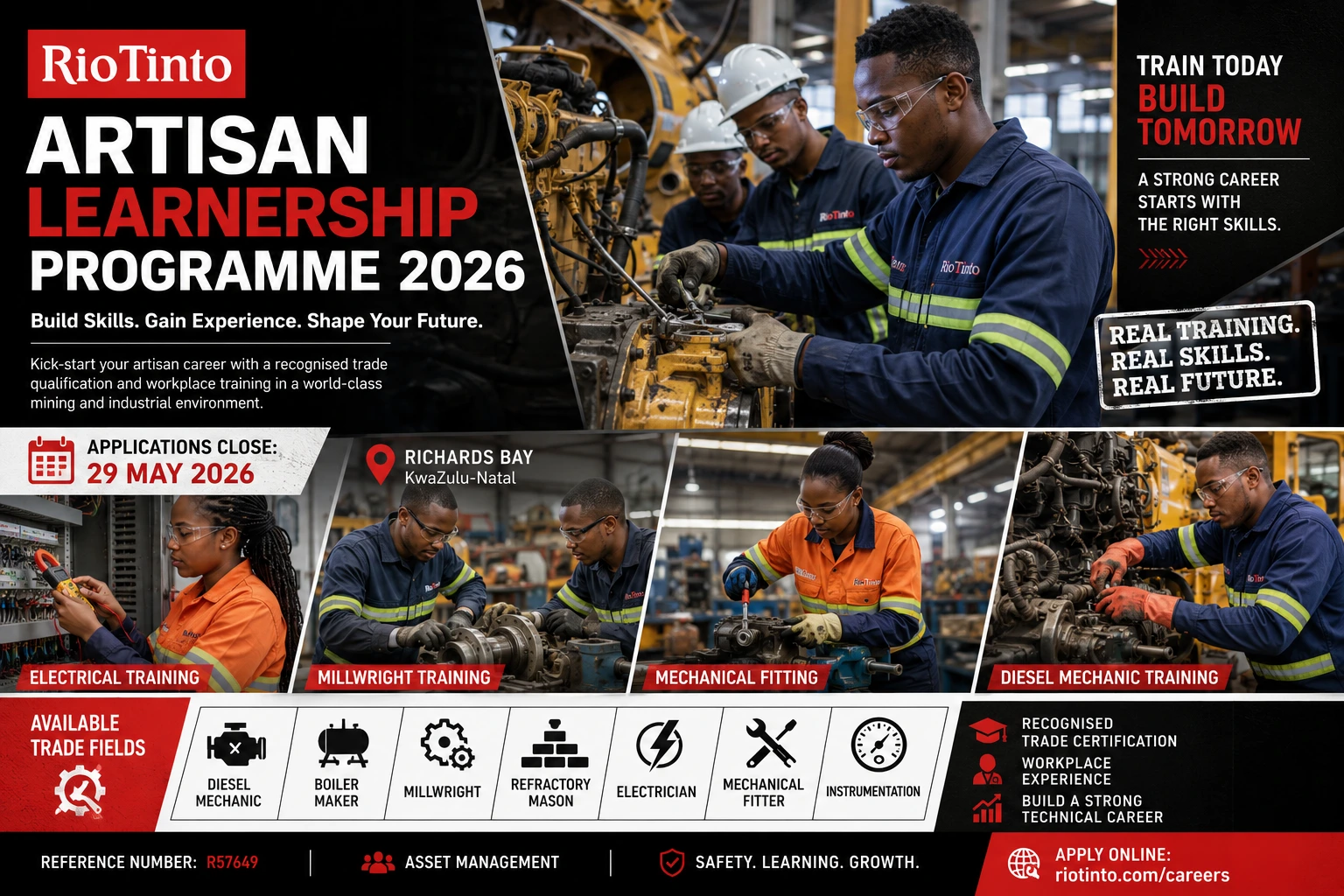
The Rio Tinto Artisan Learnership Programme 2026 offers unemployed South African youth practical trade training in engineering and maintenance fields. Discover requirements, available trades, application insights, and career benefits.
South Africa’s demand for skilled artisans continues to rise as industries struggle to replace experienced technical workers reaching retirement age. At the same time, thousands of young people remain unemployed despite completing school or technical qualifications. The growing gap between youth unemployment and the shortage of qualified artisans has made learnership programmes increasingly important across sectors such as mining, engineering, manufacturing, and industrial maintenance.
The Rio Tinto Artisan Learnership Programme 2026 arrives at a critical moment for technically minded youth who want more than temporary employment. Unlike many short-term opportunities, artisan learnerships provide structured pathways into recognised trades that remain valuable across multiple industries.
For young South Africans interested in practical careers involving machinery, maintenance systems, industrial operations, and engineering support, this opportunity in Richards Bay could represent a long-term career investment rather than simply workplace exposure.
The programme combines formal occupational training, practical workplace learning, and industry-focused development under one of the world’s largest mining and metals companies. In an economy where technical skills remain essential for industrial growth, recognised trade certification can significantly improve employability and income potential over time.
ALSO APPLY FOR Sanlam Learnership 2026 Opens Nationwide Applications for Unemployed Youth
Quick Facts: Rio Tinto Artisan Learnership Programme 2026
| Item | Details |
|---|---|
| Company Name | Rio Tinto |
| Programme | Artisan Learnership Programme 2026 |
| Closing Date | 29 May 2026 |
| Location | Richards Bay |
| Duration | Not stated in the official advert |
| Reference Number | R57649 |
| Monthly Stipend | Not stated in the official advert |
| Required Gender | Not stated in the official advert |
| Category | Asset Management |
Why Artisan Careers Remain Important in South Africa-Rio Tinto Artisan Learnership Programme 2026
One of the biggest misconceptions among young job seekers is that artisan careers offer limited growth. In reality, technical trades remain among the most economically valuable occupations in sectors dependent on machinery, industrial production, energy systems, infrastructure maintenance, and mining operations.
South Africa’s industrial economy still relies heavily on artisans to keep operations functioning safely and efficiently. Industries cannot operate without electricians, fitters, millwrights, mechanics, and instrumentation specialists capable of diagnosing technical problems and maintaining critical systems.
This demand becomes even more important in mining and heavy industrial environments where downtime can result in major operational losses.
The Rio Tinto Artisan Learnership Programme 2026 therefore reflects a broader industry need for technically trained workers who understand:
- Equipment maintenance
- Industrial safety systems
- Electrical systems
- Mechanical repair
- Engineering support operations
- Plant reliability processes
Unlike many office-based careers where automation may reduce entry-level opportunities, artisan trades continue requiring hands-on technical expertise.
Understanding the Structure of the Rio Tinto Artisan Learnership Programme 2026
The Rio Tinto Artisan Learnership Programme 2026 is designed to combine classroom-based technical learning with practical workplace exposure. This blended approach is one of the key reasons artisan programmes remain effective pathways into long-term employment.
The programme leads toward a recognised occupational trade qualification registered on the National Qualifications Framework (NQF). Successful learners may eventually obtain a Trade Certificate issued by the Quality Council for Trades and Occupations (QCTO).
This matters because recognised trade certification creates mobility across industries. Qualified artisans are often able to work in: Rio Tinto Artisan Learnership Programme 2026
- Mining operations
- Manufacturing plants
- Construction environments
- Energy facilities
- Industrial maintenance divisions
- Engineering support companies
The inclusion of practical learning also allows learners to apply technical concepts within real industrial settings rather than relying purely on theory.
This workplace exposure becomes particularly valuable because many employers prefer candidates who already understand industrial procedures, safety systems, and operational environments.
The Available Trades Reflect High-Demand Technical Skills
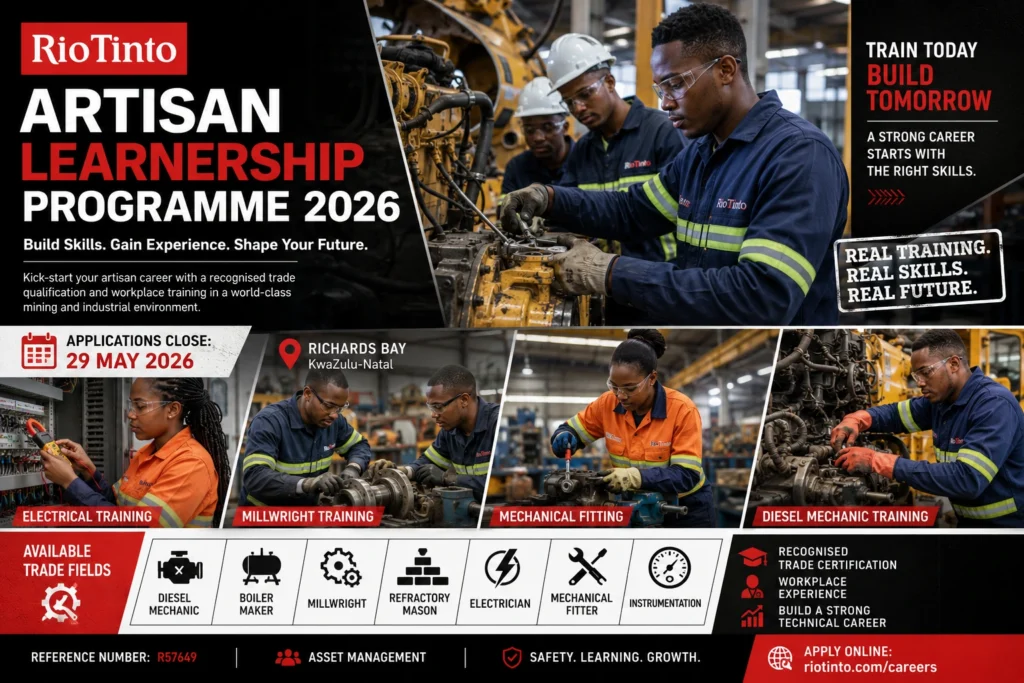
Rio Tinto is offering learnership opportunities in several important artisan trades: Rio Tinto Artisan Learnership Programme 2026
- Diesel Mechanic
- Boiler Maker
- Millwright
- Refractory Mason
- Electrician
- Mechanical Fitter
- Instrumentation
These trades remain essential across South Africa’s industrial economy.
Electricians and Instrumentation Specialists-Rio Tinto Artisan Learnership Programme 2026
As industrial operations become more automated, electricians and instrumentation technicians continue growing in importance. Modern plants rely on electrical systems, digital monitoring, sensors, and control technologies that require specialised maintenance.
Millwrights and Mechanical Fitters-Rio Tinto Artisan Learnership Programme 2026
Millwrights and fitters remain central to industrial reliability because they work across mechanical and electrical systems. Their versatility makes them highly employable in mining and manufacturing sectors.
Diesel Mechanics-Rio Tinto Artisan Learnership Programme 2026
Heavy machinery remains critical in mining and logistics environments. Skilled diesel mechanics are needed to maintain large industrial vehicles and operational equipment.
Boiler Makers and Refractory Masons-Rio Tinto Artisan Learnership Programme 2026
These trades support structural integrity, high-temperature systems, and industrial production facilities. While often overlooked, they remain highly specialised and valuable technical fields.
The diversity of trade options means applicants can align the programme with their specific interests and technical strengths.
Why the Richards Bay Location Matters-Rio Tinto Artisan Learnership Programme 2026
The learnership is based in Richards Bay, KwaZulu-Natal, which remains one of South Africa’s major industrial and export hubs.
Richards Bay hosts large-scale mining, logistics, and heavy industrial operations linked to ports, mineral processing, and manufacturing activities. This industrial environment creates strong demand for artisan skills and technical maintenance personnel.
For learners, training within such an environment offers exposure to:
- Large-scale operational systems
- Industrial safety standards
- Heavy engineering infrastructure
- Professional maintenance procedures
- Production reliability systems
This type of exposure can significantly improve workplace readiness compared to purely classroom-based training.
The programme’s domicile requirement within the King Cetshwayo District Municipality also reflects growing efforts by companies to support local youth development and regional employment opportunities.
Entry Requirements Show the Programme Targets Serious Technical Candidates
The programme requirements suggest Rio Tinto is looking for applicants with genuine technical potential and commitment.
Applicants must have:
- South African citizenship
- Unemployed youth status
- Grade 12 with Core Mathematics and Physical Science or Technical Matric
- Trade-related qualification
- Valid South African driver’s licence (minimum Code B)
- Residence within King Cetshwayo District Municipality
These requirements are important because artisan careers involve both technical understanding and workplace responsibility.
The Mathematics and Physical Science requirements indicate the programme expects applicants to handle engineering-related concepts and technical problem-solving.
Meanwhile, the driver’s licence requirement reflects the operational nature of industrial environments where mobility and site access may be necessary.
The restriction against candidates already registered in another SETA-funded programme also ensures opportunities are directed toward unemployed youth still seeking entry into the labour market.
Why Practical Workplace Exposure Matters More Than Ever
Many graduates and technical learners struggle after completing qualifications because they lack real workplace experience. Employers increasingly prioritise candidates who understand operational environments rather than those with theoretical knowledge alone.
This is one reason artisan learnerships continue holding strong value.
Within industrial environments, learners gain exposure to:
- Workshop procedures
- Equipment diagnostics
- Maintenance planning
- Safety compliance
- Team coordination
- Fault identification systems
These experiences help learners build confidence while also improving employability.
Practical exposure also teaches discipline, communication, and problem-solving under operational pressure — qualities highly valued by employers.
In technical careers, workplace habits often become just as important as technical knowledge itself.
Competition for Artisan Learnerships Is Intensifying
Technical learnership opportunities from major companies like Rio Tinto attract substantial interest because recognised trade qualifications can lead to stable careers and long-term earning potential.
Applicants should therefore understand that competition is likely to be strong.
Candidates who often stand out during selection processes usually demonstrate:
- Clear interest in a specific trade
- Workshop or practical exposure
- Good communication skills
- Technical school achievements
- Safety awareness
- Motivation to build a long-term artisan career
Rio Tinto’s selection process will include interviews and assessments, meaning preparation matters beyond document submission.
Applicants should be ready to explain:
- Why they chose a specific trade
- What technical interests they have
- Any practical experience they possess
- Their long-term career goals
Strong preparation can significantly improve competitiveness during screening and interviews.
What This Means Going Forward-Rio Tinto Artisan Learnership Programme 2026
The long-term outlook for skilled artisans in South Africa remains relatively positive despite broader unemployment challenges.
As infrastructure, mining, energy, logistics, and manufacturing sectors continue requiring technical maintenance support, artisan skills are likely to remain economically important for many years.
At the same time, experienced artisans retiring from the workforce are creating additional pressure for industries to train younger technical workers.
Programmes like the Rio Tinto Artisan Learnership Programme 2026 therefore represent more than short-term training opportunities. They form part of a larger industrial skills pipeline needed to support South Africa’s operational economy.
Future trends also suggest artisan careers may increasingly combine traditional technical work with digital systems knowledge, automation technologies, and advanced maintenance tools.
Young people entering technical trades now could therefore benefit from evolving industrial demand over time.
For unemployed youth seeking alternatives to oversaturated office-based job markets, artisan training may offer one of the more practical routes toward sustainable employment.
How can candidates submit their applications?
Applications for the Rio Tinto Artisan Learnership Programme 2026 must be submitted through the official online application portal.
Applicants should complete the online form carefully. They should also upload all required supporting documents before submitting.
FAQs About the Rio Tinto Artisan Learnership Programme 2026
Who can apply for the Rio Tinto Artisan Learnership Programme 2026?
South African unemployed youth with Grade 12, relevant trade-related qualifications, a valid driver’s licence, and residence within the King Cetshwayo District Municipality may apply.
Which artisan trades are available in the programme?
The programme includes Diesel Mechanic, Boiler Maker, Millwright, Refractory Mason, Electrician, Mechanical Fitter, and Instrumentation trades.
Conclusion-Rio Tinto Artisan Learnership Programme
The Rio Tinto Artisan Learnership Programme 2026 provides unemployed South African youth with access to structured occupational training, workplace learning, and recognised technical development within a major industrial environment.
At a time when artisan skills remain highly valuable across mining, engineering, and industrial sectors, opportunities like this can help young people build practical careers with long-term growth potential.
For applicants who meet the requirements and are genuinely committed to technical trades, the programme offers more than temporary training. It provides a pathway toward recognised occupational certification, industry experience, and future employability in an increasingly skills-driven economy.