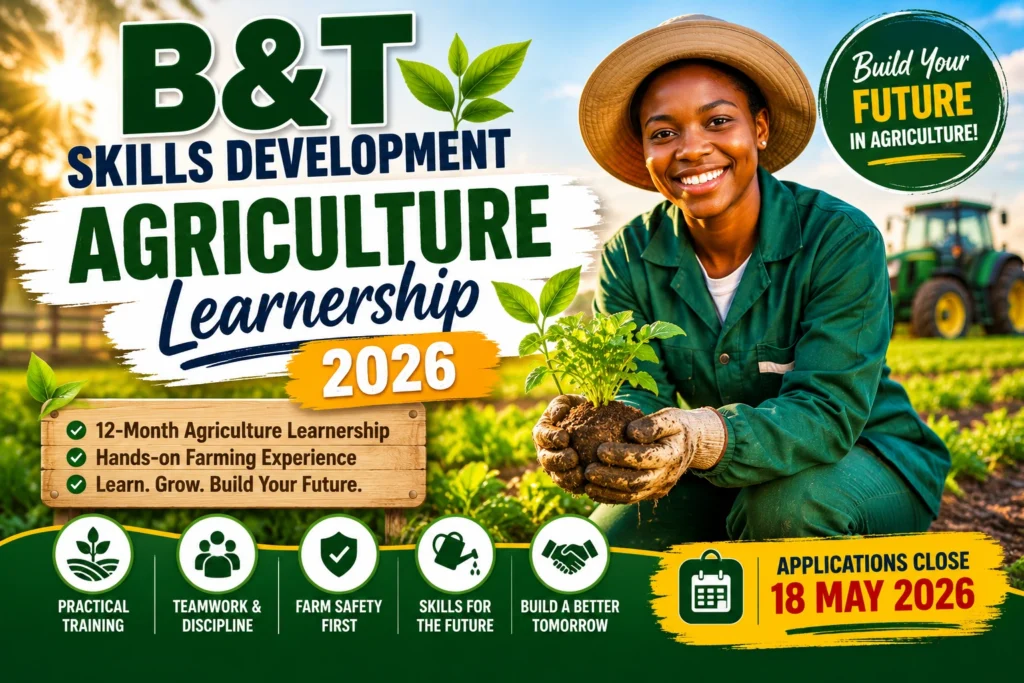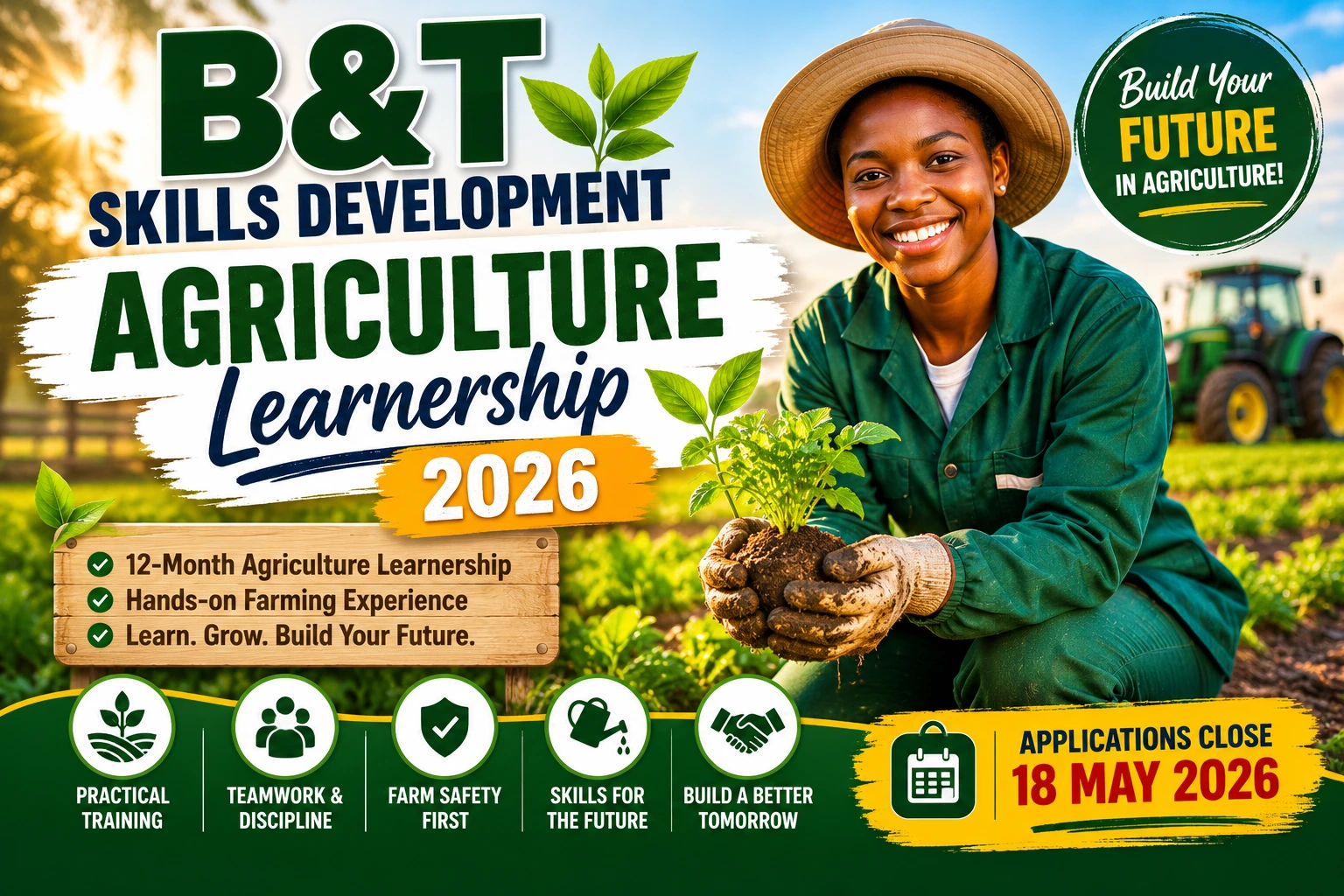
Apply for the B&T Skills Development Agriculture Learnership 2026. Learn about requirements, application details, duration, and farming career opportunities in South Africa.
Just after sunrise on many South African farms, work begins long before most cities fully wake up. Workers move through fields checking irrigation lines, preparing soil, feeding livestock or monitoring crops before the heat of the day settles in. It is demanding work, but for many communities, agriculture remains one of the country’s most important sources of employment, food production and economic survival.
Yet despite agriculture’s importance, thousands of young South Africans still struggle to access practical training opportunities that could help them enter the industry. Many are willing to work and eager to learn but lack structured workplace exposure or industry experience.
The B&T Skills Development Agriculture Learnership 2026 aims to address part of that challenge by offering unemployed South Africans an opportunity to gain practical farming-related experience while building workplace skills linked to the agricultural sector.
The programme, offered by B&T Skills Development Trainings, combines learning with hands-on exposure over a 12-month period. At a time when youth unemployment remains high and practical career pathways are increasingly valuable, agriculture learnerships continue attracting attention from young people searching for more stable futures.
Applications close on 18 May 2026, making early preparation especially important for interested candidates.
Quick Facts About the B&T Skills Development Agriculture Learnership 2026
| Details | Information |
|---|---|
| Closing Date | 18 May 2026 |
| Location | South Africa |
| Duration | 12 months |
Why the B&T Skills Development Agriculture Learnership Matters
Agriculture is often overlooked when young people discuss career options, especially compared to sectors like technology, finance or corporate business. Yet agriculture remains deeply connected to South Africa’s economy and daily life.
Food production, farming logistics, crop management and agricultural processing all depend on people with practical skills and workplace experience.
The B&T Skills Development Agriculture Learnership 2026 matters because it introduces learners to the realities of agricultural work while helping them develop employability skills that extend beyond farming itself.
For many unemployed youth, practical workplace programmes can become the first step toward structured employment environments. They provide exposure to discipline, teamwork, communication and professional expectations that employers value across industries.
In agriculture specifically, practical experience is often just as important as formal qualifications.
Agriculture Still Plays a Major Role in South Africa
Across South Africa, agriculture supports both rural and urban economies in different ways.
Commercial farms contribute to national food supply chains, while smaller farming operations help sustain local communities and household livelihoods. The sector also creates opportunities in packaging, logistics, irrigation support, crop production and agricultural services.
In provinces such as Limpopo, Mpumalanga, KwaZulu-Natal, Free State and Western Cape, agriculture remains tied closely to employment and regional economic activity.
At the same time, climate pressures, food security concerns and changing economic conditions are increasing the need for workers who understand practical farming systems.
That broader context helps explain why agriculture training programmes continue to matter today.
What Learners May Experience During the Programme
The B&T Skills Development Agriculture Learnership is designed to combine practical exposure with structured learning.
Participants may gain experience in areas such as:
- Farming practices
- Crop and plant care
- Soil preparation
- Irrigation basics
- Farm safety
- Workplace communication
- Teamwork and discipline
Although some tasks may appear basic initially, these responsibilities form the foundation of agricultural operations.
Learning how to manage routine procedures correctly, work safely and communicate effectively within farm environments becomes important for long-term growth in the sector.
For first-time learners, adapting to physically active outdoor work can also build resilience and workplace confidence.
A Different Kind of Workplace Environment
Agriculture differs from many office-based career environments because the work is often practical, physical and directly connected to environmental conditions.
Weather changes, seasonal schedules and outdoor responsibilities can all affect daily operations.
This means learners entering agriculture programmes should be prepared for hands-on tasks rather than purely classroom-based activities.
At the same time, some young people prefer this type of environment because it allows them to work actively, develop practical skills and contribute directly to visible outcomes.
For candidates who enjoy structured physical work, teamwork and outdoor settings, agricultural training may provide a more suitable pathway than traditional desk-based employment.
Who Can Apply for the Learnership?
The programme is aimed at unemployed South Africans interested in agriculture and farming-related work.
Applicants must have:
- A Matric certificate
- South African ID
- Updated CV
- SARS letter
- Disability letter, if applicable
Beyond formal requirements, applicants should also demonstrate a willingness to learn and participate actively in practical workplace activities.
Because agriculture often involves teamwork and routine responsibilities, reliability and discipline remain important qualities within training environments.
Why Soft Skills Matter in Farming Environments
Many people assume agriculture is only about planting crops or working on farms physically. In reality, modern agricultural environments also depend heavily on communication, coordination and workplace discipline.
Workers often need to:
- Follow instructions carefully
- Work within teams
- Manage time effectively
- Communicate with supervisors
- Maintain safety standards
The learnership therefore focuses not only on farming exposure but also on workplace readiness.
For unemployed youth with little formal work experience, learning how to operate professionally within structured environments can become just as valuable as technical agricultural knowledge.
Expert Insight: Agriculture Careers Are Quietly Evolving
South Africa’s agricultural sector is changing more rapidly than many people realise.
Modern farming increasingly combines traditional agricultural work with technology, irrigation systems, environmental monitoring and supply chain coordination. Even entry-level workers today are often exposed to systems and operational processes that were uncommon in previous generations.
At the same time, food security concerns and climate-related challenges are making agricultural sustainability more important globally.
This means agriculture careers are no longer limited to traditional farm labour alone. Skills gained through workplace exposure can later support movement into irrigation support, crop management, logistics coordination or agricultural assistance roles.
For young people willing to learn practically, the sector may offer more long-term possibilities than it first appears.
The Importance of a Proper CV
One challenge many first-time applicants face is preparing a professional CV despite limited work experience.
For learnerships like this, employers often understand that applicants may not yet have extensive employment histories. What matters more is showing reliability, willingness to learn and practical strengths.
Applicants are encouraged to include:
- Contact details
- Educational background
- Skills and strengths
- Teamwork experience
- Community activities or practical responsibilities
- References, if available
Even informal experiences such as helping with gardening, community projects or practical household responsibilities may help demonstrate readiness for structured work environments.
Why Learnerships Continue to Matter in South Africa
South Africa’s unemployment crisis continues affecting millions of young people, especially those without previous work exposure.
In many cases, candidates struggle not because they lack potential, but because they have not yet been given opportunities to gain practical experience.
Learnerships help bridge that gap.
Programmes like the B&T Skills Development Agriculture Learnership 2026 create structured environments where learners can build confidence, develop routines and gain exposure to professional expectations.
For some participants, this may become their first experience working within an organised training system.
And while not every learnership leads directly to permanent employment, practical exposure often strengthens future job applications significantly.
How Applicants Should Submit Their Applications
Candidates must send their applications via email to:
Applicants should attach all required documents and clearly mention the agriculture learnership in the email subject line.
Before sending, candidates should confirm that:
- All attachments are included
- Documents are clear and readable
- Contact details are correct
- The CV is updated
Submitting early may also help avoid last-minute technical problems before the deadline.
Contact Details for Enquiries
For additional enquiries, applicants may contact:
- Telephone: 012 004 1175
- Cellphone: 078 513 4511
These contact details should only be used for questions related to the learnership programme.
SEE ALSO: Richards Bay Minerals 2026 Work Integrated Learning Programme Opens for Students
Frequently Asked Questions
When does the B&T Skills Development Agriculture Learnership close?
Applications close on 18 May 2026.
How long is the programme?
When does the B&T Skills Development Agriculture Learnership close?
Applications close on 18 May 2026.
What documents are required?
Applicants need a certified ID copy, updated CV, Matric certificate, SARS letter and disability letter if applicable.
Where to Apply
Applicants must email their documents to:
Candidates should ensure all required attachments are included before submission.
SEE ALSO: SkyNet Freight Handler NQF Level 3 Learnership 2026 Opens Logistics Career Opportunities
A Bigger Reflection on Agriculture and Opportunity
Agriculture rarely receives the same attention as high-profile industries, yet it remains one of the sectors most closely tied to everyday life in South Africa. Food production, farming support and agricultural labour continue shaping communities, economies and livelihoods across the country.
At the same time, young people searching for employment opportunities increasingly need pathways that offer practical exposure rather than promises alone.
The B&T Skills Development Agriculture Learnership 2026 reflects how workplace training programmes can help bridge unemployment gaps while introducing learners to industries that remain essential to the country’s future.
For some applicants, the B&T Skills Development Agriculture Learnership 2026 may simply become a year of practical learning. For others, it could become the beginning of a long-term career connected to farming, agriculture and food production.
And in a labour market where experience often matters as much as qualifications, those first opportunities continue carrying real significance.