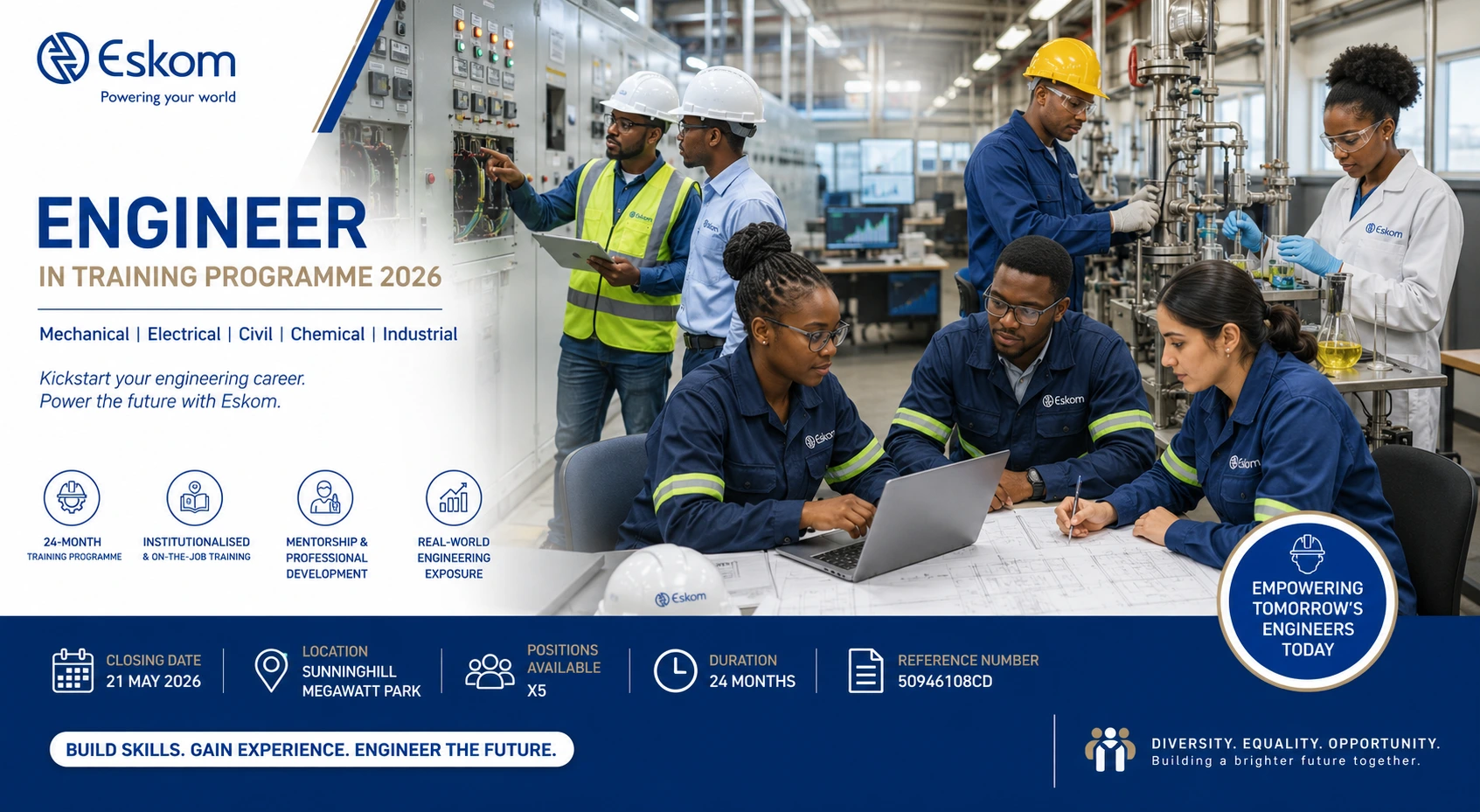
Eskom Engineer in Training Programme 2026 applications are open for Mechanical, Electrical, Civil, Chemical and Industrial Engineering graduates. Explore requirements, closing date, training structure and career insights.
The demand for engineering graduates in South Africa continues to grow as infrastructure, energy reliability, industrial development and public sector modernization remain national priorities. Against this backdrop, the newly announced Eskom Engineer in Training Programme 2026 presents a significant opportunity for young professionals seeking structured technical development inside one of the country’s largest engineering environments.
The programme arrives at an important moment for South Africa’s energy and infrastructure sectors. Utilities, municipalities and industrial operators increasingly require technically skilled professionals capable of solving complex operational, maintenance and design challenges. Graduate training programmes are therefore becoming more valuable because they bridge the gap between university theory and practical engineering application.
Eskom’s latest intake targets graduates in Mechanical, Electrical, Civil, Chemical and Industrial Engineering disciplines. The initiative offers a 24-month training programme designed to expose participants to both institutionalised learning and real workplace experience at Megawatt Park in Sunninghill.
For many graduates, the challenge after completing an engineering qualification is not academic capability but securing meaningful industry exposure. This programme directly addresses that issue by placing candidates inside a highly technical environment where engineering systems, project management and operational processes intersect daily.
ALSO APPLY FOR SynergERP Sage ERP Consultant Internship 2026 Gives Graduates a Direct Route Into South Africa’s Growing ERP Consulting Industry
Quick Facts: Eskom Engineer in Training Programme 2026
| Item | Details |
|---|---|
| Company | Eskom |
| Programme | Engineer in Training X5 |
| Location | Sunninghill / Megawatt Park |
| Closing Date | 21 May 2026 |
| Duration | 24 months |
| Positions Available | 5 |
| Reference Number | 50946108CD |
| Listing Reference | eskom_004768 |
| Stipend | Not stated in the official advert |
| Required Gender | Not stated in the official advert |
Why the Eskom Engineer in Training Programme Matters in 2026 || Eskom Engineer in Training Programme 2026
South Africa’s engineering sector faces a complicated reality. On one hand, there is strong demand for engineers in energy, infrastructure and manufacturing. On the other, many graduates struggle to gain practical workplace experience immediately after graduation.
Programmes like this one from Eskom play an important role in developing technical talent pipelines. Large state-owned utilities remain among the few employers capable of offering graduates exposure to multidisciplinary engineering systems at scale.
The energy sector itself is undergoing transformation. Power generation modernization, grid stability projects, renewable energy integration and infrastructure maintenance all require technically trained engineers who understand both theoretical engineering principles and operational realities.
Graduate programmes in engineering are no longer viewed merely as internship opportunities. Increasingly, they are becoming strategic talent development pipelines where companies identify future technical specialists, project engineers and operational leaders.
For graduates entering the labour market in 2026, structured programmes with formal mentorship and practical exposure may offer stronger long-term career value than short-term contract work with limited development support.
Understanding the Structure of the Eskom Graduate Engineering Programme || Eskom Engineer in Training Programme 2026
One of the most important details in the advert is the emphasis on both institutionalised and on-the-job training. This combination suggests that the programme is not limited to observation or administrative support tasks.
Instead, Eskom appears to be positioning the programme as a technical development pathway where graduates can build engineering competence through practical exposure.
The programme runs for 24 months, which is longer than many traditional internships. That duration matters because engineering competency develops over time through repeated exposure to technical systems, project cycles and operational environments.
Graduates are expected to engage with areas such as: Eskom Engineer in Training Programme 2026
- Engineering design
- Technical problem solving
- Cost analysis
- Economic evaluation
- Technical reporting
- Communication and presentation
- Engineering standards and design codes
These skills reflect real engineering workplace expectations rather than purely academic performance metrics.
Another important aspect is the inclusion of analytical and problem-solving capabilities. Modern engineering roles increasingly require engineers to combine technical understanding with business awareness, project efficiency and operational sustainability.
The programme’s placement within Eskom Real Estate is also notable. Many graduates may initially associate Eskom only with power generation and transmission. However, the utility also manages large infrastructure portfolios requiring civil, electrical, industrial and mechanical engineering expertise across facilities and operational assets.
The Engineering Disciplines Included and What They Suggest || Eskom Engineer in Training Programme 2026
The inclusion of five engineering disciplines reveals the multidisciplinary nature of Eskom’s operational environment.
Mechanical Engineering-Eskom Engineer in Training Programme 2026
Mechanical engineers remain central to industrial maintenance, energy systems and operational efficiency. Within Eskom environments, mechanical graduates may gain exposure to plant systems, HVAC infrastructure, maintenance planning and mechanical design processes.
The growing emphasis on asset reliability across South African industry makes mechanical engineering experience particularly valuable.
Electrical Engineering-Eskom Engineer in Training Programme 2026
Electrical engineering graduates are likely to remain among the most in-demand technical professionals in the country. Eskom’s operational environment naturally creates exposure to power systems, electrical infrastructure and technical compliance standards.
Even beyond Eskom, graduates with utility-scale electrical exposure often become attractive candidates in mining, manufacturing, renewable energy and infrastructure sectors.
Civil Engineering-Eskom Engineer in Training Programme 2026
Civil engineers play a critical role in infrastructure development and maintenance. In large operational facilities, civil expertise supports structural integrity, site development and infrastructure sustainability.
The inclusion of civil engineering indicates that Eskom continues investing in infrastructure maintenance and facilities management capability.
Chemical Engineering-Eskom Engineer in Training Programme 2026
Chemical engineering graduates may contribute to operational efficiency, process management and environmental compliance systems. Their analytical background also aligns well with optimization and process improvement functions.
As sustainability and efficiency become increasingly important in the energy sector, chemical engineering expertise continues to gain strategic relevance.
Industrial Engineering-Eskom Engineer in Training Programme 2026
Industrial engineering remains one of the most versatile disciplines because it combines systems thinking, operational efficiency and process optimization.
Graduates in this field often become essential contributors to workflow improvement, productivity analysis and business process engineering.
The diversity of disciplines included in the programme demonstrates Eskom’s broader operational requirements beyond electricity generation alone.
Skills Eskom Appears to Prioritize in Graduate Engineers
A closer examination of the advert reveals that Eskom is not only recruiting for technical knowledge. The listed competencies suggest the company is seeking adaptable professionals capable of operating in complex environments.
Among the most notable requirements are: Eskom Engineer in Training Programme 2026
- Entrepreneurial mindset
- Strong drive to learn
- Integrity
- Professionalism
- Safety consciousness
- Results orientation
This reflects a broader shift occurring across engineering industries globally. Employers increasingly value graduates who can combine technical expertise with communication, collaboration and decision-making skills.
The emphasis on safety consciousness is especially important in utility and infrastructure environments where operational risks must be carefully managed.
Technical report writing and presentation skills are also highlighted. Many engineering graduates underestimate the importance of communication inside technical industries. However, engineers routinely prepare reports, present findings and communicate technical recommendations to operational and management teams.
Graduates who can communicate technical concepts clearly often progress faster into leadership and project coordination roles.
What Makes Engineering Training Programmes Competitive in South Africa
Engineering graduate opportunities attract large numbers of applicants because structured technical programmes remain limited relative to graduate demand.
Several factors make programmes like Eskom’s especially competitive:
Industry Reputation
Eskom remains one of South Africa’s most recognized technical employers. Experience gained within Eskom environments can strengthen future employability across the broader engineering sector.
Practical Exposure
Many graduates struggle to gain access to real operational systems immediately after university. Structured programmes offer exposure that is difficult to replicate independently.
Long-Term Career Value
Even when programmes are temporary, the technical competency developed often creates long-term career advantages.
Mentorship and Learning
Formal training environments generally provide stronger technical guidance than entry-level jobs with minimal support structures.
Professional Development
Programmes with technical reporting, design and engineering standards exposure can support future professional registration pathways.
For graduates applying to programmes like this, competition is likely to extend beyond academic performance alone. Employers increasingly assess adaptability, communication capability and professional behaviour alongside technical qualifications.
The Qualification Requirements and What Applicants Should Know
The minimum qualification requirement is:
- BSc/BEng in Engineering at NQF Level 8 with 480 credits
Importantly, Eskom specifies that no work experience is required. This makes the programme accessible to recent graduates entering the labour market for the first time.
However, applicants should understand that “no experience required” does not necessarily mean low competition. Graduate programmes at major employers often receive substantial application volumes.
Candidates may therefore benefit from demonstrating:
- Strong academic consistency
- Clear communication skills
- Technical interest
- Problem-solving capability
- Professional presentation
- Understanding of engineering fundamentals
Graduates should also pay close attention to application quality. In competitive programmes, incomplete applications, poorly prepared CVs or generic motivational statements can significantly reduce selection chances.
What This Means Going Forward
The Eskom Engineer in Training Programme reflects broader trends shaping South Africa’s engineering labour market in 2026.
Firstly, employers continue prioritizing practical technical development rather than purely academic qualifications. Graduates increasingly need workplace exposure to remain competitive in engineering industries.
Secondly, multidisciplinary engineering capability is becoming more valuable. The inclusion of Mechanical, Electrical, Civil, Chemical and Industrial Engineering disciplines indicates growing operational integration across infrastructure sectors.
Thirdly, utilities and infrastructure organizations remain important entry points for graduate engineers despite ongoing transformation in the energy sector.
The future engineering workforce will likely require a blend of technical expertise, digital adaptability, operational awareness and sustainability understanding.
Programmes like this may therefore become increasingly important stepping stones for graduates seeking long-term engineering careers in South Africa.
For the broader economy, graduate engineering development also matters because infrastructure reliability, industrial growth and energy stability depend heavily on technically skilled professionals entering the workforce.
How to Apply For Eskom Engineer in Training Programme 2026
Click here to apply for Eskom Engineer in Training Programme 2026:
Frequently Asked Questions About Eskom Engineer in Training Programme 2026
Who can apply for the Eskom Engineer in Training Programme 2026?
Applicants must have a BSc or BEng Engineering qualification at NQF Level 8 with 480 credits in Mechanical, Electrical, Civil, Chemical or Industrial Engineering.
Does the Eskom Engineer in Training Programme require work experience?
No. The official advert states that no work experience is required for applicants.
Conclusion-Eskom Engineer in Training Programme 2026
The Eskom Engineer in Training Programme 2026 represents more than a standard graduate internship opportunity. It reflects the ongoing importance of structured technical development within South Africa’s engineering sector.
For graduates in Mechanical, Electrical, Civil, Chemical and Industrial Engineering, the programme offers exposure to practical engineering environments, operational systems and professional development processes that can shape long-term career growth.
As the country continues addressing infrastructure, energy and industrial challenges, programmes focused on developing technical talent are likely to remain highly valuable. Graduates who combine strong engineering foundations with adaptability, professionalism and analytical capability may find themselves well positioned for future opportunities across the broader engineering landscape.