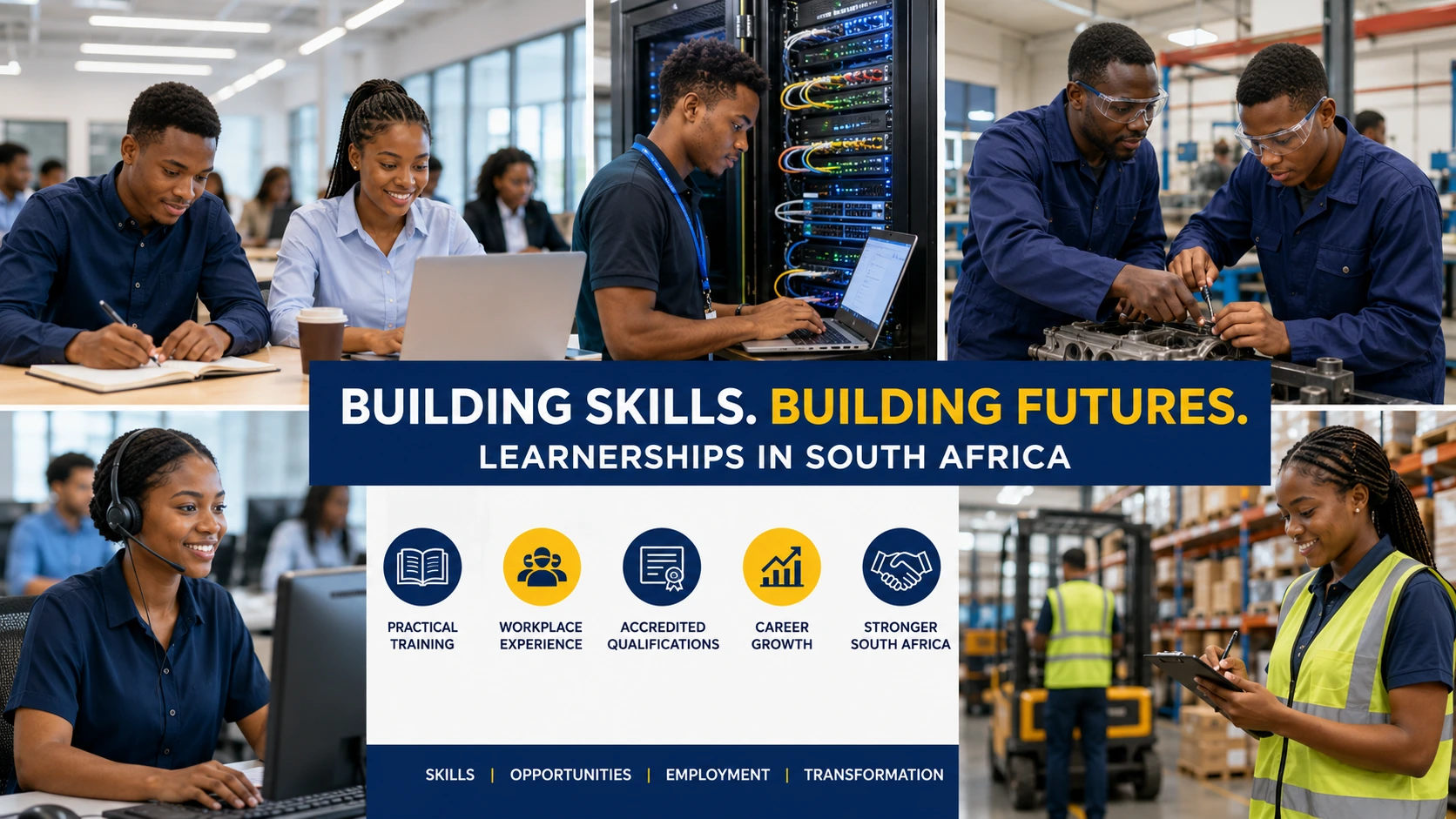
Learn everything about learnerships in South Africa in 2026, including requirements, stipends, applications, SETAs, benefits, and how learnerships can help unemployed youth build careers.
Complete Guide to Learnerships in South Africa
South Africa’s employment market continues to evolve rapidly as industries search for workers with practical skills, workplace readiness and specialised training. At the same time, millions of young people continue struggling to secure meaningful employment because they lack experience, qualifications or industry exposure.
This gap between education and employability is one of the main reasons learnerships have become increasingly important across South Africa.
A learnership is more than just a training programme. It is a structured pathway that combines theoretical learning with practical workplace experience. For many unemployed youth, learnerships provide one of the few accessible routes into industries such as banking, logistics, information technology, mining, retail, manufacturing, finance and public administration.
In 2026, learnership opportunities continue expanding as companies, government departments and Sector Education and Training Authorities (SETAs) invest more heavily in workforce development. Employers are increasingly using learnerships to identify future talent while helping address the country’s skills shortages.
For job seekers, understanding how learnerships work can significantly improve the chances of finding opportunities and building long-term careers.
This guide explains everything South Africans need to know about learnerships, including how they work, who qualifies, how stipends operate, common application mistakes and why learnerships are becoming more valuable in the modern economy.
ALSO APPLY FOR Anglo American Cybersecurity Learnership 2026 Opens New Path Into South Africa’s Fast-Growing Digital Security Industry
ALSO APPLY FOR Road Accident Fund Intern: Medical Management 2026 Opens a Rare Door for Young South African Graduates
What Is a Learnership?
Complete Guide to Learnerships
A learnership is a structured work-based learning programme registered with a SETA.
It combines classroom-style training with practical workplace experience to help learners gain recognised qualifications and industry exposure simultaneously.
Unlike short courses that focus only on theory, learnerships are designed to prepare participants for real working environments.
Most learnerships involve three parties: Complete Guide to Learnerships
- The learner
- The employer
- A training provider
The training provider delivers the academic or theoretical component, while the employer provides workplace experience and supervision.
At the end of the programme, successful learners usually receive a nationally recognised qualification registered on the National Qualifications Framework (NQF).
Learnerships are common in sectors such as: Complete Guide to Learnerships
- Banking
- Insurance
- Information technology
- Mining
- Engineering
- Retail
- Transport and logistics
- Healthcare
- Business administration
- Hospitality
Because they combine learning and practical exposure, learnerships are often viewed as one of the strongest entry points into formal employment.
Why Learnerships Have Become So Important in South Africa
South Africa’s youth unemployment crisis remains one of the country’s largest economic challenges.
Many young people complete school or tertiary studies without gaining practical workplace exposure. Employers, meanwhile, often prefer candidates with experience.
Learnerships help bridge this gap by allowing learners to gain workplace experience while studying toward qualifications.
This model benefits both employers and learners.
Benefits for Learners-Complete Guide to Learnerships
Learnerships help participants: Complete Guide to Learnerships
- Gain work experience
- Develop practical skills
- Build professional networks
- Improve employability
- Earn accredited qualifications
- Receive workplace mentorship
For unemployed youth, learnerships can also improve confidence and workplace readiness.
Benefits for Employers-Complete Guide to Learnerships
Employers benefit because learnerships help them: Complete Guide to Learnerships
- Develop future talent pipelines
- Address industry skills shortages
- Train workers according to company needs
- Support transformation objectives
- Access certain training incentives and grants
As industries become more digital and skills-focused, companies increasingly use learnerships to prepare future employees internally.
How Learnerships Work-Complete Guide to Learnerships
Although each programme differs slightly, most learnerships follow a similar structure.
1. Recruitment and Application
Companies advertise learnership opportunities through: Complete Guide to Learnerships
- Corporate career portals
- SETA websites
- Government platforms
- Recruitment portals
- Educational institutions
Applicants usually submit: Complete Guide to Learnerships
- CVs
- Certified ID copies
- Qualifications
- Proof of residence
- Academic transcripts
Some programmes may also require psychometric testing, interviews or assessments.
2. Training Component
Learners complete structured coursework through accredited training providers.
This may include:
- Classroom sessions
- Online learning
- Assessments
- Assignments
- Practical simulations
The qualification level depends on the programme.
3. Workplace Experience
Learners also gain hands-on exposure within a working environment.
This often involves:
- Administrative tasks
- Customer support
- Technical support
- Operations exposure
- Workplace projects
- Team collaboration
This practical exposure is one of the most valuable aspects of a learnership.
4. Qualification Completion
Successful learners receive accredited qualifications or certificates linked to NQF standards.
These qualifications can improve future employment prospects and support further studies.
What Are SETAs and Why Do They Matter?
SETAs — Sector Education and Training Authorities — play a central role in South Africa’s learnership system.
Sector Education and Training Authorities were established to help develop industry-specific skills and workforce training.
Each SETA focuses on a particular sector.
Examples include:
- BANKSETA — banking and microfinance
- MICT SETA — media, information and communication technologies
- Services SETA — services industries
- merSETA — manufacturing and engineering
- TETA — transport and logistics
SETAs help:
- Register learnerships
- Approve qualifications
- Monitor training quality
- Distribute grants
- Support skills development initiatives
Understanding which SETA aligns with your industry interests can help job seekers identify more opportunities.
Who Can Apply for Learnerships?
Requirements differ depending on the programme and industry.
However, many South African learnerships target:
- Unemployed youth
- School leavers
- TVET graduates
- University graduates
- Persons with disabilities
Common requirements include:
- South African citizenship
- Grade 12 certificate
- Age between 18 and 35
- Good communication skills
- Basic computer literacy
Technical learnerships may require Mathematics and Science.
Graduate learnerships may require diplomas or degrees.
Some programmes prioritise Employment Equity candidates or applicants from disadvantaged backgrounds.
Do Learnerships Pay a Stipend?
Most learnerships provide stipends, although amounts vary significantly.
A stipend is not a salary. It is a training allowance intended to help learners cover costs such as:
- Transport
- Meals
- Data
- Basic living expenses
Stipend amounts depend on:
- Industry
- Employer
- Qualification level
- SETA funding structures
Some stipends may be modest, while technical or specialised programmes may offer higher amounts.
Importantly, not all adverts disclose stipend information publicly.
Applicants should therefore carefully read official vacancy notices before applying.
Which Industries Offer the Most Learnership Opportunities?
Several sectors continue offering large numbers of learnerships in South Africa.
Banking and Financial Services
Banks frequently recruit learners for:
- Administration
- Customer service
- Digital banking
- Finance support
- Compliance
Information Technology and Cybersecurity
Technology-focused learnerships are growing rapidly because companies need digital skills.
Popular areas include:
- IT support
- Data analytics
- Cybersecurity
- Cloud systems
- Software support
Logistics and Supply Chain
Transport and logistics companies often recruit learners for:
- Warehousing
- Inventory management
- Fleet operations
- Freight administration
Mining and Engineering
Mining companies continue investing heavily in technical training programmes and artisan development.
Retail and Wholesale
Retail learnerships focus heavily on customer service, operations and store administration.
As digital transformation accelerates, technology-linked learnerships are expected to grow further over the next few years.
Common Mistakes Applicants Make-Complete Guide to Learnerships
Many applicants lose opportunities because of avoidable mistakes.
Poor CV Quality-Complete Guide to Learnerships
A rushed CV with spelling mistakes or missing information creates a poor impression.
Applicants should keep CVs: Complete Guide to Learnerships
- Clear
- Accurate
- Professional
- Easy to read
Applying Without Reading Requirements-Complete Guide to Learnerships
Many candidates apply without checking minimum requirements.
This wastes time and reduces application quality.
Missing Documents-Complete Guide to Learnerships
Incomplete applications are often rejected automatically.
Always prepare: Complete Guide to Learnerships
- Certified ID copy
- Qualifications
- Updated CV
- Supporting certificates
Ignoring Deadlines-Complete Guide to Learnerships
Late applications are usually not considered.
Applicants should monitor closing dates carefully.
Using Generic Motivations-Complete Guide to Learnerships
Strong applications show genuine interest in the industry and programme.
Employers often favour candidates who demonstrate curiosity, motivation and willingness to learn.
What This Means Going Forward-Complete Guide to Learnerships
Learnerships are likely to become even more important as South Africa’s economy becomes increasingly skills-driven and technology-focused.
Several major trends are shaping the future of learnerships: Complete Guide to Learnerships
- Digital transformation across industries
- Increased automation
- Rising demand for technical skills
- Expansion of hybrid work environments
- Greater employer investment in workforce development
This means future learnerships may increasingly focus on: Complete Guide to Learnerships
- Cybersecurity
- Data analytics
- ERP systems
- Cloud computing
- Renewable energy
- Artificial intelligence support roles
Companies are also becoming more focused on practical capability rather than qualifications alone.
As a result, workplace-based learning models like learnerships may continue growing in importance.
For job seekers, this creates opportunities to build practical experience earlier while developing industry-specific skills.
FAQs-Complete Guide to Learnerships
Can a learnership lead to permanent employment?
Yes. While permanent employment is not guaranteed, many companies use learnerships to identify strong future employees.
Are learnerships only for unemployed people?
No. Some learnerships target unemployed youth, while others are designed for employed workers who want additional qualifications or skills development.
Conclusion-Complete Guide to Learnerships
Learnerships remain one of the most important tools for skills development and workforce preparation in South Africa.
By combining theoretical learning with practical workplace exposure, learnerships help bridge the gap between education and employment while giving learners valuable industry experience.
For young South Africans entering the job market, understanding how learnerships work can open pathways into industries that might otherwise seem difficult to access.
As technology, automation and digital transformation continue reshaping the economy, learnerships are likely to play an even larger role in preparing future workers for evolving career opportunities.