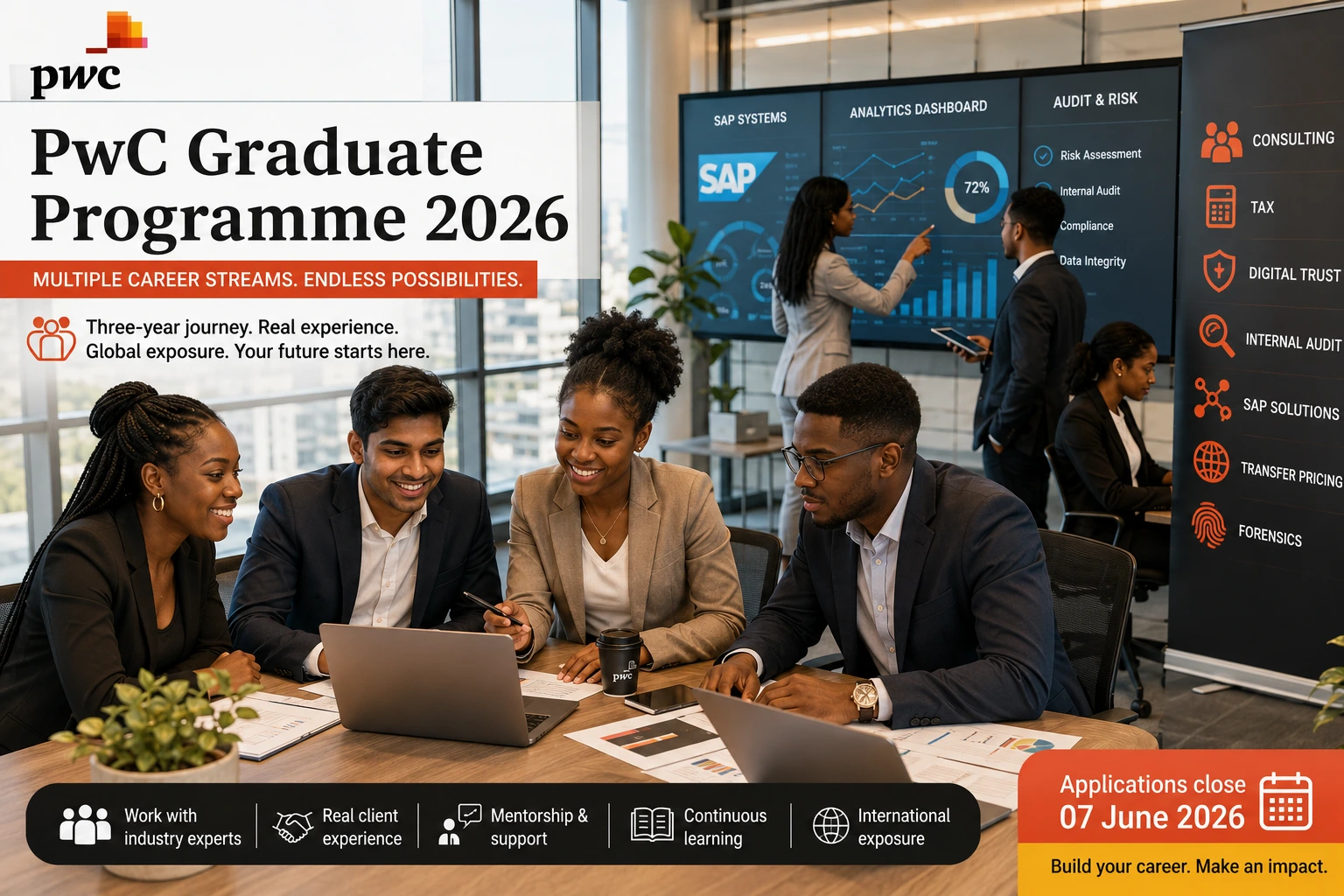
PwC Graduate Programme 2026 offers consulting, tax, SAP, audit and forensics career streams with mentorship and industry exposure.
PwC Graduate Programme 2026: Why This Opportunity Matters More Than a Standard Graduate Job
The PwC Graduate Programme 2026 arrives at an important moment for South African graduates entering a highly competitive job market shaped by automation, digital transformation and rising employer expectations.
For many students, completing a degree is no longer enough to secure long-term career momentum. Employers increasingly want graduates who can combine technical knowledge with adaptability, communication, analytical thinking and commercial awareness. That is one reason structured graduate programmes have become more valuable than traditional entry-level jobs.
The PwC Graduate Programme 2026 stands out because it offers several career streams across consulting, tax, digital trust, SAP, internal audit, transfer pricing and forensics. Instead of placing graduates into isolated junior roles, the programme appears designed to develop professionals through mentorship, business exposure and client-facing experience over a three-year period.
Another factor making this programme significant is timing. South Africa’s graduate unemployment challenge continues to affect thousands of qualified young people annually, especially those struggling to gain recognised workplace experience after university. Programmes linked to major firms can help bridge that transition between academic achievement and professional capability.
For candidates studying accounting, IT, business, law, economics, engineering, risk management or data-related fields, this opportunity represents more than workplace training. It reflects how large professional services firms are reshaping graduate recruitment around digital systems, multidisciplinary skills and global business demands.
ALSO APPLY FOR DFFE EPWP Youth Employment Programme 2026 Gives Graduates Public Sector Workplace Exposure
Understanding the Structure of the PwC Graduate Programme 2026
One of the most important aspects of the PwC Graduate Programme 2026 is its structure.
The programme is not positioned as a short internship or temporary graduate placement. According to the official information, it runs over three years and combines practical work exposure with mentorship, on-site training and stretch assignments.
That distinction matters.
Many graduates enter workplaces where learning depends entirely on self-navigation. Structured graduate programmes work differently. They usually include planned development pathways, performance support and exposure to multiple business functions.
PwC specifically mentions:
- mentorship,
- supportive teams,
- client exposure,
- practical workplace training,
- and international exposure opportunities.
This suggests the programme is intended to develop graduates into long-term professionals capable of handling increasingly complex client and operational responsibilities.
The industries linked to the programme also provide useful context. Exposure to sectors such as:
- banking,
- insurance,
- analytics,
- employee benefits,
- and broader consulting environments
can help graduates understand how different industries operate commercially.
That type of exposure often becomes valuable later because graduates gain insight into real business decision-making rather than purely academic case studies.
Why the Multiple Career Streams Matter
A major strength of the PwC Graduate Programme 2026 is the diversity of available pathways.
Instead of focusing only on traditional accounting or audit careers, the programme reflects how professional services firms are evolving around technology, data, compliance and strategic consulting.
The available streams include:
- SAP: Digital Trust Graduate Programme
- Tax Programme SAIT
- Transfer Pricing Programme SAIT
- Foundation for the Future Consulting Graduate Programme
- Internal Audit GRIA Graduate Programme
- SAP Centre of Excellence Graduate Programme 2027
- Digital Trust IT Audit Graduate Programme
- Forensics Graduate Programme
This range is significant because graduate recruitment is shifting globally toward hybrid skills.
For example:
A graduate with technology and accounting knowledge may fit into SAP or Digital Trust.
Someone with legal and financial interests may find transfer pricing or forensics more suitable.
Candidates with analytical or strategy-focused interests may align better with consulting.
This reflects a broader labour market trend where employers increasingly value cross-functional thinking instead of narrow specialisation alone.
It also means applicants should avoid treating the programme like a single generic opportunity. Stream selection is likely to influence both competitiveness and long-term career direction.
Choosing the wrong stream could weaken application relevance even if academic results are strong.
The Growing Importance of SAP, Digital Trust and Data Skills
One of the clearest themes across the programme streams is digital transformation.
Several pathways focus directly on: PwC Graduate Programme 2026
- SAP systems,
- digital trust,
- IT audit,
- information systems,
- AI,
- data analysis,
- and risk technology.
That is not accidental.
Professional services firms worldwide are adapting to increased automation, cybersecurity concerns, data governance pressures and AI integration across industries.
As a result, graduates entering firms like PwC are increasingly expected to understand both business processes and technology systems.
The SAP-focused opportunities are particularly important because enterprise systems remain central to modern business operations. Companies rely on SAP platforms for:
- finance,
- procurement,
- supply chain,
- compliance,
- reporting,
- and operational management.
Graduates with exposure to these systems may position themselves more competitively for future corporate roles.
Similarly, Digital Trust and IT Audit streams reflect how organisations now treat cybersecurity, governance and data integrity as board-level concerns rather than purely technical functions.
This means graduates entering these pathways may work in environments where business risk, compliance and technology intersect directly.
Consulting and Forensics Reflect Changing Corporate Demands
The consulting and forensics streams provide another important insight into where graduate hiring is heading.
The Foundation for the Future Consulting Graduate Programme includes candidates from:
- economics,
- engineering,
- mathematics,
- logistics,
- AI,
- industrial psychology,
- statistics,
- and information systems.
That diversity highlights how consulting firms increasingly need multidisciplinary thinkers capable of solving complex business problems across industries.
Modern consulting work often extends beyond strategy presentations. It may involve:
- operational redesign,
- analytics,
- workforce planning,
- sustainability,
- digital transformation,
- or AI implementation.
This creates opportunities for graduates outside traditional commerce degrees.
The Forensics Graduate Programme also reflects changing market realities.
Corporate fraud, financial misconduct, cybercrime and regulatory investigations continue to shape business risk environments globally. As a result, forensics professionals increasingly combine:
- accounting,
- law,
- criminology,
- economics,
- and investigative analysis.
Graduates interested in investigative or compliance-oriented careers may therefore find this stream particularly valuable.
Competition for the PwC Graduate Programme 2026 Will Likely Be High
The competition level for the PwC Graduate Programme 2026 is likely to be Very High.
Several factors contribute to this:
Brand recognition
PwC is one of the most recognised professional services firms globally, which naturally attracts strong applicant volumes.
Multiple disciplines can apply
The programme is open across many qualification categories, increasing the potential applicant pool significantly.
Structured development appeals to graduates
Many graduates actively seek mentorship and long-term development rather than temporary work.
Corporate experience remains highly valued
Experience gained inside a recognised multinational firm can strengthen future employability.
Graduate unemployment pressures
South Africa’s graduate employment market remains competitive, especially for first-time entrants.
Because of this, academic qualifications alone may not guarantee shortlisting.
Candidates who communicate clarity, professionalism and alignment with the correct stream may position themselves more effectively.
What Strong Applicants Are Likely Doing Differently-PwC Graduate Programme 2026
Many graduate applicants underestimate how much recruitment teams evaluate alignment rather than only marks.
Strong applicants often:
Match their studies to the correct stream carefully
Applicants who understand why they fit a specific stream usually appear more intentional and prepared.
Present a focused CV
Recruiters often review large application volumes quickly. Clear structure and relevance matter.
Demonstrate analytical thinking
Even non-technical roles increasingly value problem-solving ability.
Highlight leadership or project involvement
University societies, tutoring, research assistance and volunteer leadership can strengthen applications.
Show commercial awareness
Candidates who understand industry trends often perform better during interviews and assessments.
Prepare for behavioural assessments
Large firms frequently evaluate communication, judgement and teamwork alongside technical capability.
This means applicants should not rely only on academic transcripts.
Common Mistakes That Could Hurt Applications-PwC Graduate Programme 2026
Several realistic mistakes may weaken applications for the PwC Graduate Programme 2026.
Applying for the wrong stream
This is probably one of the biggest risks because the programme includes several specialised pathways.
Generic motivational responses
Recruiters can often recognise copied or low-effort answers immediately.
Weak understanding of the role
Candidates who cannot explain why they chose a stream may appear unprepared.
Ignoring academic requirements
Some streams specifically require honours-level study or minimum performance standards.
Poor document presentation
Formatting, spelling and organisation still influence professional impressions.
Waiting until the deadline
Large application systems sometimes experience technical congestion closer to closing dates.
What This Means Going Forward-PwC Graduate Programme 2026
The PwC Graduate Programme 2026 reflects broader changes taking place across graduate employment and professional services recruitment.
First, technical qualifications alone are becoming less sufficient. Employers increasingly want graduates who can combine:
- communication,
- analytical reasoning,
- technology awareness,
- adaptability,
- and commercial understanding.
Second, digital transformation is reshaping career pathways. The strong focus on SAP, digital trust, AI, systems and data indicates where future corporate demand is moving.
Third, multidisciplinary recruitment is expanding. Firms no longer recruit only accountants for professional services environments. Engineers, economists, technologists, data analysts and law graduates are increasingly entering the same ecosystems.
For graduates, this means career planning may need to become more strategic earlier.
Choosing opportunities aligned with long-term skills demand could influence employability far beyond the first graduate role.
Where to Apply For PwC Graduate Programme 2026
Applications must be submitted through the relevant online application portal for each graduate stream.
How can candidates submit applications?
Applications must be submitted through the correct PwC online application portal for each graduate stream.
| Graduate Programme | Closing Date | Application Portal |
|---|---|---|
| SAP: Digital Trust Graduate Programme | 07 June 2026 | Submit your application for the SAP: Digital Trust Graduate Programme |
| Tax Programme SAIT | 07 June 2026 | Submit your application for the Tax Programme SAIT |
| Transfer Pricing Programme SAIT | 07 June 2026 | Submit your application for the Transfer Pricing Programme SAIT |
| Foundation for the Future Consulting Graduate Programme | 07 June 2026 | Submit your application for the Foundation for the Future Consulting Graduate Programme |
| Internal Audit GRIA Graduate Programme | 07 June 2026 | Submit your application for the Internal Audit GRIA Graduate Programme |
| SAP Centre of Excellence Graduate Programme 2027 | 07 June 2026 | Submit your application for the SAP Centre of Excellence Graduate Programme 2027 |
| Digital Trust IT Audit Graduate Programme | 07 June 2026 | Submit your application for the Digital Trust IT Audit Graduate Programme |
| Forensics Graduate Programme | 07 June 2026 | Submit your application for the Forensics Graduate Programme |
FAQ-PwC Graduate Programme 2026
1. Does the PwC Graduate Programme 2026 require honours qualifications?
Some streams require honours-level study or postgraduate qualifications, while others accept undergraduate qualifications with honours considered advantageous.
2. Is prior work experience required?
The advert focuses mainly on graduate and student applicants. Prior experience is not broadly listed as mandatory.
Conclusion-PwC Graduate Programme 2026
The PwC Graduate Programme 2026 appears positioned as a long-term professional development pathway rather than a standard graduate intake process.
Its strongest advantage is the breadth of available career streams combined with structured mentorship and practical business exposure. For graduates interested in consulting, tax, digital trust, SAP, forensics or audit-related environments, the programme may provide valuable early-career experience inside a globally recognised firm.
At the same time, competition is likely to be intense. Applicants who approach the process strategically — especially when selecting the correct stream and presenting relevant skills clearly — may improve their chances of progressing further in the recruitment process.