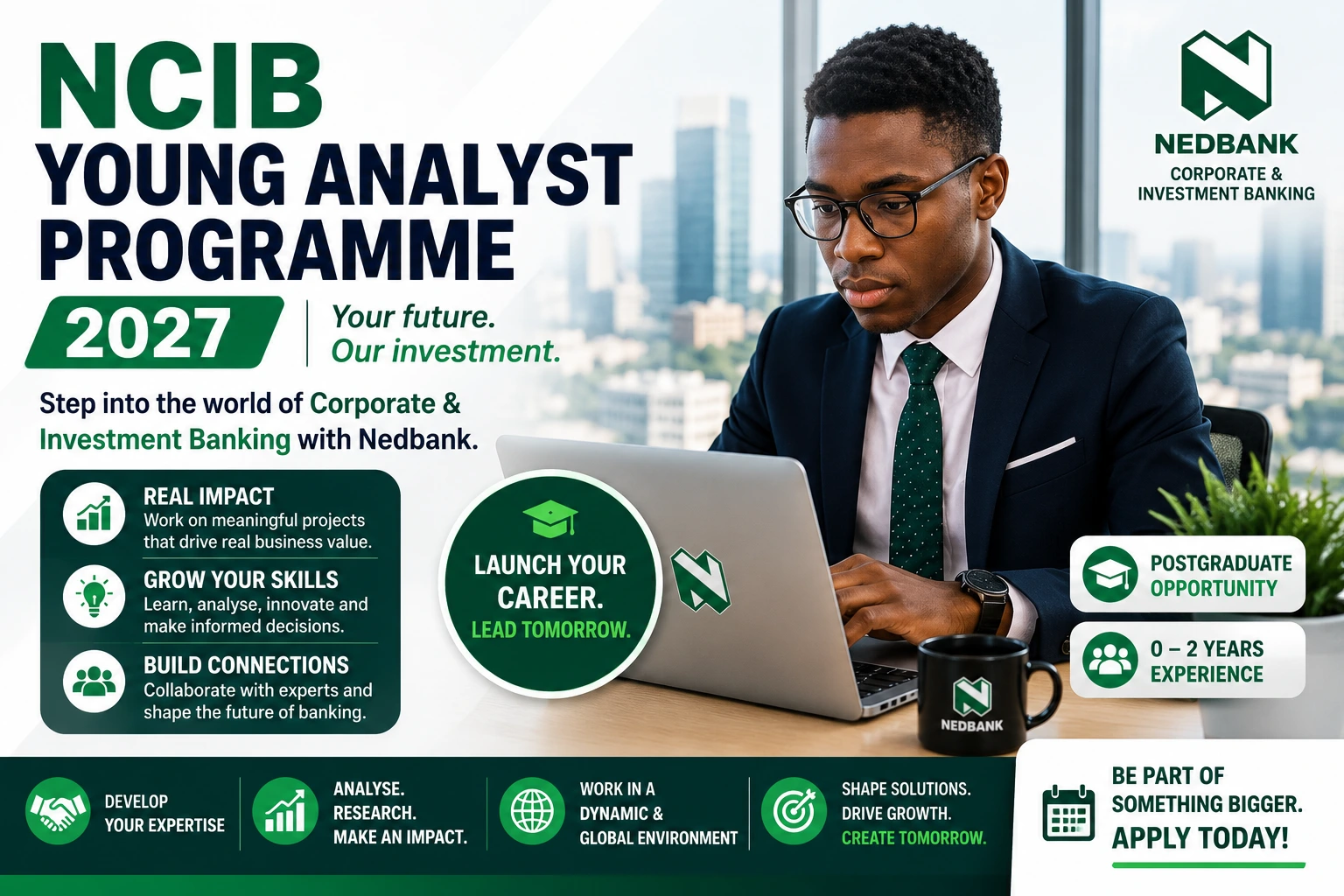
Explore the NCIB Young Analyst Programme 2027 at Nedbank. Learn about requirements, responsibilities, and how to apply for this top graduate opportunity.
On a typical weekday morning in Sandton, the glass towers reflect a fast-moving city that rarely pauses. Inside one of those buildings, a graduate analyst studies a spreadsheet filled with market data—interest rates shifting, currencies fluctuating, sectors rising and falling. A few desks away, another analyst prepares a presentation for senior stakeholders, translating numbers into decisions that could shape millions of rand in investment strategy.
This is the world the NCIB Young Analyst Programme 2027 opens up—a structured entry point into corporate and investment banking for South Africa’s most academically strong graduates.
Run by Nedbank Group under its Corporate and Investment Banking division, the programme is not just about learning finance. It’s about learning how decisions are made at the highest level of business—and how data becomes strategy.
What the NCIB Young Analyst Programme 2027 Really Offers
At first glance, the NCIB Young Analyst Programme 2027 looks like a typical graduate programme: strong academic requirements, limited experience needed, and a focus on analytical skills.
But its structure reveals something deeper.
Participants are placed in environments where they are expected to contribute—not just observe. From day one, analysts are involved in:
- Researching economic and industry trends
- Supporting investment decisions
- Preparing presentations for stakeholders
- Analysing financial performance of funds and portfolios
This is not simulated work. It is real exposure to the decision-making processes within corporate and investment banking.
And that distinction matters.
In a competitive sector like finance, the difference between theory and applied experience often determines career trajectory.
The Role: More Than Just Numbers
The title “analyst” often brings to mind spreadsheets and formulas. While those are certainly part of the role, the reality is more complex.
The NCIB Young Analyst Programme 2027 blends technical work with strategic thinking.
Participants are expected to:
- Interpret complex data sets and identify patterns
- Develop investment recommendations using both quantitative and qualitative analysis
- Engage with internal and external stakeholders
- Contribute to process improvements within the organisation
This means the role sits at the intersection of data, communication, and decision-making.
An analyst who can calculate but not explain will struggle.
An analyst who can explain but not analyse will also fall short.
The programme is designed to build both.
Who the Programme Is Designed For
Nedbank’s criteria are intentionally demanding.
Applicants must:
- Be South African citizens
- Have 0–2 years of working experience
- Maintain a 70% academic average across all years of study
- Be completing or have completed a postgraduate qualification
The academic disciplines considered are broad but highly quantitative and analytical, including:
- Finance and Investment Management
- Actuarial Science
- Data Science and Analytics
- Engineering
- Mathematics and Statistics
- Computer Science and Information Systems
This range reflects the evolving nature of banking.
Modern investment decisions are no longer made by finance graduates alone. They increasingly rely on data scientists, engineers, and risk specialists working together.
Why the NCIB Young Analyst Programme 2027 Matters Now
South Africa’s financial sector is undergoing a subtle but important transformation.
Digital systems are reshaping how banks operate.
Global markets are becoming more interconnected.
Risk management is more complex than ever.
In this environment, banks need a new kind of analyst—one who is not only technically skilled but also adaptable and strategically aware.
The NCIB Young Analyst Programme 2027 is part of that shift.
It is not just recruiting talent. It is shaping the next generation of decision-makers within corporate banking.
For graduates, this represents something rare: access to a high-impact environment early in their careers.
A Day in the Life: Inside Corporate and Investment Banking
While no two days are identical, the rhythm of the programme follows a pattern.
Morning might begin with reviewing market updates—interest rate movements, commodity prices, global economic news.
Midday could involve working on a financial model, analysing how a particular investment is performing or projecting future returns.
Afternoon might shift toward collaboration—team discussions, stakeholder meetings, or preparing a presentation.
Throughout, analysts are expected to:
- Ask questions
- Challenge assumptions
- Back their insights with data
This environment rewards curiosity as much as competence.
The Skills That Set Candidates Apart
Meeting the academic threshold is only part of the equation.
The NCIB Young Analyst Programme 2027 places strong emphasis on behavioural competencies, including:
- Adaptability in fast-changing environments
- Clear communication of complex ideas
- Strong work standards and accountability
- Ability to manage multiple projects simultaneously
In practice, this means the programme is looking for individuals who can operate under pressure without losing precision.
It is one thing to analyse data in a classroom.
It is another to do it when decisions depend on your output.
Expert Insight: Why Hybrid Skills Are Becoming Essential in Banking
The traditional image of banking professionals is changing.
Today, the most effective analysts combine three capabilities:
- Technical expertise (data analysis, financial modelling)
- Business understanding (market trends, industry dynamics)
- Communication skills (presenting insights clearly)
The NCIB Young Analyst Programme 2027 reflects this shift.
By exposing participants to real business challenges, it accelerates the development of hybrid skills—those that sit between disciplines.
In the long term, these are the skills that differentiate high-performing professionals from technically competent ones.
Types of Exposure That Shape Your Career
One of the programme’s strengths is the variety of experiences it offers.
Participants engage in:
- Analysing complex data requiring multi-layered evaluation
- Influencing stakeholders to gain buy-in for ideas
- Working in agile teams to solve problems
- Interacting with different levels of management
This exposure builds more than knowledge—it builds confidence.
For many graduates, this is the first time they operate in an environment where their input carries weight.
Application Requirements: What You Need to Prepare
To be considered for the NCIB Young Analyst Programme 2027, applicants must submit:
- A copy of their ID
- A detailed CV
- Full academic transcripts for all years of study
These documents are not just formalities.
They are used to assess consistency, performance, and attention to detail.
A strong academic record signals capability, but a well-prepared application signals professionalism.
Where to Apply for the NCIB Young Analyst Programme 2027
Applications are submitted through Nedbank’s official careers platform.
Candidates should ensure:
- All documents are complete and clearly scanned
- Academic records reflect the required average
- Information provided is accurate and consistent
APPLY HERE: NCIB Young Analyst Programme 2027
Given the competitive nature of the programme, early application is advisable.
FAQ: NCIB Young Analyst Programme 2027
1. Do I need prior work experience to apply?
No. The programme is designed for graduates with 0–2 years of experience.
2. What is the minimum academic requirement?
A 70% average across all years of study is required.
3. Which fields of study are accepted?
A wide range, including finance, data science, engineering, mathematics, and related disciplines.
The Bigger Picture: A Career That Starts With Exposure
The NCIB Young Analyst Programme 2027 is not just about securing a job. It is about entering a system where decisions shape industries, investments, and economic outcomes.
For those who meet the requirements, it offers something few opportunities can match:
Early exposure to high-level thinking.
A platform to develop critical skills.
A pathway into one of the most influential sectors of the economy.
In a competitive job market, access matters.
And sometimes, the difference between watching the economy move—and helping shape it—starts with a single programme like this one.