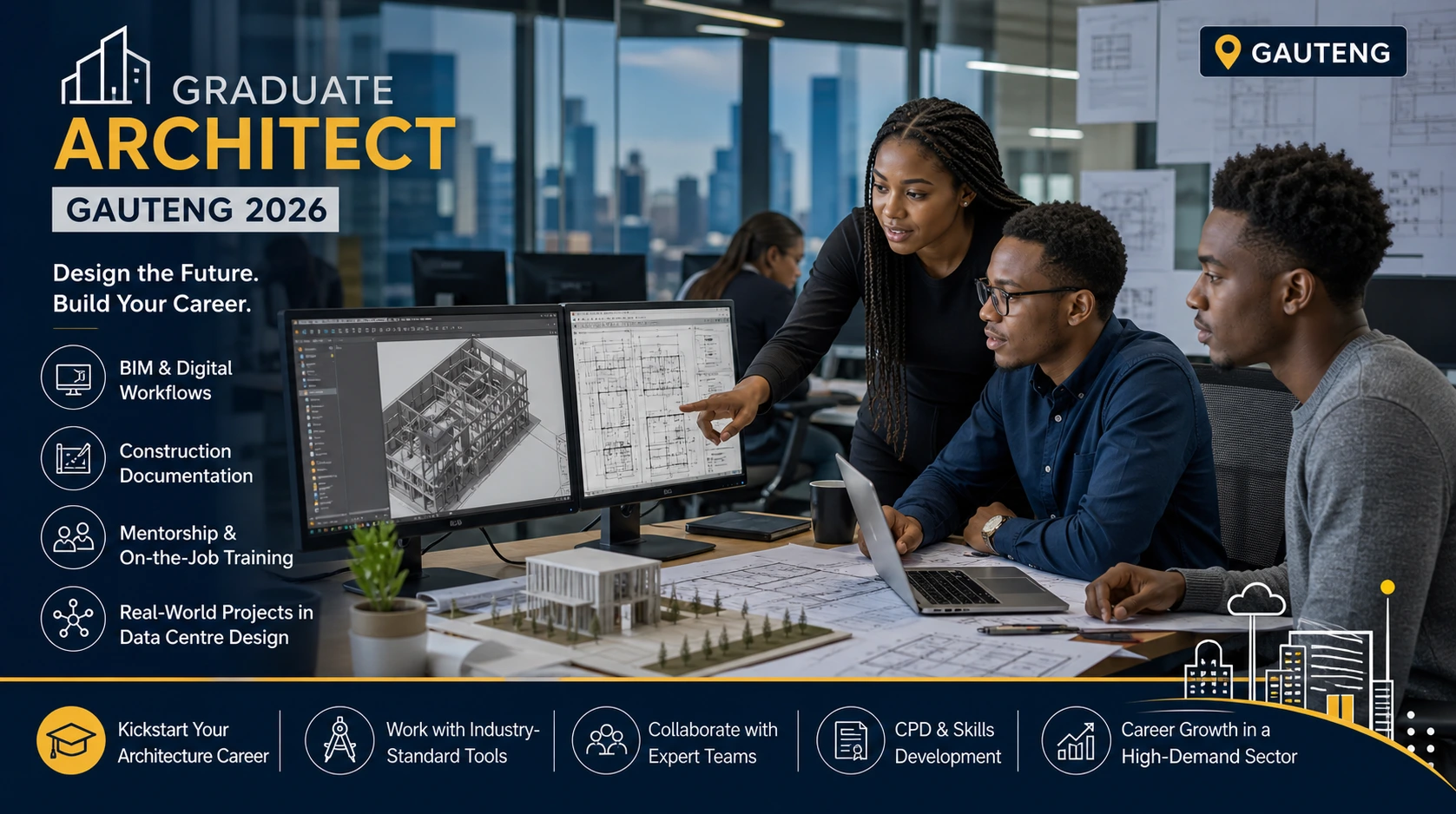
Explore the Graduate Architect Gauteng 2026 opportunity, key requirements, benefits, and what it reveals about the future of architectural careers in South Africa.
Introduction: Why the Graduate Architect Gauteng Opportunity Matters Now
The Graduate Architect Gauteng opportunity arriving in 2026 is more than just another entry-level role—it reflects a deeper transformation happening in South Africa’s construction and infrastructure landscape. As industries accelerate digital transformation, demand for data centres, smart buildings, and technically complex facilities is rising sharply. This shift is quietly redefining what it means to start a career in architecture.
For graduates, this creates a rare intersection: practical experience combined with exposure to highly specialised sectors. Unlike traditional architectural roles that may focus on residential or commercial projects, this opportunity positions candidates at the core of technical infrastructure development, where precision, coordination, and digital workflows dominate.
Understanding this role is not just about applying—it’s about recognising where the profession is heading.
ALSO APPLY FOR NARYSEC Youth Recruitment Programme 2026/27: Why This Rural Opportunity Could Change Your Career Path
Context: The Changing Nature of Architectural Careers in South Africa || Graduate Architect Gauteng
Historically, architectural graduates in South Africa followed a relatively predictable path: internships in design firms, gradual exposure to construction documentation, and eventual professional registration. However, several trends are reshaping that trajectory:
- Infrastructure-driven demand: The rise of data centres, logistics hubs, and industrial developments is creating new specialisations.
- Digital transformation in design: Tools like BIM (Building Information Modelling) are no longer optional—they are central to project delivery.
- Cross-disciplinary collaboration: Architects now work closely with engineers, IT specialists, and sustainability consultants.
The Graduate Architect Gauteng role reflects all three shifts. It emphasises technical drawing, BIM workflows, and coordination—skills that align with the future rather than the past of architecture.
Quick Facts: Graduate Architect Gauteng Opportunity
- Closing Date: Not stated in the official advert
- Location: Gauteng
- Duration: 1 – 2 Years
- Positions Available: Not stated in the official advert
- Reference Number: GA01
- Stipend: Not stated in the official advert
- Required Gender: Not stated in the official advert
- Name of the Company: Not stated in the official advert
1. The Technical Core: Why Drawing Skills Still Matter in a Digital Age
One of the key responsibilities in the Graduate Architect Gauteng role is preparing accurate architectural drawings and construction documentation. At first glance, this may seem like a routine task—but it carries deeper significance.
Despite advances in automation and AI-assisted design, precision in documentation remains the backbone of construction projects. Errors in drawings can lead to: Graduate Architect Gauteng
- Cost overruns
- Construction delays
- Compliance failures
Graduates entering this role will be trained to work within strict standards and regulations, ensuring that every line drawn has real-world implications.
More importantly, mastering tools like AutoCAD and Revit is not just about software proficiency—it’s about understanding how digital models translate into physical structures.
2. BIM and Data-Driven Design: The New Competitive Advantage
The advert highlights exposure to industry-standard drafting and BIM workflows, which is arguably one of its strongest advantages.
BIM is transforming architecture from a design-focused discipline into a data-driven profession. Instead of static drawings, architects now create intelligent models that include:
- Material specifications
- Structural data
- Energy performance metrics
- Lifecycle cost analysis
For graduates, early exposure to BIM offers a significant career edge. Employers increasingly prioritise candidates who can:
- Navigate complex digital models
- Collaborate in shared data environments
- Integrate design with engineering systems
In this context, the Graduate Architect Gauteng opportunity becomes a gateway into high-demand technical expertise.
3. The Rise of Data Centres: A Hidden Growth Sector
One of the most interesting aspects of this opportunity is its connection to data centre specialists. While not always visible to the public, data centres are among the fastest-growing infrastructure sectors globally—and South Africa is no exception.
Several factors are driving this growth:
- Expansion of cloud computing services
- Increased internet usage across Africa
- Demand for secure, local data storage
Designing data centres requires a different architectural mindset. These facilities prioritise:
- Thermal efficiency
- Redundancy systems
- Security and access control
- Precise spatial planning
For a graduate, working in this environment means gaining experience in high-performance architecture, which is often more complex than traditional building projects.
4. Collaboration as a Core Skill: Beyond Individual Design
Another key responsibility in the Graduate Architect Gauteng role is supporting coordination between design teams and external consultants.
This reflects a broader shift: architecture is no longer a solo discipline. Modern projects involve: Graduate Architect Gauteng 2026
- Structural engineers
- Mechanical and electrical specialists
- Sustainability consultants
- Project managers
Graduates must learn how to communicate effectively across disciplines, ensuring that designs are: Graduate Architect Gauteng 2026
- Technically feasible
- Cost-efficient
- Compliant with regulations
This collaborative exposure is particularly valuable early in a career. It builds the soft skills—communication, adaptability, teamwork—that often determine long-term success more than technical ability alone.
5. Training, Mentorship, and CPD: Building Long-Term Career Value
The benefits outlined in the advert go beyond immediate job experience. They include: Graduate Architect Gauteng 2026
- On-the-job training
- Mentorship from experienced specialists
- Continuing Professional Development (CPD) opportunities
This is significant because many graduates struggle to find structured environments that support professional growth.
Mentorship, in particular, plays a critical role. Learning from experienced professionals accelerates:
- Technical skill development
- Understanding of industry standards
- Career decision-making
In a competitive job market, these elements can make the difference between stagnation and progression.
6. Entry Requirements: What Employers Are Really Looking For
The requirements listed—such as proficiency in AutoCAD and Revit, attention to detail, and teamwork—may appear standard. However, they reveal deeper expectations.
Employers are increasingly looking for graduates who can:
- Transition quickly into productive roles
- Work independently with minimal supervision
- Adapt to fast-paced project environments
The emphasis on accuracy and organisation is particularly telling. In technical sectors like data centre design, even small mistakes can have significant consequences.
This suggests that the ideal candidate is not just creative, but also methodical and disciplined.
What This Means Going Forward-Graduate Architect Gauteng 2026
The Graduate Architect Gauteng opportunity highlights several trends that will shape the future of architecture:
- Specialisation will become more important
Generalist roles are giving way to niche expertise, especially in sectors like data centres and infrastructure. - Digital skills will define employability
Mastery of BIM and drafting software will be essential, not optional. - Collaboration will outweigh individual design brilliance
The ability to work within multidisciplinary teams will be a key differentiator. - Early career choices will have long-term impact
Graduates who enter technical, high-growth sectors may find faster career progression.
For aspiring architects, this means thinking strategically about where to start—not just taking any opportunity, but choosing one aligned with future demand.
How To Apply for Graduate Architect Gauteng 2026
APPLY HERE Graduate Architect Gauteng 2026
FAQs-Graduate Architect Gauteng 2026
1. Is the Graduate Architect Gauteng role suitable for final-year students?
Yes. The advert specifically states that final-year students or those who have completed a relevant qualification can apply, making it accessible to those about to enter the workforce.
2. Do I need experience with BIM software to apply?
While not always mandatory, proficiency in tools like AutoCAD and Revit is strongly preferred. Having basic BIM knowledge will significantly improve your chances.
Conclusion-Graduate Architect Gauteng 2026
The Graduate Architect Gauteng opportunity is more than a stepping stone—it is a reflection of where the architectural profession is heading. With its focus on technical documentation, BIM workflows, and data centre exposure, it offers a forward-looking career entry point.
For graduates willing to embrace precision, collaboration, and digital tools, this role provides a foundation that extends far beyond the typical internship experience. In a rapidly evolving industry, those who start in the right environment are often the ones who lead it in the future.