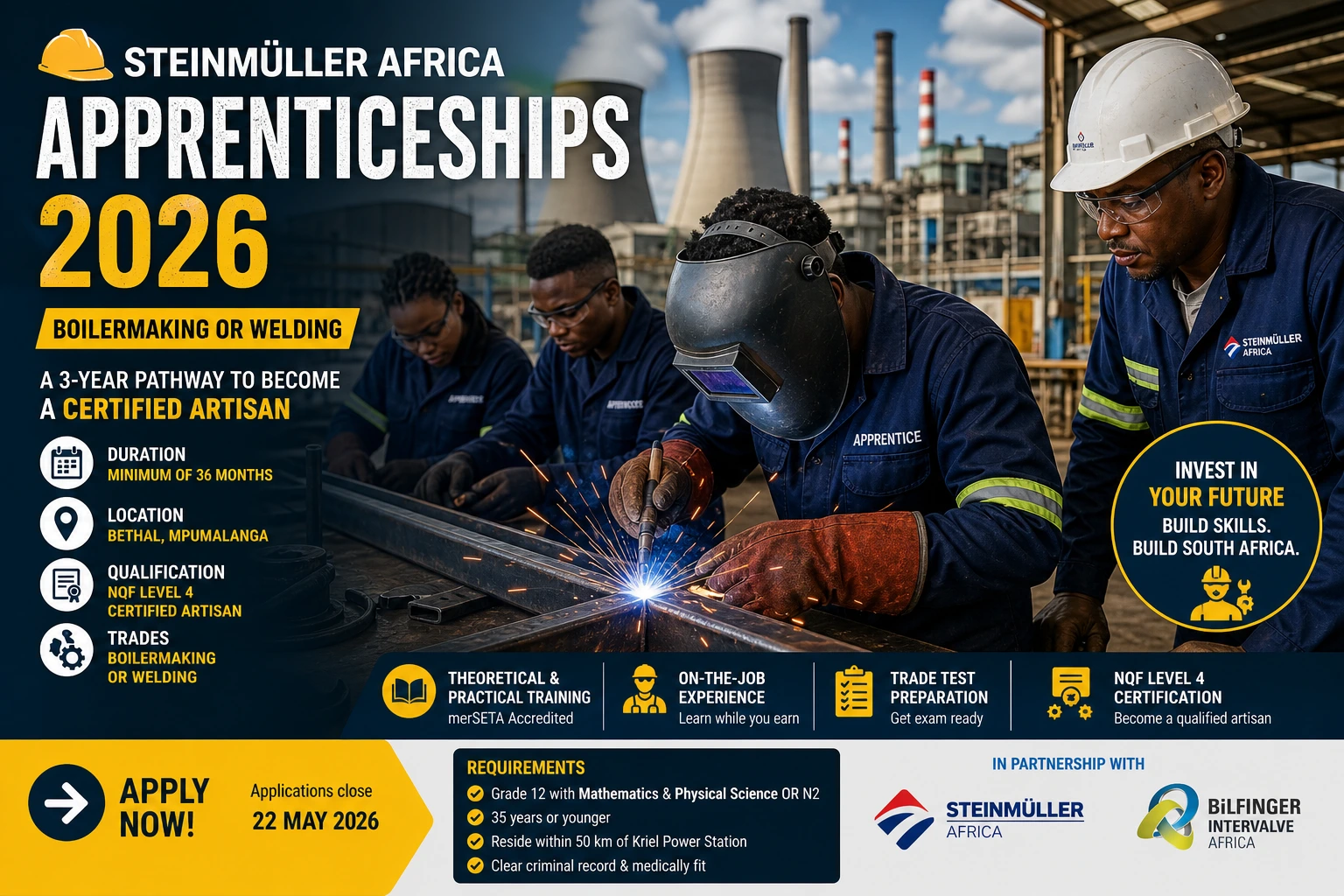
Discover the Steinmüller Africa Apprenticeships 2026, including requirements, duration, and why this artisan programme is a game-changer for South African youth.
Introduction: Why the Steinmüller Africa Apprenticeships 2026 Matter Now
As South Africa continues to confront high youth unemployment and a shortage of technical skills, programmes like the Steinmüller Africa Apprenticeships 2026 are becoming increasingly critical. Unlike short-term internships or entry-level roles that often lead to uncertain career paths, this apprenticeship offers a structured, long-term route into a recognised trade.
What makes this opportunity particularly relevant in 2026 is its alignment with the country’s infrastructure and energy sectors. With ongoing investments in power generation and industrial maintenance—especially around facilities like Kriel Power Station—the demand for qualified artisans is not just rising, it is becoming urgent.
The Steinmüller programme is not merely about employment—it is about building a sustainable pipeline of skilled professionals who can support South Africa’s industrial backbone.
ALSO APPLY FOR Western Cape Department of Health Graduate Internships 2026: A Strategic Entry Into Public Sector Careers
Quick Facts: Steinmüller Africa Apprenticeships 2026
- Closing Date: 22 May 2026
- Location: Bethal, Mpumalanga, South Africa
- Duration: Minimum of 36 months (3 years)
- Positions Available: Not stated in the official advert
- Reference Number: Not stated in the official advert
- Stipend: Not stated in the official advert
- Required Gender: Not stated in the official advert
- Company Name: Steinmüller Africa (in partnership with Bilfinger Intervalve Africa)
Programme Structure: Why a 3-Year Apprenticeship Still Holds Value
One of the defining features of the Steinmüller Africa Apprenticeships 2026 is its 36-month duration. In an era where many programmes promise quick results, this extended timeline reflects the complexity and depth required to master trades like boilermaking and welding.
Participants will:
- Complete merSETA-accredited training modules
- Gain hands-on experience in real industrial environments
- Prepare for and complete a trade test
- Qualify as a Certified Artisan (NQF Level 4)
This structure mirrors internationally recognized apprenticeship systems, where competency is built gradually through repetition, mentorship, and exposure to real-world challenges.
From an analytical standpoint, longer programmes tend to produce more employable graduates because they combine:
- Technical knowledge
- Practical skill development
- Workplace discipline
In contrast, shorter programmes often lack this depth, leaving participants underprepared for industry demands.
Geographic Targeting: Local Development With Strategic Intent
A notable aspect of the Steinmüller Africa Apprenticeships 2026 is its geographic focus. Applicants must:
- Reside within a 50 km radius of Kriel Power Station
- Be willing to relocate to Bethal if necessary
This requirement is not arbitrary—it reflects a broader trend in South African skills development: community-based talent pipelines.
By prioritizing local candidates, the programme aims to:
- Reduce unemployment in surrounding communities
- Build a stable, locally sourced workforce
- Minimize logistical challenges such as transport and relocation
However, this also limits access for candidates outside the region. While this may seem restrictive, it aligns with national development goals that emphasize localized economic upliftment.
Entry Requirements: A High Technical Threshold
The eligibility criteria for the Steinmüller Africa Apprenticeships 2026 are deliberately stringent. Applicants must have:
- Grade 12 with Mathematics (not Mathematical Literacy) and Physical Science
OR - An N2 qualification with relevant subjects
Additional requirements include:
- Being 35 years or younger
- Medical and physical fitness
- A clear criminal record
The exclusion of Mathematical Literacy is particularly significant. It signals that the programme requires analytical and problem-solving capabilities, not just basic numeracy.
In trades like welding and boilermaking, precision is non-negotiable. Measurements, material calculations, and structural understanding all rely on solid mathematical foundations.
This high entry threshold ensures that candidates are equipped to handle both the technical and safety demands of the profession.
Workplace Integration: Learning Beyond the Classroom
A key strength of the Steinmüller Africa Apprenticeships 2026 is its integration of training with real-world work environments. Participants are not isolated in classrooms—they are actively involved in:
- Production support
- Site operations
- Supervised technical tasks
This model reinforces the idea that skills are best learned in context.
Working alongside experienced mentors allows apprentices to:
- Observe industry standards in action
- Develop problem-solving skills in real time
- Build professional habits and discipline
This type of experiential learning is often what differentiates successful artisans from those who struggle to transition from theory to practice.
Employment Equity and Access: Balancing Opportunity and Policy
The programme is explicitly open to Employment Equity (EE) candidates, reflecting South Africa’s broader transformation agenda.
While this may limit eligibility for some applicants, it serves an important purpose:
- Addressing historical inequalities in skilled trades
- Promoting diversity within industrial sectors
- Expanding access to high-value career pathways
From a policy perspective, programmes like this are part of a larger effort to rebalance participation in technical professions, which have historically been less inclusive.
However, this also underscores the importance of transparency and clarity in application requirements, ensuring that candidates understand eligibility before applying.
Practical Constraints: The Hidden Costs of Opportunity
Despite its benefits, the Steinmüller Africa Apprenticeships 2026 comes with certain practical limitations:
- No accommodation provided
- No transport assistance
- Strict documentation requirements
These factors can create barriers for otherwise qualified candidates, particularly those from lower-income backgrounds.
From an analytical standpoint, this highlights a recurring issue in apprenticeship programmes: access is not just about eligibility, but also about affordability.
Candidates must carefully consider whether they can manage:
- Daily commuting costs
- Relocation expenses
- Living arrangements during the programme
While the long-term benefits may outweigh these challenges, the short-term realities cannot be ignored.
Industry Relevance: Why Boilermaking and Welding Remain Critical
The trades offered in the Steinmüller Africa Apprenticeships 2026 are deeply embedded in South Africa’s industrial ecosystem.
Boilermakers and welders are essential for:
- Power station maintenance
- Infrastructure development
- Manufacturing and fabrication
- Mining operations
With aging infrastructure and ongoing energy challenges, the demand for these skills is expected to remain strong.
Globally, skilled artisans are also in demand, particularly in regions investing in energy and construction projects. This means that completing such an apprenticeship can open doors beyond South Africa.
In this context, the programme is not just a job opportunity—it is an entry point into a globally relevant profession.
What This Means Going Forward-Steinmüller Africa Apprenticeships 2026
The Steinmüller Africa Apprenticeships 2026 reflect several important shifts in South Africa’s labour market:
- Long-Term Skills Investment
Employers are prioritizing depth over speed, investing in multi-year training programmes. - Localized Talent Development
There is a growing emphasis on building skills within specific communities. - Stricter Entry Standards
Programmes are raising academic and technical requirements to improve outcomes. - Integrated Learning Models
Combining classroom and workplace training is becoming the standard approach.
Looking ahead, similar programmes are likely to expand, particularly in sectors linked to energy and infrastructure. However, competition will remain high, and only well-prepared candidates will succeed.
For applicants, this means focusing not just on meeting minimum requirements, but on demonstrating commitment, readiness, and long-term career intent.
How to Apply For Steinmüller Africa Apprenticeships 2026
Click here to apply for the Steinmüller Africa Apprenticeships 2026
Make sure you meet all requirements and submit all required documents before the closing date.
FAQs About Steinmüller Africa Apprenticeships 2026
1. How long does the Steinmüller Africa Apprenticeship Programme last?
The programme runs for a minimum of 36 months (3 years), combining both theoretical and practical training.
2. Do I need to live near Kriel Power Station to apply?
Yes. Applicants must reside within a 50 km radius of Kriel Power Station or be willing to relocate to Bethal at their own cost.
Conclusion-Steinmüller Africa Apprenticeships 2026
The Steinmüller Africa Apprenticeships 2026 offer a compelling opportunity for young South Africans seeking a stable and skilled career path. With its structured training, industry alignment, and clear progression toward certification, the programme stands out in a crowded field of entry-level opportunities.
However, it also demands a high level of commitment—from meeting strict academic requirements to managing practical challenges like transport and relocation.
For those who are prepared, this apprenticeship represents more than just training. It is a gateway into a resilient and in-demand profession, one that plays a critical role in both South Africa’s economy and the global industrial landscape.