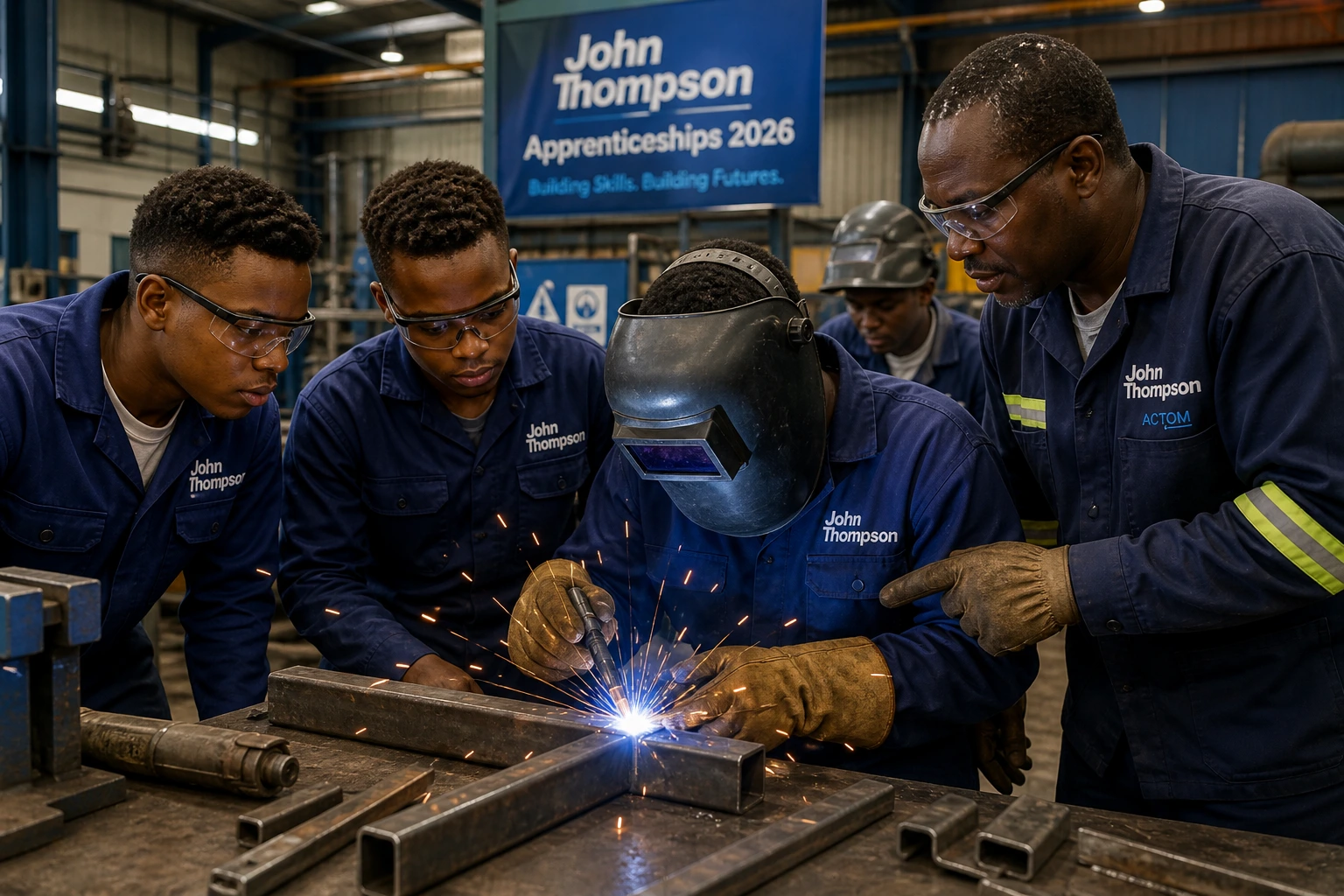
Explore the John Thompson Apprenticeships 2026 in detail—requirements, selection process, and why this opportunity matters for South Africa’s skills economy.
Introduction: Why the John Thompson Apprenticeships 2026 Matter Now
South Africa’s youth unemployment crisis continues to demand more than just policy discussions—it requires practical, skills-based pathways into sustainable careers. The John Thompson Apprenticeships 2026 arrive at a critical moment, offering a structured route into artisan trades that remain both scarce and economically vital.
While many entry-level programmes focus on administrative or retail exposure, this apprenticeship shifts the focus toward industrial skills development, specifically in boilermaking and welding—two trades that underpin infrastructure, energy, and manufacturing sectors. What makes this opportunity particularly significant is its accessibility: no prior experience is required, lowering barriers for thousands of technically inclined but underexposed young people.
In a labour market where experience often becomes a gatekeeper, this programme disrupts that cycle by prioritizing potential over history.
ALSO READ OUR PRIVACY POLICY
ALSO APPLY FOR Western Cape Department of Health Graduate Internships 2026: A Strategic Entry Into Public Sector Careers
Quick Facts: John Thompson Apprenticeships 2026
- Closing Date: 15 May 2026
- Location: Bellville, Western Cape, South Africa
- Duration: Not stated in the official advert
- Positions Available: Maximum 20
- Reference Number: Not stated in the official advert
- Stipend: Not stated in the official advert
- Required Gender: Not stated in the official advert
- Company Name: John Thompson (Division of ACTOM Pty Ltd)
Understanding the Programme: More Than Just Training
At first glance, the John Thompson Apprenticeships 2026 may seem like a standard artisan training programme. However, a closer look reveals a more layered structure designed to filter, develop, and ultimately retain high-potential candidates.
The programme offers:
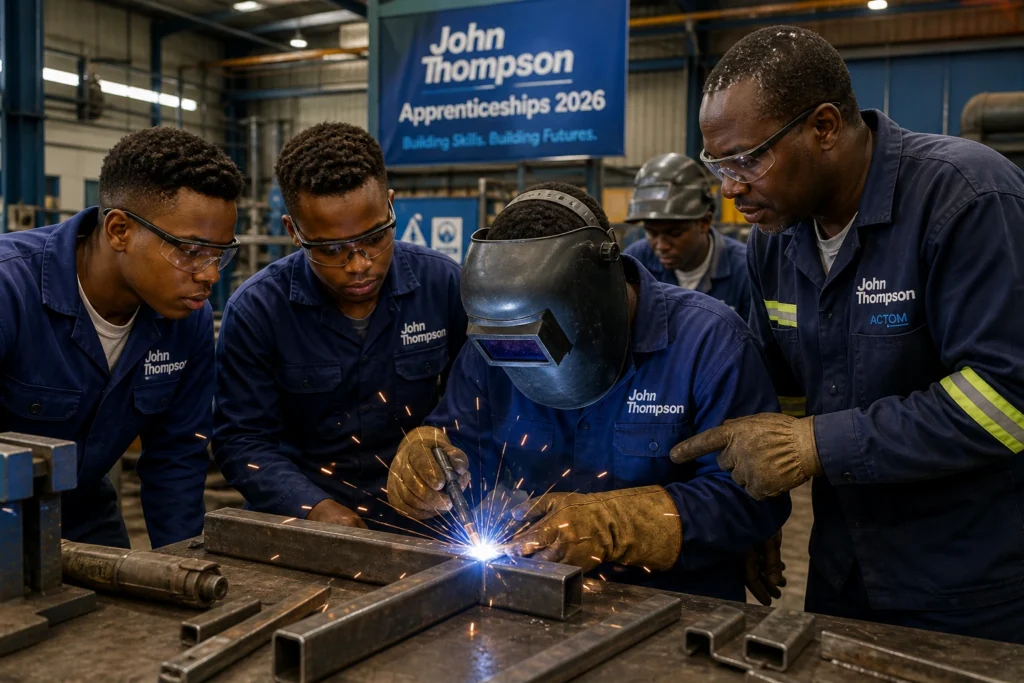
- Training in boilermaking and welding
- Workplace exposure in a real industrial environment
- A pathway toward becoming a certified artisan
John Thompson, as a leading manufacturer of industrial boilers, operates within a sector that demands precision, safety, and technical excellence. This means the apprenticeship is not just about learning skills—it’s about aligning with industry-grade standards from day one.
Unlike short-term learnerships, apprenticeships in trades like welding often translate into long-term employability, both locally and internationally.
ALSO APPLY FOR eMedia Bursary Programme 2026: Funding Opportunity for Media Students
The Selection Process: Why It’s Designed to Filter for Commitment
One of the most important aspects of the John Thompson Apprenticeships 2026 is its multi-stage selection process. Rather than offering immediate placement, candidates must pass through several filters:
- Psychometric testing
- A 3-month evaluation period as unskilled workers
- Final selection based on performance
This approach may seem demanding, but it reflects a broader industry reality: artisan work requires discipline, adaptability, and resilience.
The 3-month evaluation phase is particularly telling. It allows both the employer and the candidate to assess fit in a real-world environment. For the company, it reduces the risk of investing in unsuitable candidates. For applicants, it provides a realistic preview of the trade before committing long-term.
In many ways, this model mirrors global apprenticeship systems where trial-based learning ensures better outcomes than purely academic selection.
Education Requirements: A Focus on Technical Foundations || John Thompson Apprenticeships 2026
The eligibility criteria for the John Thompson Apprenticeships 2026 highlight a strong emphasis on foundational technical knowledge. Applicants must meet one of several academic pathways:
- Grade 12 (Technical) with subjects like Metalwork and Technical Science
- Grade 12 (Academic) with Mathematics and Physical Science
- N2 Trade Theory subjects
- NCV Level 4 in Fabrication
A critical detail stands out: Mathematics Literacy is not accepted.
This requirement signals the technical intensity of the programme. Welding and boilermaking are not purely manual trades—they involve calculations, measurements, and an understanding of material properties.
From an analytical perspective, this requirement aligns with industry demands where errors can lead to costly or dangerous outcomes. By enforcing a mathematics baseline, the programme ensures candidates can engage with both the practical and theoretical aspects of the trade.
Accessibility vs Exclusivity: Who Really Benefits?
Although the programme is open to unemployed youth aged 18–35, there are notable limitations:
- Applicants must reside in the Western Cape
- Only 20 positions are available
- Strict documentation requirements apply
This creates a tension between accessibility and exclusivity.
On one hand, the “no experience required” policy broadens access. On the other, the limited intake and geographic restriction narrow the pool significantly.
From a policy standpoint, this reflects a common challenge in South Africa’s skills development ecosystem: high-quality programmes often operate at limited scale.
However, for those who do qualify, the value proposition remains strong. Artisan careers typically offer:
- Higher long-term earning potential than entry-level office jobs
- Opportunities for self-employment or contracting
- Mobility across industries such as construction, energy, and manufacturing
Industry Context: Why Boilermaking and Welding Still Matter || John Thompson Apprenticeships 2026
In an increasingly digital economy, it’s easy to overlook traditional trades. Yet, boilermaking and welding remain foundational to economic infrastructure.
These skills are essential in:
- Power generation and energy plants
- Mining operations
- Manufacturing facilities
- Infrastructure development projects
South Africa continues to face a shortage of qualified artisans, particularly in technical trades. According to industry reports, the demand for welders and boilermakers consistently exceeds supply, especially in large-scale industrial projects.
This makes the John Thompson Apprenticeships 2026 more than just a training programme—it’s a strategic entry point into a skills-scarce sector.
Globally, skilled welders are also in demand, meaning successful candidates could eventually access international opportunities, particularly in regions investing heavily in infrastructure.
Application Requirements: Where Many Candidates Fall Short
Despite the opportunity, a significant number of applicants are likely to be disqualified due to administrative errors.
The advert clearly states:
- CV must not exceed 4 pages
- All documents must be certified
- Applications without certificates will be rejected
These requirements may seem minor, but they often determine success or failure at the initial stage.
Additionally, certain candidates are explicitly excluded:
- Qualified artisans
- Individuals with Electrical, Diesel, or Fitting & Turning qualifications
This exclusion ensures the programme targets true entry-level candidates, rather than those seeking additional credentials.
For applicants, this highlights the importance of careful compliance with instructions—an often overlooked but critical aspect of job applications.
How to Apply
📧 Email your application to: HumanResource@johnthompson.co.za
OR send via post to:
Senior HR Officer
PO Box 129
Bellville, 7535
What This Means Going Forward
The John Thompson Apprenticeships 2026 offer insight into the evolving nature of skills development in South Africa.
Several key trends emerge:
- Shift Toward Technical Skills
There is growing recognition that artisan trades are essential for economic recovery and industrial growth. - Structured Entry Pathways
Programmes are becoming more rigorous, combining testing, evaluation, and real-world exposure. - Limited but High-Impact Opportunities
While intake numbers remain small, the long-term impact on successful candidates is significant. - Employer-Led Training Models
Companies are increasingly taking responsibility for developing their own talent pipelines.
Looking ahead, similar programmes are likely to expand, particularly in sectors facing skills shortages. However, competition for these opportunities will remain high, making preparation and awareness crucial.
FAQs About John Thompson Apprenticeships 2026
1. Do I need experience to apply for the John Thompson Apprenticeships 2026?
No. The programme explicitly states that no prior experience is required, making it suitable for first-time job seekers.
2. Can I apply if I live outside the Western Cape?
No. Applicants must reside in the Western Cape, as the programme is based in Bellville and does not offer relocation support.
Conclusion-John Thompson Apprenticeships 2026
The John Thompson Apprenticeships 2026 stand out as a rare opportunity in a crowded landscape of entry-level programmes. By focusing on technical trades, structured training, and real-world exposure, the initiative addresses both individual career needs and broader economic challenges.
However, the opportunity is not without its constraints. Limited positions, strict requirements, and a rigorous selection process mean that only a small number of applicants will ultimately benefit.
For those who meet the criteria and are willing to commit, this apprenticeship could serve as a launchpad into a stable and in-demand career path—one that extends far beyond the boundaries of a single programme.