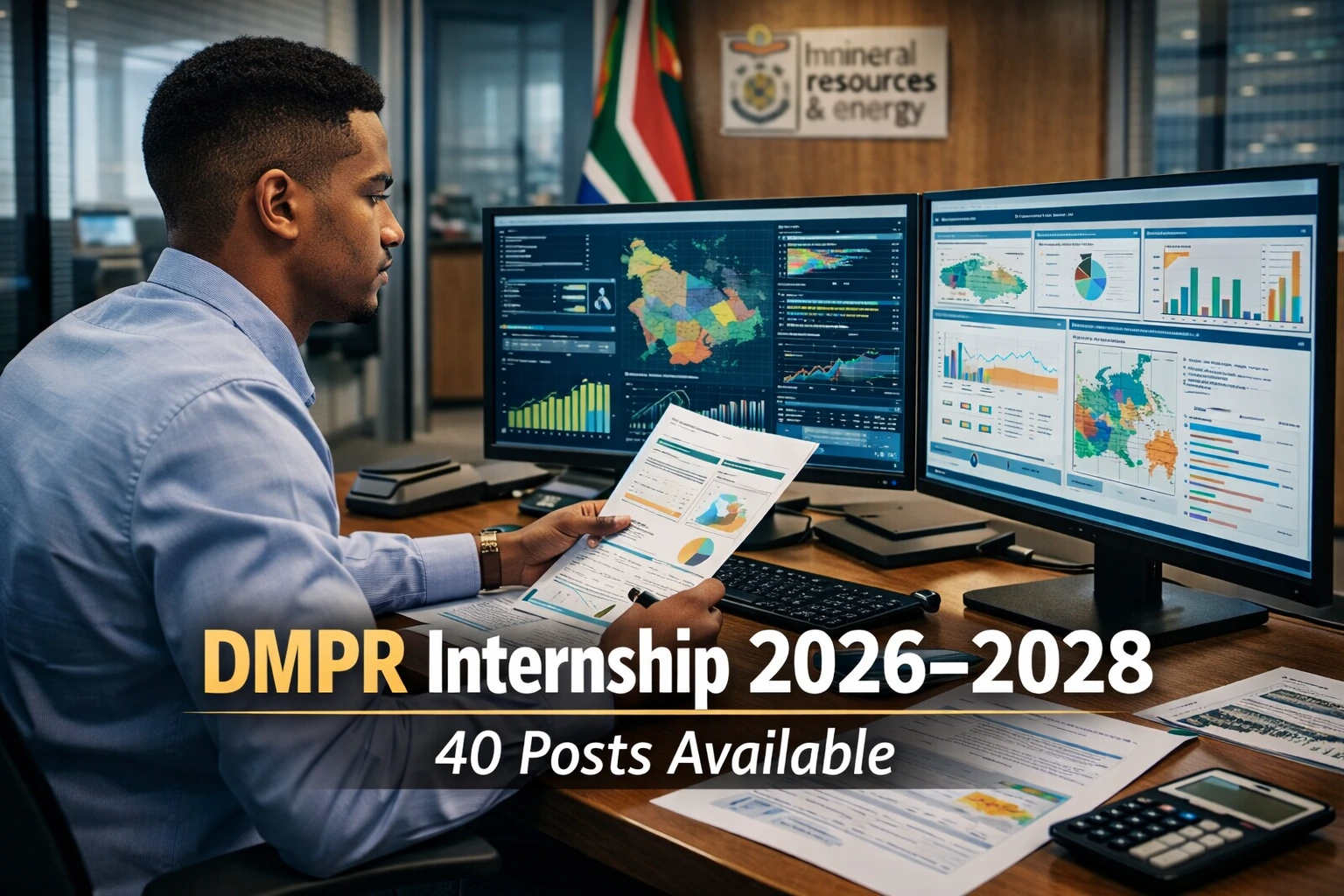
The DMPR Internship Programme 2026–2028 offers 40 paid posts across South Africa. Discover insights, stipend details, fields, and how to improve your chances.
DMPR Internship Programme 2026–2028 Opens a Rare Window for Graduates Seeking Real Experience
The launch of the DMPR Internship Programme 2026–2028 by the Department of Mineral and Petroleum Resources comes at a critical time for South African graduates facing a highly competitive job market. With youth unemployment remaining a persistent challenge, structured internship programmes like this are no longer optional stepping stones—they are essential entry points into the workforce.
What makes this particular programme stand out is not just the number of posts available, but the combination of national reach, financial support, and field-specific placements. With 40 internship positions across multiple provinces and a stipend of up to R9,482 per month, the DMPR Internship Programme 2026–2028 represents one of the more substantial government-backed opportunities currently open.
For many applicants, this could be the difference between remaining unemployed and gaining meaningful, career-aligned experience.
ALSO APPLY FOR Siza Water Plumber Learnerships 2026: Requirements, Application Guide & Career Opportunities
ALSO READ OUR PRIVACY POLICY
Quick Facts: DMPR Internship Programme 2026–2028
- Closing date: 08 May 2026
- Location: Nationwide (Gauteng, Mpumalanga, Limpopo, Free State, Northern Cape, Eastern Cape, Western Cape, North West, KwaZulu-Natal)
- Duration: 24 months (2026–2028)
- Positions available: 40 posts
- Reference number: Not stated in the official advert
- Stipend:
- R7,860.50/month (Diploma, Degree, Honours)
- R9,482/month (Master’s degree)
- Required Gender: Not stated in the official advert
- Name of the Company: Department of Mineral and Petroleum Resources
Why the DMPR Internship Programme 2026–2028 Matters Now
The relevance of the DMPR Internship Programme 2026–2028 extends beyond the individuals applying for it. It reflects a broader effort by government institutions to address the gap between academic qualifications and employability.
In South Africa, many graduates struggle not because they lack qualifications, but because they lack practical experience. Employers consistently prioritise candidates who understand workplace expectations, systems, and professional environments.
This programme directly addresses that gap.
By offering structured placements within a government department responsible for key sectors such as mining, energy, and environmental regulation, the programme provides exposure to industries that are central to the country’s economic development.
At a time when economic diversification and resource management are under scrutiny, this kind of experience becomes even more valuable.
A Closer Look at the Scale and Structure of the Programme || DMPR Internship Programme 2026
Unlike smaller internship programmes that offer limited intake, the DMPR Internship Programme 2026–2028 includes 40 positions across a wide geographic spread. This scale is significant for two reasons.
Firstly, it increases accessibility. With placements in cities such as Pretoria, Polokwane, Kimberley, Cape Town, and Durban, the programme is not limited to a single urban centre.
Secondly, it allows for specialisation. Each post is linked to a specific function or department, meaning applicants can align their placement with their academic background.
This is a critical advantage.
Many internships fail to provide relevant experience because they are too generalised. In contrast, this programme allows candidates to work in areas directly related to their qualifications, increasing the long-term value of the experience.
Financial Support: Why the Stipend Matters More Than It Seems || DMPR Internship Programme 2026
The stipend offered under the DMPR Internship Programme 2026–2028 is more than just a financial incentive—it is a structural enabler.
With monthly payments of R7,860.50 for most graduates and up to R9,482 for those with a Master’s degree, the programme addresses one of the biggest barriers to participation: affordability.
Internships often come with hidden costs, including:
- Transport to and from the workplace
- Daily meals and living expenses
- Communication and connectivity costs
Without financial support, many qualified candidates are unable to accept internship opportunities.
By providing a stipend, the programme ensures broader access and allows participants to focus on gaining experience rather than managing financial strain.
However, it is important to note that accommodation and transport remain the responsibility of the intern. This means applicants must still plan carefully before accepting placement.
Successful applicants may be placed at offices in:
Gauteng, including Pretoria and Braamfontein
Mpumalanga, including Witbank
Limpopo, including Polokwane
Free State, including Welkom
Northern Cape, including Kimberley
Eastern Cape, including Port Elizabeth and East London
Western Cape, including Cape Town
North West, including Klerksdorp and Mafikeng
KwaZulu-Natal, including Durban
Fields and Opportunities: A Multi-Disciplinary Approach || DMPR Internship Programme 2026
One of the strongest aspects of the DMPR Internship Programme 2026–2028 is the diversity of fields it covers.
Opportunities are available in areas such as: DMPR Internship Programme 2026
- Finance and Accounting
- Law and Compliance
- Environmental Management
- Mining Engineering and Geology
- GIS and Geography
- Human Resources and Public Administration
- Communications and Strategic Planning
- Internal Audit and Risk
This range reflects the complexity of the department’s mandate.
The Department of Mineral and Petroleum Resources operates across technical, regulatory, environmental, and administrative domains. As a result, it requires a workforce with varied expertise.
For applicants, this creates an important strategic decision.
Rather than applying broadly, candidates should focus on positions that align closely with their qualifications and career goals. A targeted application is far more effective than a generic one.
Eligibility Rules That Could Make or Break Your Application || DMPR Internship Programme 2026
While the programme is accessible to many graduates, there are specific requirements that applicants must not overlook.
Key criteria include: DMPR Internship Programme 2026
- Applicants must be unemployed
- They must meet the qualification requirements for the specific post
- They must not have previously participated in a government internship programme
This last requirement is particularly important.
Many applicants are unaware that prior participation in a government internship disqualifies them. Ignoring this rule can lead to wasted time and effort.
Additionally, TVET students requiring experiential learning may apply, provided they submit a formal letter from their institution.
Attention to detail is essential throughout the application process. Small mistakes—such as submitting the wrong reference number or failing to complete the Z83 form correctly—can result in disqualification.
Application Strategy: What Separates Strong Candidates
The DMPR Internship Programme 2026–2028 is competitive, and success depends heavily on the quality of the application.
Strong candidates typically demonstrate:
- Clear alignment between their qualification and the internship post
- A well-structured and tailored CV
- Understanding of the department’s work and mandate
- Attention to detail in completing application documents
One of the most common mistakes is applying for multiple posts using a single application form. The department has clearly stated that each post requires a separate Z83 form and application.
Another critical factor is relevance.
A candidate applying for a finance role should highlight budgeting, reporting, and analytical skills. A law graduate should emphasise policy, compliance, and legal research. Generic applications rarely stand out.
In a competitive environment, precision and relevance often outweigh volume.
What This Means Going Forward
The DMPR Internship Programme 2026–2028 highlights a broader trend in South Africa’s employment landscape: the increasing importance of structured work experience.
As the economy evolves, employers are placing greater emphasis on practical skills, adaptability, and industry exposure. Academic qualifications remain important, but they are no longer sufficient on their own.
Programmes like this serve as a bridge between education and employment.
For graduates, this means that securing an internship is not just about short-term experience—it is about long-term positioning. The right internship can shape career direction, build professional networks, and open doors to future opportunities.
For the public sector, initiatives like this contribute to building capacity and ensuring that critical departments have access to skilled talent.
How do you apply for the DMPR Internship Programme?
Applications must be submitted through the official online application portal.
Applicants need to create a profile on the system, complete their personal details, and then apply for the relevant internship post linked to their qualification.
Internship Program Listings
The department has also indicated that applications may be submitted through post, courier, or hand delivery. However, the online portal remains the most practical route for many applicants.
Applications must include:
- A completed and signed Z83 form
- A detailed CV
Only shortlisted candidates will later be asked to provide certified copies of qualifications and other supporting documents.
Applicants who need help with the form should use the new Z83 form 2026 download guide before submitting their application.
FAQs
1. Can I apply if I have already completed another government internship?
No. The programme specifically excludes applicants who have previously participated in a government internship.
2. Do I need to submit certified documents with my application?
No. Only shortlisted candidates will be asked to provide certified copies of qualifications and supporting documents.
Conclusion
The DMPR Internship Programme 2026–2028 stands out as one of the more comprehensive government internship opportunities currently available in South Africa. With 40 posts, a structured two-year duration, and a meaningful stipend, it offers both financial support and career-relevant experience.
However, the opportunity also requires careful preparation. Applicants must choose the right posts, submit accurate documentation, and align their applications with the department’s needs.
For those who approach it strategically, this programme can serve as a strong foundation for long-term career growth in both the public and private sectors.