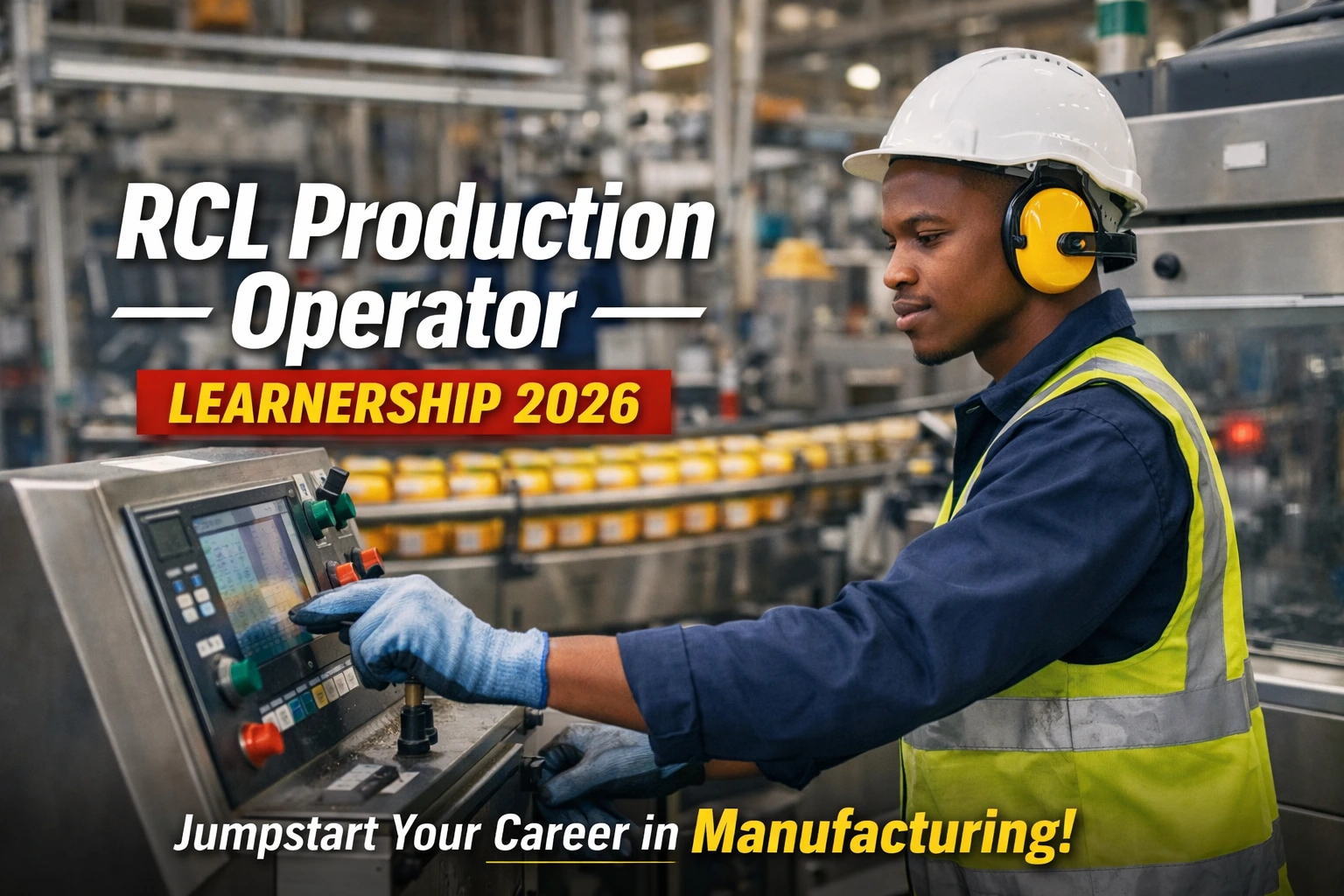
The RCL Production Operator Learnership 2026 offers Matriculants a structured path into manufacturing with an NQF Level 3 qualification, hands-on training, and real workplace exposure. Here’s what makes it a standout opportunity.
RCL Production Operator Learnership 2026: Why This Opportunity Matters Right Now
The RCL Production Operator Learnership 2026 arrives at a critical time for South Africa’s youth employment landscape. With youth unemployment still a persistent challenge and employers increasingly demanding practical experience, opportunities that combine structured training with real workplace exposure are becoming more valuable than ever.
For many Matriculants, the gap between education and employment is not a lack of ambition but a lack of access. Entry-level roles often require experience, while experience itself is difficult to gain without that first opportunity. This is where learnerships like this one step in—not as temporary solutions, but as structured entry points into long-term career pathways.
The RCL programme, offered through Siqalo Foods’ Spreads Division, is particularly noteworthy because it blends formal learning with real production-floor experience. It does not just prepare candidates for a job; it prepares them for a career within South Africa’s manufacturing sector.
ALSO APPLY FOR Huawei 4IR Skills Programme 2026: HCIA Datacom Training Opens Doors for ICT Careers
Understanding the RCL Production Operator Learnership 2026
At its core, the RCL Production Operator Learnership 2026 is designed to develop competent, independent production operators. This is not theoretical training. Instead, it focuses on equipping learners with practical skills required to operate machinery, monitor production processes, and maintain safety standards in a real manufacturing environment.
The programme leads to an NQF Level 3 qualification, which is aligned with skills development frameworks in industrial processing environments. This level of qualification is particularly important because it builds a foundation for further technical training and potential career progression.
Unlike many short-term training initiatives, this learnership integrates:
- Workplace-based learning
- Structured academic support
- Continuous assessment and development
This combination ensures that learners are not only exposed to the environment but are actively guided through it.
Quick Facts: RCL Production Operator Learnership 2026
- Closing Date: 23 April 2026
- Location: Not stated in the official advert
- Duration: Not stated in the official advert
- Positions Available: Not stated in the official advert
- Reference Number: RCL260416-8
- Stipend: Not stated in the official advert
- Required Gender: Not stated in the official advert
- Company: Siqalo Foods
Why Manufacturing Learnerships Are Gaining Importance || RCL Production Operator Learnership 2026
South Africa’s manufacturing sector remains one of the most important contributors to economic growth and job creation. However, it is also a sector undergoing transformation, driven by automation, efficiency demands, and global competition.
This shift has created a growing demand for semi-skilled and technically capable workers—individuals who understand machinery, processes, and production systems.
The RCL Production Operator Learnership 2026 aligns directly with this demand. Instead of focusing on general workplace readiness, it targets specific operational skills such as:
- Machine setup and operation
- Production monitoring
- Equipment handling
- Basic maintenance awareness
This is significant because manufacturing employers are increasingly prioritising job-ready candidates over purely academic qualifications.
From an economic perspective, programmes like this also support broader national goals around skills development and industrial growth.
Who Should Apply—and Why This Matters
The learnership is specifically aimed at Matriculants with Mathematics and Science, along with a minimum aggregate of 60%. This requirement is not arbitrary. It reflects the technical nature of production environments, where numerical understanding and problem-solving are essential.
However, one of the most progressive aspects of this programme is that numeracy and literacy assessments are not used as disqualifiers. This approach broadens access while still maintaining standards.
This signals a shift in recruitment thinking—from rigid filtering to potential-based selection.
For candidates, this means: RCL Production Operator Learnership 2026
- A fairer opportunity to compete
- Recognition beyond test performance
- A chance to demonstrate real capability
In a labour market where many applicants are filtered out early, this approach could make a meaningful difference.
The Real Value of Hands-On Training
One of the defining features of the RCL Production Operator Learnership 2026 is its emphasis on practical training. Learners are not confined to classrooms. Instead, they are immersed in real production environments where they can develop critical skills.
These include: RCL Production Operator Learnership 2026
- Operating industrial machinery safely
- Understanding production workflows
- Identifying equipment faults
- Supporting operational efficiency
In addition, learners are introduced to first-line maintenance tasks, such as lubrication, part replacement, and defect identification.
This exposure is particularly valuable because it bridges the gap between operator and technician roles. While learners are not trained as artisans, they gain foundational knowledge that can support future specialization.
From an industry perspective, this creates more versatile workers—individuals who understand both operation and maintenance basics.
Structured Learning Support: A Key Differentiator || RCL Production Operator Learnership 2026
Another strength of the programme is its structured learning support system. Many entry-level workers struggle not because they lack ability, but because they lack guidance.
This learnership addresses that through: RCL Production Operator Learnership 2026
- Facilitated contact sessions
- Micro-learning modules
- Ongoing assessment support
This layered approach to learning ensures that participants are not left to navigate complex environments on their own.
Micro-lessons, in particular, reflect modern training trends. Instead of overwhelming learners with large volumes of information, content is delivered in manageable segments, improving retention and understanding.
This approach aligns with global best practices in workforce training, where continuous learning is prioritized over once-off instruction.
Breaking the “No Experience” Barrier || RCL Production Operator Learnership 2026
One of the biggest challenges facing young job seekers is the paradox of needing experience to get a job, but needing a job to gain experience.
The RCL Production Operator Learnership 2026 directly addresses this issue by embedding experience into the learning process.
Participants do not just complete a course—they actively work within a production environment. This means that by the end of the programme, they have: RCL Production Operator Learnership 2026
- Practical experience
- A recognised qualification
- Exposure to workplace expectations
This combination significantly improves employability.
Employers often view candidates with learnership experience as lower-risk hires because they are already familiar with workplace dynamics.
How Applicants Can Strengthen Their Chances || RCL Production Operator Learnership 2026
While the programme is entry-level, competition is likely to be high. Learnerships linked to recognised employers typically attract a large number of applicants.
To improve their chances, candidates should focus on: RCL Production Operator Learnership 2026
- Ensuring accurate and complete application details
- Clearly reflecting Mathematics and Science results
- Demonstrating an understanding of manufacturing work
- Preparing for the assessment process
Attention to detail is particularly important. In many cases, applications are filtered based on completeness and accuracy before deeper evaluation.
Applying early is also a strategic advantage, especially given the 23 April 2026 closing date.
What This Means Going Forward
The RCL Production Operator Learnership 2026 reflects a broader shift in how skills development is being approached in South Africa.
Instead of separating education and employment, programmes are increasingly integrating the two. This has several implications:
- Greater accessibility: More young people can enter technical fields without prior experience
- Improved workforce readiness: Employers gain candidates who are already trained in practical environments
- Stronger career pathways: Learnerships create stepping stones toward further qualifications and roles
In the long term, this model could play a significant role in addressing both unemployment and skills shortages.
For the manufacturing sector, it represents a move toward sustainable talent development rather than short-term hiring.
How can candidates submit their applications?
Candidates must submit their applications through the official online application portal using reference number RCL260416-8.
Before submitting, applicants should double-check their personal details, Matric results, and subject information. In addition, they should complete their submission as early as possible to avoid last-minute issues.
Work Experience Platform
The closing date is 23 April 2026.
FAQs-RCL Production Operator Learnership 2026
1. Do I need prior work experience to apply?
No. The RCL Production Operator Learnership 2026 is designed for entry-level candidates, particularly Matriculants without prior work experience.
2. Will I receive a qualification after completing the programme?
Yes. Successful learners will obtain an NQF Level 3 qualification, which can support future employment or further studies in manufacturing.
Conclusion-RCL Production Operator Learnership 2026
The RCL Production Operator Learnership 2026 stands out as a structured, practical, and accessible opportunity for young South Africans seeking a foothold in the manufacturing sector.
It addresses one of the most pressing challenges in the job market—the lack of entry-level opportunities that offer both training and experience. By combining hands-on learning with formal qualification, it creates a pathway that is both realistic and sustainable.
While it may not guarantee immediate employment, it significantly strengthens a candidate’s position in a competitive labour market. For Matriculants with Mathematics and Science, this could be more than just a learnership—it could be the beginning of a long-term career in manufacturing.