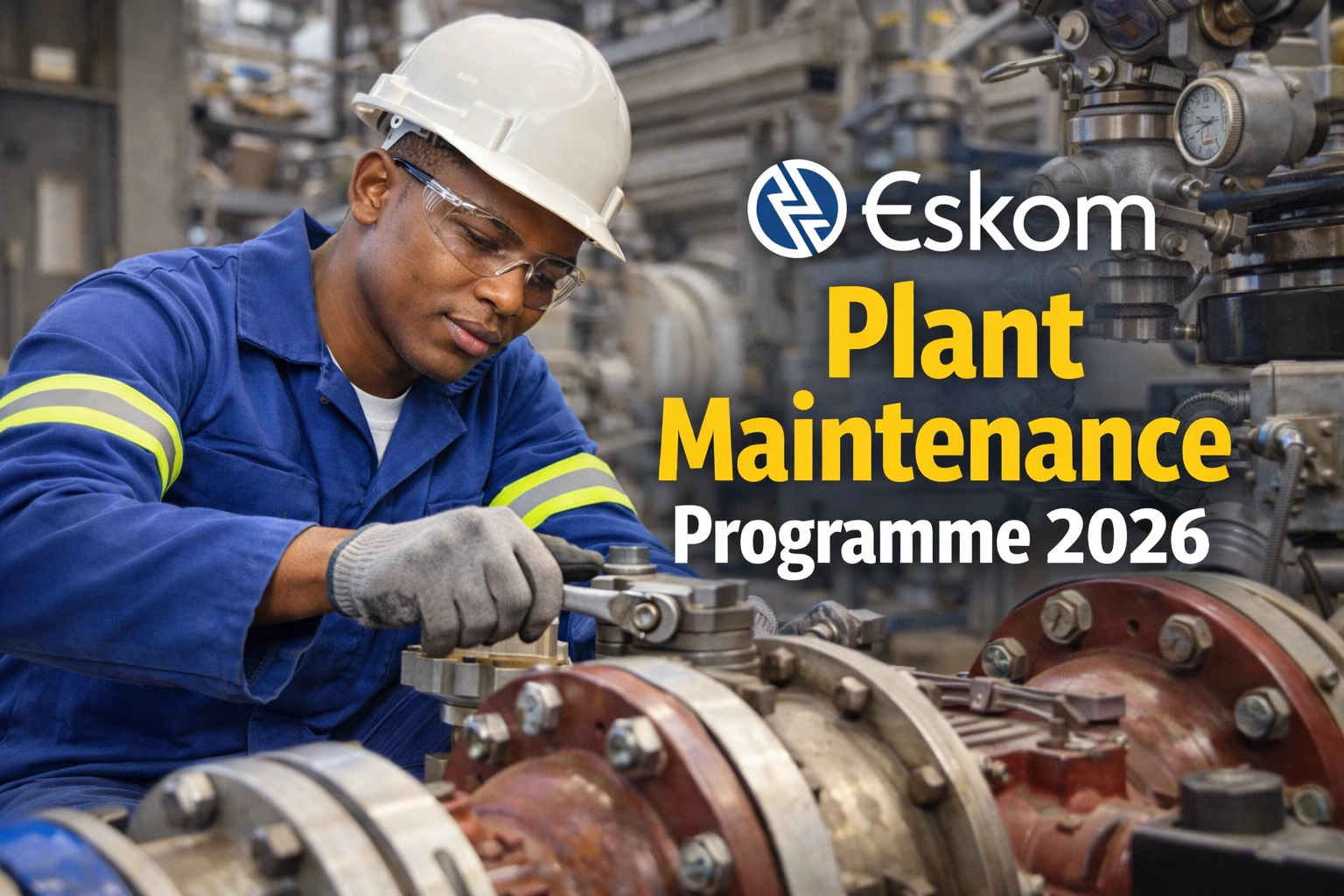
The Eskom Plant Maintenance Programme 2026 offers engineering graduates hands-on training and real plant exposure. Learn how to apply and why it matters.
Just after sunrise, the hum of turbines begins to rise inside one of South Africa’s power stations. Engineers move between control panels, maintenance crews inspect equipment, and somewhere in the middle of it all stands a young graduate — hard hat on, notebook open, trying to connect years of classroom theory to the noise, heat, and complexity unfolding around them.
This is the kind of environment the Eskom Plant Maintenance Programme 2026 is built for.
For many engineering graduates across South Africa, the transition from university to the workplace is not smooth. Degrees are earned, but opportunities to apply that knowledge in real industrial settings remain limited. This programme steps directly into that gap, offering structured technical exposure inside one of the country’s most critical sectors.
Quick Facts: Eskom Plant Maintenance Programme 2026
- Closing Date: 1 May 2026
- Location: Various sites across South Africa
- Duration: 2 Years
- Positions Available: 10
- Reference Number: eskom_004458
- Stipend: Market-related
Understanding the Eskom Plant Maintenance Programme 2026
At its core, the Eskom Plant Maintenance Programme 2026 is not just another graduate intake. It is a two-year technical training pathway designed to move graduates from theoretical understanding into practical engineering environments.
Hosted within Eskom’s Turbo Gen Services division, the programme focuses on plant maintenance — the backbone of power generation. Without consistent maintenance, even the most advanced systems fail. And in South Africa’s current energy landscape, reliability is everything.
Participants are placed in real working environments where they are exposed to daily operational challenges. This includes everything from equipment diagnostics to maintenance planning and system troubleshooting.
It’s not simulated learning. It’s operational learning.
Why This Programme Matters in South Africa Right Now
South Africa’s energy challenges are well documented. Load shedding, infrastructure strain, and aging equipment have made energy reliability a national conversation.
But behind every outage or system failure lies a technical reality: maintenance capacity.
There is a growing need for skilled engineers who understand not just how systems are designed, but how they are maintained, repaired, and optimised over time.
The Eskom Plant Maintenance Programme 2026 speaks directly to that need. It is part of a broader effort to rebuild technical capacity within the energy sector by investing in young engineers.
For graduates, this creates a rare alignment between personal career growth and national importance.
Who Should Apply — And Why It’s More Than Just Qualifications
The minimum requirement is clear: an S4 qualification in fields such as Mechanical Engineering, Electrical Engineering, Mechatronics, or Electronics (C&I).
But qualifications alone don’t define the ideal candidate.
This programme is best suited for graduates who are:
- Comfortable working in industrial environments
- Curious about how systems function beyond textbooks
- Willing to learn through observation, repetition, and hands-on tasks
- Open to working at different sites across the country
There is also no requirement for prior work experience. That detail alone makes the Eskom Plant Maintenance Programme 2026 stand out in a job market where “entry-level” roles often demand years of experience.
Here, potential matters more than history.
Inside the Training: What You’ll Actually Learn
The structure of the programme allows participants to build layered technical competence over time.
Rather than overwhelming learners with complexity from day one, the training introduces key areas progressively.
Participants will gain exposure to:
- Plant maintenance operations and engineering systems
- Reading and interpreting technical drawings and tolerances
- Equipment measurement and diagnostic techniques
- Quality control systems and engineering standards
- Maintenance planning and execution
These are not abstract skills. They are directly tied to how power plants operate daily.
Over two years, learners begin to understand not just individual components, but how entire systems interact — and where failures are most likely to occur.
The Technical Foundation Eskom Is Looking For
While the programme does not require work experience, it does expect a baseline level of technical understanding.
Applicants should be comfortable with:
- Using basic measuring instruments
- Interpreting engineering drawings
- Understanding technical specifications
- Applying basic quality standards
This foundation is important because it allows learners to integrate more quickly into real maintenance environments.
Without it, the learning curve becomes steep.
With it, the experience becomes transformative.
A Closer Look at Skills That Make Candidates Stand Out
Technical knowledge opens the door, but personal attributes often determine how far someone goes inside programmes like this.
Eskom highlights several key qualities:
- Strong work ethic and reliability
- Ability to work under pressure
- Adaptability in changing environments
- Good communication skills
- Initiative and problem-solving mindset
In a plant maintenance environment, things do not always go according to plan. Equipment fails, schedules shift, and urgent repairs arise.
The ability to stay focused and responsive in these situations is what separates average learners from exceptional ones.
Expert Insight: Why Maintenance Skills Are Becoming the New Engineering Advantage
In many engineering disciplines, design and innovation receive the most attention. But in industries like energy, maintenance is where long-term performance is decided.
A well-maintained system can extend its lifespan significantly, reduce operational costs, and improve reliability. Poor maintenance, on the other hand, leads to frequent breakdowns and inefficiencies.
The Eskom Plant Maintenance Programme 2026 reflects a shift in how engineering talent is being developed in South Africa. There is a growing recognition that maintenance expertise is not secondary — it is central.
Graduates who understand this early often position themselves for more stable and impactful careers.
How to Strengthen Your Application
With only 10 positions available, competition is expected to be high. A focused and technically aligned application can make a significant difference.
Here are a few practical ways to improve your chances:
- Clearly state your S4 qualification and specialisation
- Highlight technical modules, workshops, or lab work
- Mention any experience with tools, diagnostics, or engineering projects
- Keep your CV structured, concise, and relevant
- Avoid including unrelated information
A strong application tells a clear story: you have the foundation, the interest, and the readiness to grow in a technical environment.
SEE ALSO: Eskom Engineering Design Internships 2026: Only 2 Positions Available – Apply Before 23 April
Where to Apply
Applications for the Eskom Plant Maintenance Programme 2026 must be submitted online through Eskom’s official careers portal.
Application Details:
- Position: Learner – Plant Maintenance
- Reference Number: eskom_004458
- Department: Plant Maintenance
- Business Unit: Turbo Gen Services
APPLY HERE: Eskom Plant Maintenance Programme 2026
For enquiries, applicants can contact: recruitmenteri@eskom.co.za
Why This Programme Can Shape Long-Term Careers
Eskom remains one of the most recognized organisations in South Africa’s energy sector. Experience gained within its systems carries weight.
But beyond the name, it’s the nature of the training that matters.
Participants leave with:
- Practical engineering experience
- Exposure to real maintenance operations
- Understanding of industry standards
- Improved technical confidence
These are the kinds of attributes that employers across the engineering sector value.
For many graduates, this programme becomes the bridge between academic knowledge and employable skill.
FAQ: Eskom Plant Maintenance Programme 2026
1. Do I need work experience to apply?
No, the programme is designed for graduates without prior work experience.
2. Will I be placed at a specific location?
Placements are across various Eskom sites, depending on operational needs.
3. Is the programme paid?
Yes, participants receive a market-related stipend during the two-year programme.
Final Reflection: Building Skills That Power More Than Just Careers
In a country where energy reliability affects everything from small businesses to national growth, the importance of technical skills cannot be overstated.
The Eskom Plant Maintenance Programme 2026 is not just about training engineers. It is about strengthening the systems that keep South Africa running.
For graduates, it offers something increasingly rare: a structured, practical, and meaningful entry into the engineering world.
Not every opportunity changes the direction of a career. But some do.
And for the right candidate, this could be one of them.
Final Thought
In a country where infrastructure challenges are no longer abstract headlines but daily lived realities, opportunities like the Eskom Plant Maintenance Programme 2026 carry weight beyond individual career growth. They represent a quiet but necessary investment in the technical backbone of South Africa.
For many graduates, the hardest part of the journey is not earning the qualification — it is finding a space where that knowledge can be tested, refined, and trusted in real environments. This programme offers exactly that. It places young engineers where decisions matter, where systems are complex, and where learning is shaped by responsibility, not just theory.
What stands out is not only the structure of the programme, but its intention. It acknowledges a gap in the system — the disconnect between education and industry — and attempts to close it through practical exposure. That approach may not solve the broader employment challenge overnight, but it creates meaningful progress where it counts.
For applicants, the decision to apply should be grounded in more than urgency. It should come from a willingness to engage deeply with technical work, to learn patiently, and to adapt within demanding environments.
Because in the end, programmes like this do more than build careers. They help develop the kind of professionals who keep essential systems running — often behind the scenes, but always at the centre of progress.