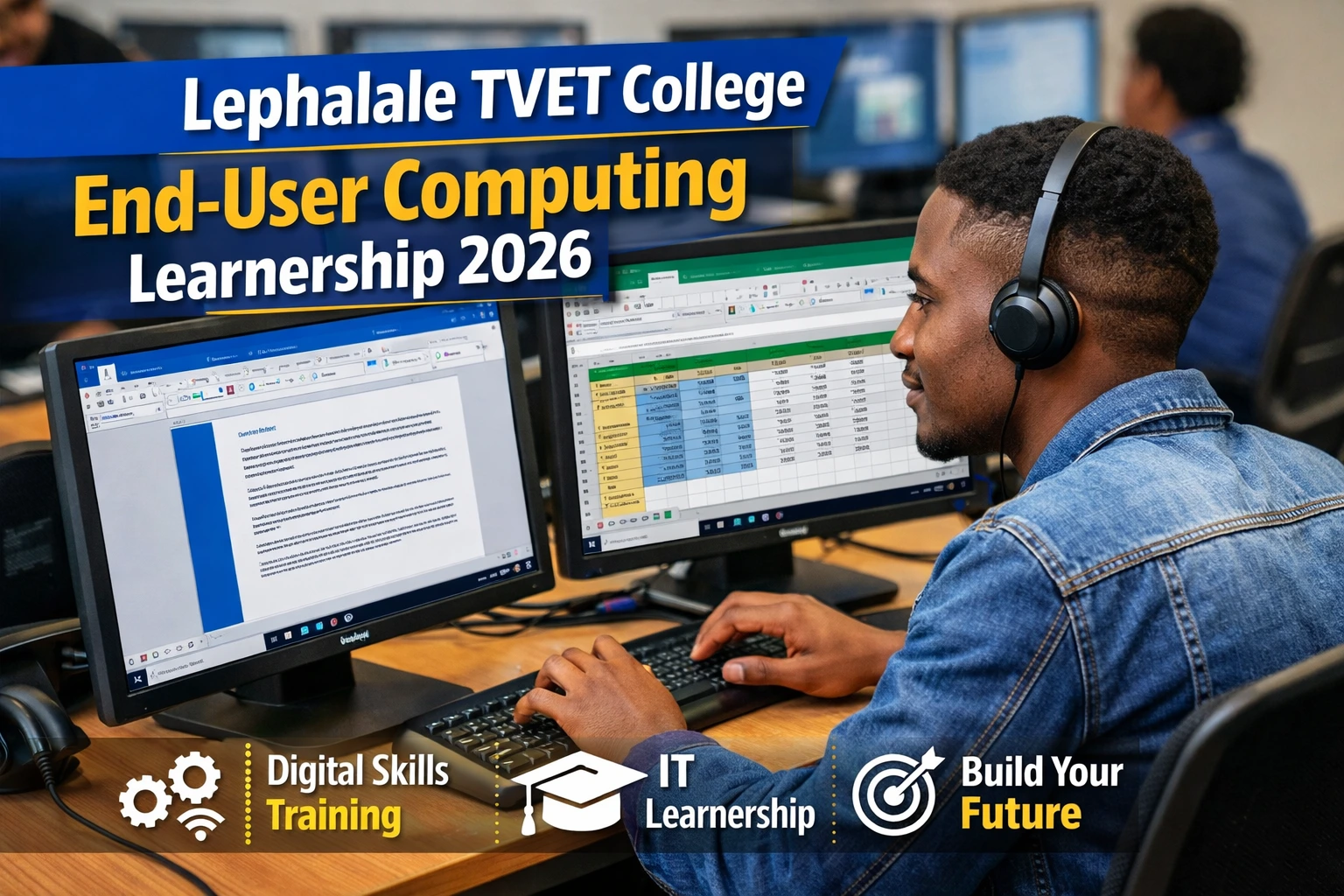
The Lephalale TVET College End-User Computing Learnership 2026 offers unemployed youth a powerful entry into digital careers. Here’s why it matters now.
Lephalale TVET College End-User Computing Learnership 2026: Why This Opportunity Matters Now
The Lephalale TVET College End-User Computing Learnership 2026 arrives at a critical moment for South Africa’s youth employment landscape. With unemployment among young people remaining persistently high and digital skills increasingly becoming a baseline requirement across industries, opportunities like this are no longer optional stepping stones — they are essential gateways.
What makes this particular learnership stand out is not just its accessibility, but its alignment with current workplace demands. As businesses across sectors digitize operations, even entry-level roles now require a level of computer literacy that many jobseekers still lack.
This programme, therefore, is more than just training. It represents a structured pathway into the digital economy — one that can shape long-term employability for those who take it seriously.
ALSO APPLY FOR Eskom Engineering Design Internships 2026: Only 2 Positions Available – Apply Before 23 April
ALSO READ OUR PRIVACY POLICY
Quick Facts: Lephalale TVET College End-User Computing Learnership Learnership 2026
- Closing Date: 21 April 2026 at 16h00
- Location: Lephalale TVET College (Lephalale Campus)
- Duration: 12 months
- Positions Available: Not stated in the official advert
- Reference Number: Not stated in the official advert
- Stipend: Not stated in the official advert
- Required Gender: Not stated in the official advert
- Name of the Company: Lephalale TVET College
Understanding the End-User Computing Learnership: More Than Basic Computer Skills
At first glance, the Lephalale TVET College End-User Computing Learnership 2026 might appear to be a standard IT training programme. However, a deeper look reveals its broader significance.
End-User Computing at NQF Level 3 focuses on practical, everyday digital competencies — the kind that employers expect but often find missing. These include:
- Basic computer operations
- Office software usage (word processing, spreadsheets, presentations)
- Email communication and digital collaboration
- Data handling and file management
These are not advanced technical skills, but they are foundational. In many workplaces, the inability to perform these tasks efficiently can immediately disqualify candidates from consideration.
This is where the learnership becomes impactful. It closes a real and measurable skills gap.
Why Digital Skills Are Now Non-Negotiable || End-User Computing Learnership
Across South Africa, the shift toward digital-first operations is accelerating. From retail and logistics to government services and small businesses, technology is embedded in daily workflows.
Even roles traditionally considered “non-technical” — such as receptionists, clerks, and customer service agents — now require digital fluency.
The implication is clear:
Without basic computing skills, jobseekers are effectively excluded from a large portion of the job market.
The Lephalale TVET College End-User Computing Learnership 2026 directly addresses this issue by targeting unemployed youth and equipping them with practical, workplace-relevant skills.
Importantly, the programme does not require prior IT experience. This lowers the barrier to entry while still delivering meaningful value.
Accessibility and Inclusion: Who Really Benefits?
One of the most notable aspects of this learnership is its accessibility.
The minimum requirements are: End-User Computing Learnership
- Grade 12 or NCV Level 4
- Age between 18 and 35
- Unemployed status
This makes the programme particularly relevant for: End-User Computing Learnership
- School leavers who did not pursue tertiary education
- Young adults struggling to secure their first job
- Individuals looking to pivot into administrative or office-based roles
By not demanding advanced qualifications, Lephalale TVET College is effectively widening access to digital training.
However, accessibility does not mean lack of competition.
Given the simplicity of the requirements, it is likely that the programme will attract a high volume of applications. This makes the quality of submission a key differentiator.
The Application Process: Where Many Candidates Fall Short
While the requirements are straightforward, the application process introduces a level of discipline that many applicants underestimate.
Candidates must submit: End-User Computing Learnership
- A detailed CV
- Certified copies of qualifications (not older than six months)
- A certified ID copy
- Proof of residence
Applications must be emailed with the correct subject line:
“IT End-User Computing”
This might seem like a minor detail, but it reflects a broader reality:
Employers and training providers often use small indicators to assess professionalism.
Common mistakes that can weaken an application include:
- Missing attachments
- Expired certified documents
- Poorly structured CVs
- Incorrect subject lines
In a competitive pool, these errors can result in immediate disqualification.
In contrast, a well-prepared application signals attention to detail — a trait highly valued in administrative and digital roles.
ALSO APPLY FOR York Timbers Internships 2026: Forestry Internship Experience Programme Guide
The Strategic Value of TVET Colleges in South Africa || End-User Computing Learnership
Technical and Vocational Education and Training (TVET) colleges have increasingly become central to South Africa’s skills development strategy.
Institutions like Lephalale TVET College play a dual role: End-User Computing Learnership
- Providing accessible education and training
- Bridging the gap between theory and practical workplace skills
Unlike traditional academic pathways, TVET programmes are designed with employability in mind. They focus on competencies that can be applied immediately in real-world settings.
This aligns closely with employer expectations, particularly for entry-level roles.
In this context, the Lephalale TVET College End-User Computing Learnership 2026 is not just a training programme — it is part of a broader national effort to reduce the skills mismatch in the labour market.
Timing and Urgency: Why Early Preparation Matters
The closing date — 21 April 2026 at 16h00 — introduces a strict deadline that cannot be ignored.
Late applications will not be considered.
This is a critical point, especially for candidates who may underestimate the time required to:
- Certify documents
- Update their CV
- Scan and organize files
- Ensure all attachments are correct
Procrastination is often the biggest risk.
In many cases, candidates who meet all the eligibility criteria still miss out simply because they delay preparation.
The insight here is simple but important:
Preparation is part of the selection process.
Location Factor: Practical Considerations Often Overlooked
The training will take place at the Lephalale campus of Lephalale TVET College.
This raises an important but often overlooked factor: logistics.
Candidates should consider:
- Daily transport costs
- Travel time
- Possible relocation if necessary
These practical considerations can impact attendance and overall success in the programme.
Ignoring them at the application stage can lead to challenges later on.
What This Means Going Forward
The Lephalale TVET College End-User Computing Learnership 2026 reflects a broader trend in South Africa’s labour market — the increasing importance of foundational digital skills.
Looking ahead, several key implications emerge:
- Digital literacy will continue to define employability
Even entry-level roles will require basic computing competence. - Short-term training programmes will gain importance
Learnerships and skills-based programmes offer faster entry into the workforce compared to traditional degrees. - Competition for accessible opportunities will increase
As more young people recognize the value of these programmes, application volumes will rise. - Employers will prioritize practical skills over theoretical knowledge
Candidates who can demonstrate real-world competencies will have an advantage.
In this context, opportunities like this learnership are likely to become even more valuable — and more competitive.
How must candidates submit for End-User Computing Learnership?
Applications must be emailed to skillsrecruitment@leptvetcol.edu.za.
The subject line must indicate:
IT End-User Computing
Using the exact subject line helps ensure the application is correctly identified and processed under the right programme.
When is the closing date for End-User Computing Learnership?
The closing date is 21 April 2026 at 16h00.
FAQs-End-User Computing Learnership
1. Can I apply if I don’t have prior IT experience?
Yes. The learnership is designed for beginners and does not require previous IT knowledge. However, you must meet the minimum academic requirements.
2. What happens after completing the learnership?
While employment is not guaranteed, the skills gained can significantly improve your chances of securing entry-level roles in administration, customer service, or office support.
Conclusion-End-User Computing Learnership
The Lephalale TVET College End-User Computing Learnership 2026 stands out as a practical, accessible, and timely opportunity for unemployed youth seeking to build relevant digital skills.
Its strength lies not in complexity, but in its alignment with real-world workplace demands. For many applicants, this could be the first meaningful step toward long-term employability.
However, eligibility alone is not enough. Success begins with preparation — from compiling documents to submitting a complete and professional application.
In a competitive environment, the difference between being considered and being overlooked often comes down to attention to detail.