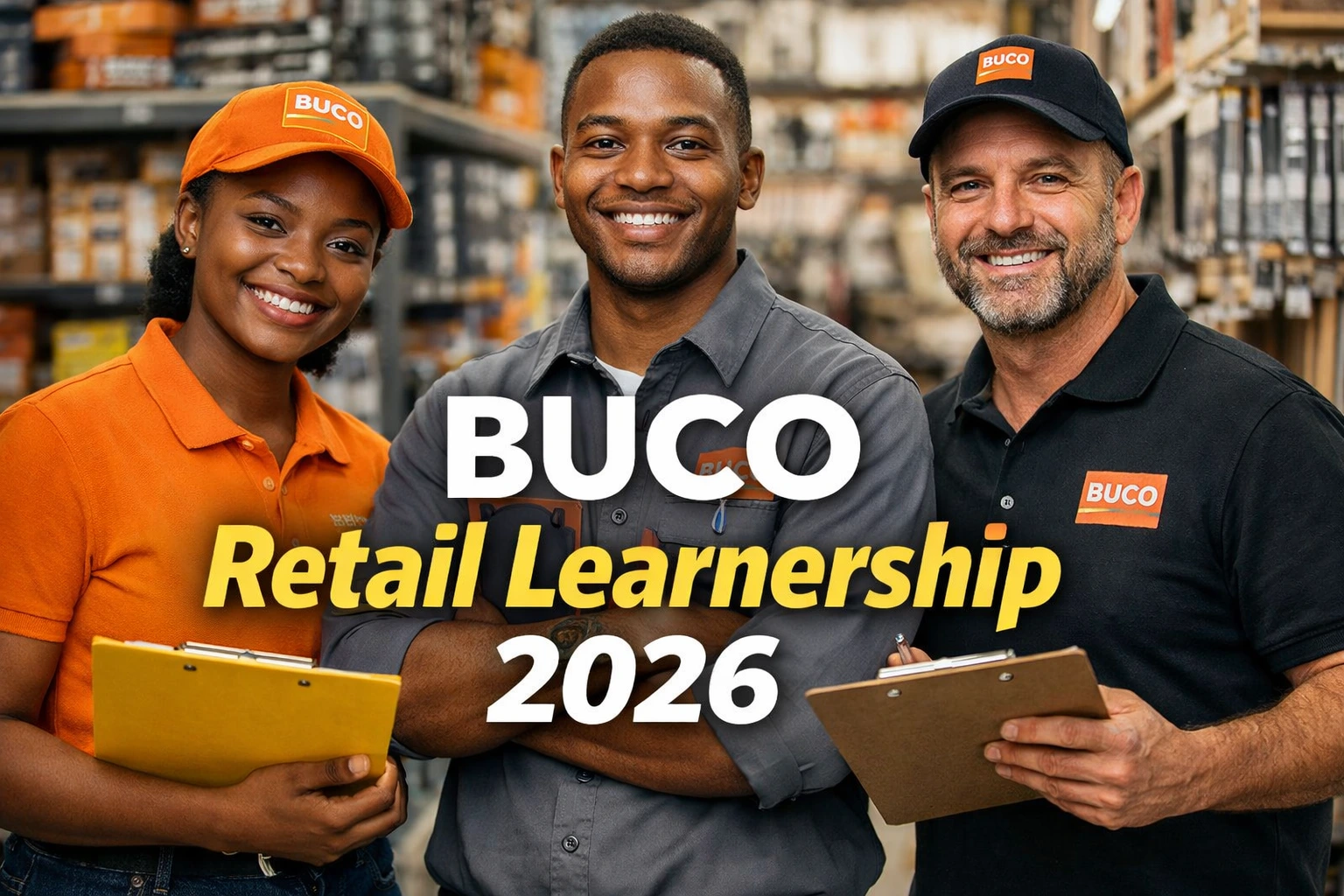
Apply for the BUCO Retail Learnership 2026. A 12-month work-and-learn opportunity for Grade 12 graduates to gain retail experience and earn a stipend.
On a typical weekday morning in Pretoria, the line outside a hardware store doesn’t look unusual. Contractors in overalls wait for supplies, a young DIY enthusiast studies shelves of paint, and somewhere between them stands a recent matriculant—uncertain, hopeful, and quietly determined. For many young South Africans, this is more than a store. It’s a possible entry point into the working world.
The BUCO Retail Learnership 2026 arrives at a time when thousands of school leavers are searching for something beyond short-term gigs or endless job applications. It offers something structured, practical, and increasingly valuable: a way to learn and earn at the same time.
But what makes this learnership stand out in a crowded field of opportunities? And why does it matter now more than ever?
Understanding the BUCO Retail Learnership 2026 in Today’s Job Market
The BUCO Retail Learnership 2026 is not just another training programme. It’s part of a broader shift in South Africa’s approach to youth employment—one that blends education with real-world experience.
Offered by BUCO, a division of The Building Company, the programme is aligned with the Wholesale and Retail SETA (W&RSETA). That alignment matters because it ensures the training is nationally recognised and structured according to industry needs.
Participants spend 12 months rotating between classroom-based learning and hands-on work in a retail environment. This dual model is critical in a country where employers increasingly prioritise experience over theory.
In practical terms, this means a learner might spend the morning understanding inventory systems and the afternoon applying that knowledge on the shop floor—assisting customers, managing stock, or handling point-of-sale systems.
Why This Learnership Matters More in 2026
South Africa’s youth unemployment rate remains one of the highest globally. While many interventions exist, not all of them bridge the gap between education and employment effectively.
The BUCO Retail Learnership 2026 addresses this gap in three important ways:
- It provides structured workplace exposure
- It builds industry-specific skills
- It results in a Portfolio of Evidence (PoE) that proves competency
This last point is often underestimated. In many job interviews, candidates struggle to demonstrate what they can actually do. A PoE changes that—it becomes tangible proof of skills, not just claims on a CV.
In a competitive retail and FMCG environment, this can make a measurable difference.
Inside the Experience: What Learners Actually Do
The day-to-day experience of a BUCO learner is designed to mirror real retail operations. This isn’t simulated training—it’s participation in a functioning business.
Learners rotate through key areas such as:
- Customer Service: Assisting customers with product selection, especially in a specialised hardware environment
- Merchandising: Organising shelves, pricing items correctly, and maintaining visual standards
- Stock Replenishment: Understanding the flow of goods from delivery to display
- Housekeeping: Ensuring safety and cleanliness across the store
- Theory Sessions: Learning retail principles, compliance, and operational systems
What makes BUCO unique is its hardware retail focus. Unlike general retail, this sector requires product knowledge that ranges from tools to construction materials. Over time, learners develop niche expertise that can open doors beyond traditional retail roles.
The W&RSETA Pathway: More Than Just a Job
Expert Insight: Why Learnerships Are Structured This Way
Learnerships in South Africa are governed by Sector Education and Training Authorities (SETAs), and W&RSETA plays a key role in retail programmes like this one.
One important rule often overlooked is the “one-time opportunity” principle. If you’ve already completed a SETA-funded unemployed learnership, you may not qualify again. This policy ensures that opportunities reach as many first-time participants as possible.
Another critical component is the Portfolio of Evidence (PoE). Unlike traditional exams, the PoE is built over time. It includes:
- Task logs
- Supervisor evaluations
- Practical demonstrations
This approach reflects a deeper shift in education—moving from memorisation to demonstrated competence.
In essence, the BUCO learnership is not just training you to work in a store. It’s training you to prove you can work in a store.
Who Should Apply for the BUCO Retail Learnership 2026?
The programme targets a very specific group:
- Unemployed South Africans aged 18–35
- Individuals with a Grade 12 (Matric) certificate
- Candidates with a clear criminal record
- Those willing to work retail hours, including weekends
But beyond these formal requirements, there’s something less visible that recruiters look for: trainability.
This includes attitude, reliability, and willingness to learn. Retail environments move quickly, and adaptability often matters more than prior experience.
A strong CV for this opportunity doesn’t need to be long—it needs to be focused. Highlighting basic numeracy, communication skills, and a positive mindset can significantly improve your chances.
Quick Facts: BUCO Retail Learnership 2026
- Closing Date: Not specified (rolling applications)
- Location: Various BUCO stores across South Africa
- Duration: 12 months
- Positions Available: Not specified
- Reference Number: Not specified
- Stipend: Monthly learner allowance (not a full salary)
ALSO APPLY FOR: Renault YES Learnership Programme 2026: Requirements, Benefits, and How to Apply
Required Documents: Getting Your Application Ready
Preparation can make the difference between being shortlisted or overlooked. Applicants should have the following ready:
- Updated CV
- Certified copy of South African ID
- Certified Grade 12 certificate
- Proof of residence
All documents should be clear, properly scanned, and ideally saved as PDFs. Many applications are rejected simply because documents are incomplete or unreadable.
Where to Apply
Applications for the BUCO Retail Learnership 2026 are processed through the official BUCO careers portal.
To apply:
- Visit the BUCO careers website
- Search for “Retail Learnership” or “Learner”
- Complete your profile fully
- Upload all required documents
- Submit your application
APPLY HERE: BUCO Retail Learnership 2026
Because there is no fixed closing date, applications are reviewed on a rolling basis. Once positions are filled, the listing may disappear without notice.
A Subtle Advantage: Why Hardware Retail Skills Are Valuable
Retail is often seen as a general entry-level field, but not all retail experience is equal.
Working in a hardware-focused environment like BUCO exposes learners to:
- Construction materials
- Tools and equipment
- Trade-related customer interactions
This creates a unique advantage. Learners are not only prepared for retail roles but can also transition into:
- Sales consulting in construction supply
- Warehouse operations
- Procurement roles
In a country investing heavily in infrastructure and housing, these skills are increasingly relevant.
FAQ: BUCO Retail Learnership 2026
1. Do I need prior work experience to apply?
No. The programme is designed for individuals with no formal work experience.
2. Will I get a permanent job after the learnership?
There is no guarantee, but strong performers may be considered for permanent roles within the company.
3. Is the stipend enough to live on?
The stipend is intended to cover basic expenses like transport. It is not equivalent to a full salary.
The Bigger Picture: More Than Just One Opportunity
The BUCO Retail Learnership 2026 reflects a broader reality about the future of work in South Africa. Traditional pathways—study, graduate, find a job—are no longer guaranteed. Instead, hybrid models like learnerships are becoming essential stepping stones.
For many young people, the challenge isn’t just finding a job—it’s finding a way in. Programmes like this create that entry point, offering not just income, but direction.
Standing in that morning queue outside a hardware store, the opportunity might not look life-changing at first glance. But for someone willing to learn, adapt, and grow, it could be the beginning of something much bigger—a career built one skill, one shift, and one experience at a time.
Final Thought-BUCO Retail Learnership 2026
In a country where opportunity often feels just out of reach for many young people, programmes like the BUCO Retail Learnership 2026 carry a deeper significance than what appears on the surface. This is not simply about gaining retail experience or earning a monthly stipend—it is about access. Access to structured learning, to a recognised qualification, and most importantly, to a real working environment where skills are built through practice, not theory alone.
For a matriculant standing at the uncertain crossroads between education and employment, this learnership represents a practical first step. It acknowledges a reality many face: that potential alone is not enough without opportunity. By combining classroom knowledge with hands-on exposure, BUCO is helping to bridge a gap that has long defined South Africa’s youth employment landscape.
There is also something quietly powerful about starting in a space like retail. It teaches resilience, communication, problem-solving, and discipline—skills that extend far beyond the shop floor. Whether a learner chooses to stay in retail, move into sales, or explore entirely different industries, the foundation remains valuable.
Ultimately, the BUCO Retail Learnership 2026 is not a guaranteed path to success, but it is a meaningful starting point. And sometimes, that first step—taken with intention and effort—is what shapes everything that follows.