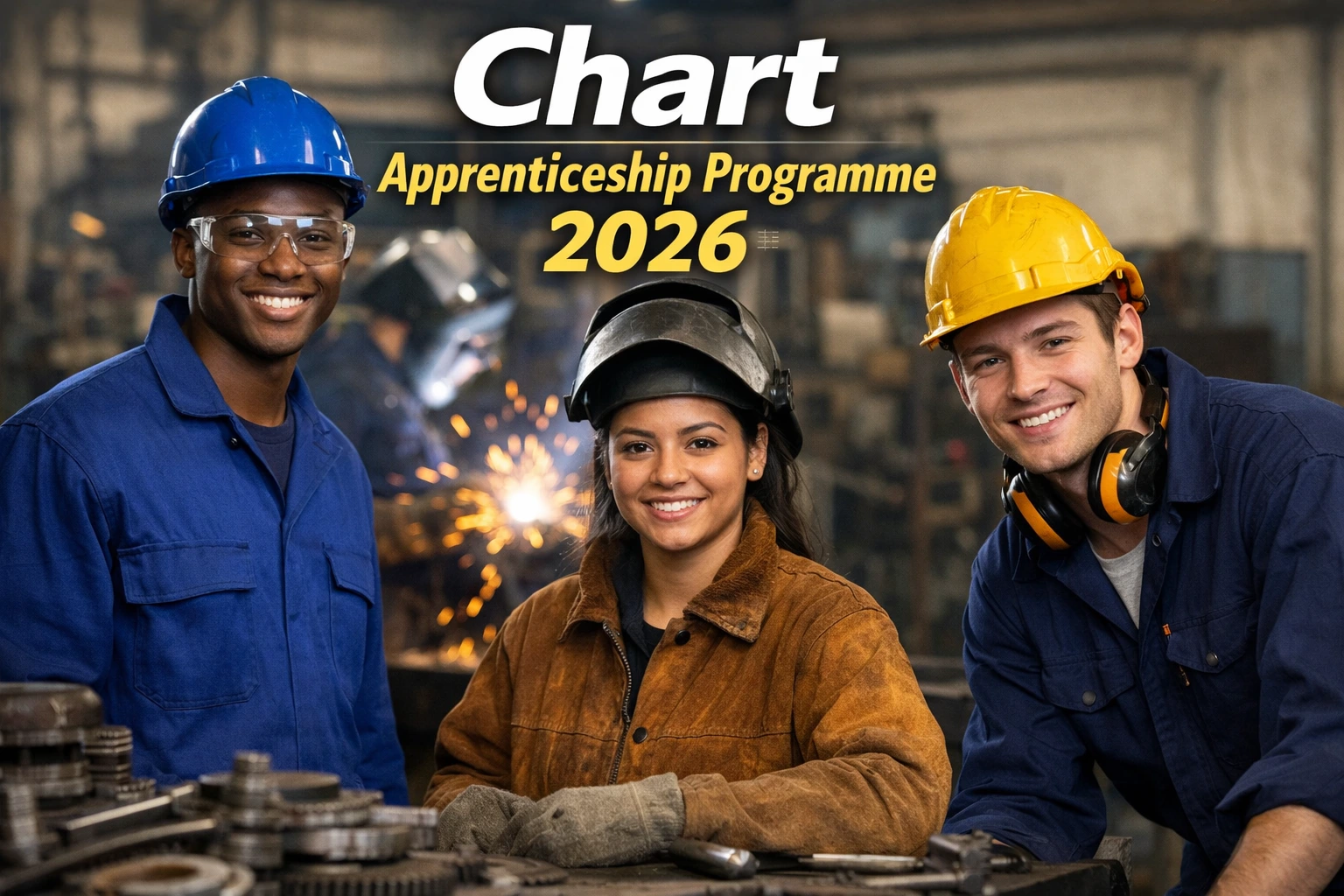
Explore the Chart Apprenticeship Programme 2026 in Johannesburg. Learn how this 4-year artisan training opportunity can shape your engineering career in South Africa.
The early morning air in Booysens carries a familiar rhythm — the hum of machinery, the metallic clang of tools, and the quiet focus of skilled hands at work. For many young South Africans standing at the edge of unemployment, spaces like this feel distant, almost unreachable. But for a small group of determined applicants, the Chart Apprenticeship Programme 2026 could be the doorway into that world.
At a time when practical skills are becoming just as valuable as formal degrees, opportunities like this are not just jobs — they are lifelines. And in a country where youth unemployment remains a pressing issue, structured apprenticeship programmes are slowly redefining what career success can look like.
A hands-on future: Why the Chart Apprenticeship Programme 2026 matters
The Chart Apprenticeship Programme 2026 arrives at a crucial moment. South Africa’s industrial and engineering sectors continue to face a shortage of skilled artisans, even as thousands of young people search for work. This mismatch is not new — but programmes like this aim to bridge that gap in a practical, sustainable way.
Offered by Chart Industries through its Howden division, the programme is built on more than a century of engineering expertise. Howden has long been known for its work in air and gas handling systems — critical components in industries ranging from mining to energy. For apprentices, this means exposure to real-world operations that keep major sectors running.
Unlike short-term learnerships, this is a four-year structured apprenticeship, combining classroom-based theory with on-the-job training. It’s not quick or easy, but that’s precisely what makes it valuable.
Inside the programme: trades, training, and real work experience
This apprenticeship is not a generic training scheme. It is targeted, focused, and built around specific trades that are in demand.
Successful candidates will train in one of the following:
- Boilermaking (2 positions in Gauteng)
- Welding (1 position in Gauteng)
- Mechanical Fitting (2 positions in Mpumalanga)
Each trade offers a different pathway into the engineering ecosystem. A boilermaker shapes and assembles metal structures. A welder ensures precision joining of materials. A mechanical fitter works on installation and maintenance of machinery.
But what makes the Chart Apprenticeship Programme 2026 stand out is how learning happens. Apprentices won’t just sit in classrooms — they will:
- Assist experienced artisans on real projects
- Work with industrial tools and systems
- Develop problem-solving skills in live environments
- Gain exposure to safety protocols and technical standards
This blend of theory and practice is what transforms learners into artisans.
Who should apply — and who usually succeeds
Not every applicant will make it through — and that’s intentional. Apprenticeships like this are designed for individuals who are serious about building a long-term career in engineering.
To qualify, applicants need:
- A Technical Matric with Mathematics and Science, or
- An N3 qualification with relevant trade subjects
But qualifications alone are not enough. The programme looks for something deeper:
- Engineering aptitude
- Attention to detail
- Strong problem-solving ability
- Willingness to learn and adapt
- Ability to work in a team
There are also strict requirements — candidates must be medically fit, have no criminal record, and pass psychometric assessments.
This may sound demanding, but it reflects the reality of the work. Engineering environments require discipline, focus, and responsibility.
SEE ALSO: Bursaries vs Student Loans: Which Is Better for South African Students in 2026?
Local impact: From Gauteng workshops to Mpumalanga sites
One of the most compelling aspects of the Chart Apprenticeship Programme 2026 is its regional footprint.
Training is not limited to a single location. Instead, apprentices are placed across key industrial areas:
- Gauteng (Booysens): Boilermakers and welders
- Mpumalanga (Arnot and Kendal): Mechanical fitters
This distribution reflects where the work actually happens. Mpumalanga, for example, is home to major power stations and industrial operations, making it an ideal environment for mechanical training.
For many young people, this also means relocation — a challenge, but also an opportunity. Exposure to different industrial settings can significantly broaden career prospects.
SEE ALSO: 10 Costly Mistakes Students Must Avoid in 2026 to Succeed Academically and Financially
Beyond training: What this opportunity really offers
At first glance, an apprenticeship might seem like just another training programme. But the long-term value runs much deeper.
Completing the Chart Apprenticeship Programme 2026 can lead to:
- Recognised artisan qualifications
- Increased employability in engineering sectors
- Opportunities within global companies
- Potential for career progression into supervisory or specialist roles
In a labour market where experience often matters more than theory, this kind of hands-on training can be a game changer.
SEE ALSO: Bursaries vs Student Loans: Which Is Better for South African Students in 2026?
Expert insight: Why artisan careers are quietly rising again
For years, university degrees dominated the conversation around success. But that narrative is shifting.
Across South Africa, industries are rediscovering the importance of skilled artisans — people who can build, repair, and maintain the systems that keep the economy running.
Engineering experts often point out that:
- Infrastructure development depends heavily on artisans
- Renewable energy projects require technical skills
- Manufacturing and mining sectors cannot function without them
This means apprenticeships are no longer a “second option.” They are becoming a primary pathway into stable, well-paying careers.
The Chart Apprenticeship Programme 2026 sits directly within this shift — offering not just training, but relevance in a changing economy.
Quick facts: Chart Apprenticeship Programme 2026
- Location: Johannesburg (Gauteng) and Mpumalanga (Arnot & Kendal)
- Duration: 4 years
- Positions available: 5
- Trades: Boilermaker, Welder, Mechanical Fitter
Where to apply
To apply for the Chart Apprenticeship Programme 2026, candidates should visit the official Chart Industries careers portal or apply directly through the listing where the programme was advertised.
Ensure that you submit:
- Certified copy of your ID
- Certified academic results
- Relevant qualifications
APPLY HERE: Chart Apprenticeship Programme 2026
Incomplete applications are unlikely to be considered, so attention to detail matters even before the selection process begins.
ALSO APPLY FOR: Valterra Platinum Learnership Fitter 2026: A High-Value Entry Into South Africa’s Engineering Job Market
FAQ: Chart Apprenticeship Programme 2026
1. Is the Chart Apprenticeship Programme 2026 paid?
The advert does not specify a stipend. Applicants should confirm details during the application or interview process.
2. Can I apply without Mathematics and Science?
No. A Technical Matric with Mathematics and Science or an N3 with relevant subjects is required.
3. Will I get a job after completing the apprenticeship?
While employment is not guaranteed, completing the programme significantly improves your chances of finding work in the engineering sector.
The bigger picture: More than just an opportunity
The Chart Apprenticeship Programme 2026 is not just about filling five positions. It represents something larger — a shift toward skills-based development in South Africa.
For young people who feel locked out of traditional career paths, apprenticeships offer a different kind of hope. One that is grounded in real work, real skills, and real progress.
And in workshops like those in Booysens or industrial sites in Mpumalanga, that hope becomes tangible — shaped in steel, refined through effort, and built into something lasting.
Because sometimes, the most powerful careers don’t begin in lecture halls. They begin with tools in hand, learning step by step, until one day, you’re no longer the apprentice — you’re the expert others look up to.
Final Thought
In many ways, the Chart Apprenticeship Programme 2026 represents more than just an opportunity to learn a trade — it reflects a broader shift in how young people in South Africa can approach their futures. For years, the pressure to follow a single path — often university — has left many feeling excluded when that route wasn’t accessible. But programmes like this quietly challenge that idea, proving that success can be built through skill, discipline, and hands-on experience.
What stands out most about this apprenticeship is not just the four-year training period, but the intention behind it. It is designed to produce artisans who are not only technically competent but also capable of adapting to real industrial environments. In sectors where precision, safety, and problem-solving are essential, this kind of preparation is invaluable. It bridges the gap between education and employment in a way that feels practical and grounded.
There’s also something deeply important about where this opportunity takes place. From workshops in Gauteng to industrial sites in Mpumalanga, apprentices are exposed to the realities of South Africa’s working landscape. These are not controlled classroom settings — they are spaces where real work happens, where mistakes teach lessons, and where growth is earned through effort.
For many applicants, this programme could be the first real step into a stable and meaningful career. And while not everyone who applies will be selected, the existence of opportunities like the Chart Apprenticeship Programme 2026 sends a powerful message: that there is value in building, fixing, and creating — and that these skills are not only needed but respected.
Ultimately, the bigger picture is clear. South Africa doesn’t just need more jobs — it needs more pathways. And apprenticeships like this are quietly becoming one of the most important ones.