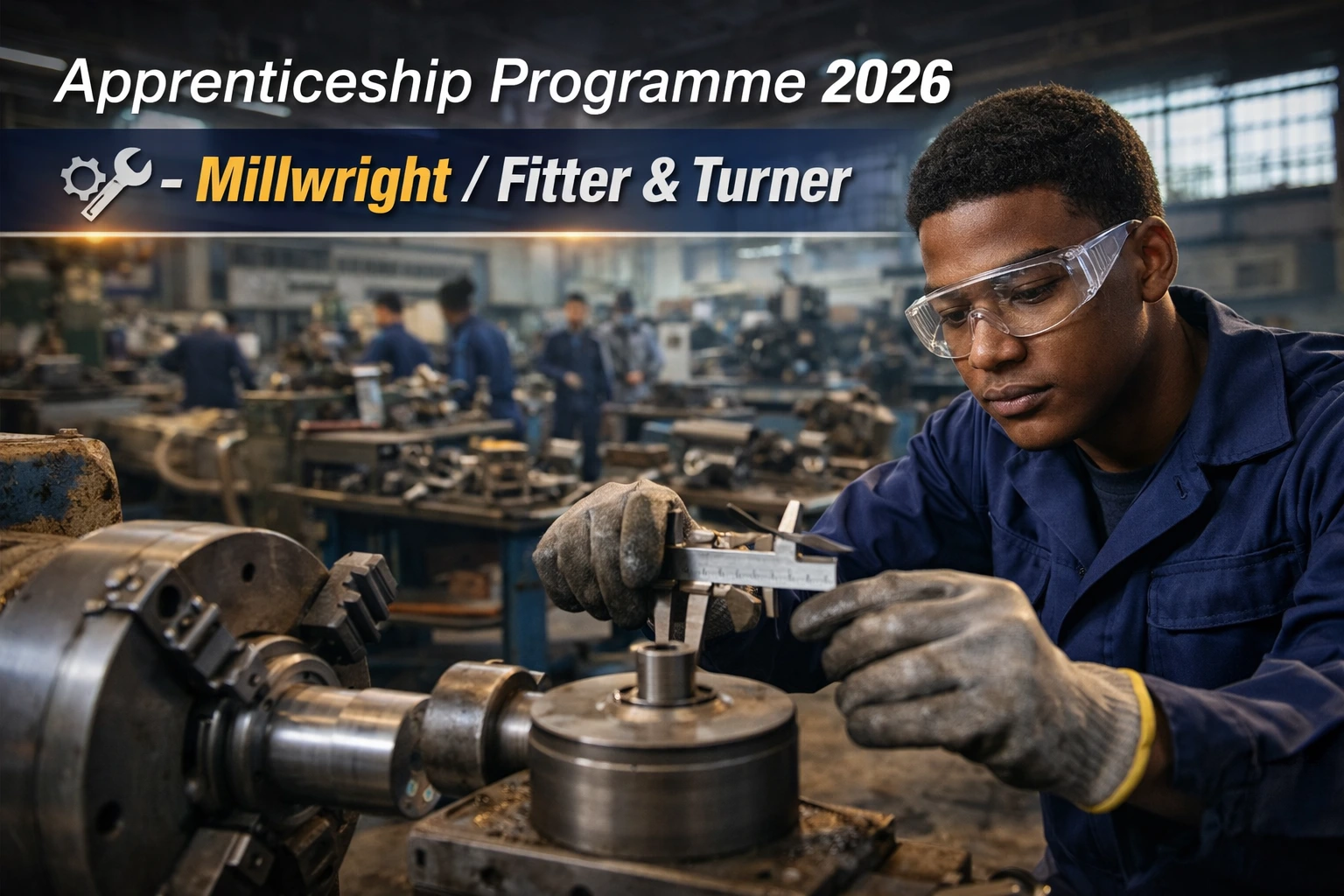
Apply for the Apprenticeship Programme 2026 in Durban. Train as a Millwright or Fitter & Turner and gain real technical experience before 10 April 2026
Apprenticeship Programme 2026: A Practical Pathway Into South Africa’s Skilled Trades
The sound of machinery echoes through a workshop in Prospecton, Durban — metal against metal, tools clanking, engines humming in steady rhythm. For many young South Africans, this is where a different kind of education begins. Not in lecture halls or online classrooms, but on factory floors where precision matters and mistakes carry real consequences.
The Apprenticeship Programme 2026 offers exactly this kind of hands-on entry into the world of skilled trades. At a time when university degrees dominate conversations about success, apprenticeships quietly continue to build the backbone of South Africa’s industrial economy.
For those willing to work with their hands, think critically, and commit to technical mastery, this programme could represent more than training — it could be a long-term career foundation.
Inside the Apprenticeship Programme 2026: What to Expect
The Apprenticeship Programme 2026 is structured to develop technical competence in two key trades: Millwright and Fitter & Turner. These are not entry-level jobs in the traditional sense; they are specialised roles that require a blend of mechanical knowledge, problem-solving ability, and precision.
Participants will be placed in an hourly-rated contract position for the duration of the programme, where learning is directly tied to real operational tasks.
Unlike purely academic pathways, this programme is immersive. Apprentices are expected to:
- Engage with machinery and systems daily
- Learn through observation, repetition, and correction
- Develop technical and analytical thinking skills
- Understand how industrial environments operate
There’s also an important reality to acknowledge: permanent employment is not guaranteed. Placement depends on available vacancies, reflecting how industry demand shapes career progression.
Why Skilled Trades Still Matter in South Africa
In a country facing high youth unemployment, there’s often a heavy focus on white-collar careers. Yet, industries such as manufacturing, engineering, and maintenance continue to face a shortage of skilled artisans.
Trades like Millwright and Fitter & Turner are critical in keeping production lines running, maintaining infrastructure, and ensuring operational efficiency. Without these roles, entire sectors would struggle to function.
Durban, particularly areas like Prospecton, remains a key industrial hub. Factories, logistics centres, and manufacturing plants rely heavily on technically trained individuals. This makes the Apprenticeship Programme 2026 especially relevant — it feeds directly into an ecosystem that needs these skills.
For many young people, this pathway also offers something increasingly rare: a chance to earn while learning, rather than accumulating debt.
Understanding the Trades: Millwright vs Fitter & Turner
Choosing between trades can be a defining moment for applicants. While both roles operate within industrial environments, they focus on different aspects of engineering work.
Millwrights typically combine mechanical and electrical skills. They install, maintain, and repair machinery, often dealing with complex systems that require both technical knowledge and troubleshooting ability.
Fitters & Turners, on the other hand, focus more on precision engineering. They work with components, shaping and assembling parts to exact specifications using tools and machinery.
Both roles demand attention to detail, patience, and a strong foundation in technical subjects.
Requirements for the Apprenticeship Programme 2026
To qualify for the Apprenticeship Programme 2026, applicants must meet specific educational requirements aligned with their chosen trade.
For both pathways, candidates need:
- NTC3 or Technical Matric
- Mathematics
- Engineering Science
- Relevant trade theory subjects
- Technical Drawing or equivalent
While prior workshop experience is not mandatory, it is considered advantageous — especially in a competitive selection process.
Beyond academic qualifications, the programme also emphasizes competencies that reflect workplace readiness. These include:
- Analytical thinking and problem-solving
- Communication skills
- Perseverance and adaptability
- Ability to work within structured systems
These qualities often determine how well an apprentice transitions into the demands of industrial work.
Quick Facts: Apprenticeship Programme 2026
- Closing Date: 10 April 2026
- Location: Prospecton, Durban, KwaZulu-Natal
- Duration: Contract (duration not specified)
- Positions Available: Not specified
- Reference Number: 3397
- Stipend: Not specified (hourly-rated position)
Learning Beyond the Classroom: The Real Value of Apprenticeships
There’s a noticeable shift happening globally — and South Africa is no exception. More young people are beginning to reconsider the value of practical skills in a rapidly changing economy.
The Apprenticeship Programme 2026 reflects this shift. It offers a learning model that is:
- Experience-driven rather than theory-heavy
- Rooted in real-world application
- Focused on long-term employability
This approach aligns closely with industry needs. Employers are increasingly looking for individuals who can step into roles and contribute immediately, rather than requiring extensive retraining.
Expert Insight: Why Apprenticeships Build Stronger Careers
From a workforce development perspective, apprenticeships create a different kind of professional.
Unlike traditional graduates, apprentices develop muscle memory for problem-solving. They learn how to respond to unexpected breakdowns, adapt to changing conditions, and work under pressure.
This kind of training builds resilience — a trait that is difficult to teach in academic environments.
It also fosters a deeper understanding of systems. Instead of seeing isolated concepts, apprentices learn how components interact, how failures occur, and how to prevent them.
In industries where downtime can cost thousands of rands per hour, this level of insight is invaluable.
SEE ALSO: 10 Costly Mistakes Students Must Avoid in 2026 to Succeed Academically and Financially
What Applicants Should Consider Before Applying
While the opportunity is promising, it’s important for applicants to approach it with realistic expectations.
Apprenticeships are demanding. They require:
- Physical stamina in some cases
- Willingness to learn through repetition
- Comfort with structured environments and supervision
- Patience, as mastery takes time
They are not shortcuts to success — but they are reliable pathways for those committed to the process.
Where to Apply
To apply for the Apprenticeship Programme 2026, candidates should submit their applications through the official recruitment platform associated with the posting.
Ensure all required documents are included and submitted before the closing date of 10 April 2026. Late or incomplete applications may not be considered.
APPLY HERE: Apprenticeship Programme 2026
ALSO APPLY FOR: Valterra Platinum Learnership Fitter 2026: A High-Value Entry Into South Africa’s Engineering Job Market
Frequently Asked Questions (FAQ)-Apprenticeship Programme 2026
1. Is this apprenticeship paid?
Yes, successful candidates will be appointed in an hourly-rated position, although the exact stipend is not specified.
2. Can I apply without workshop experience?
Yes. While experience is advantageous, it is not a strict requirement.
3. Will I get a permanent job after completion?
Not necessarily. Permanent placement depends on available vacancies within the organisation.
Conclusion: Rethinking Career Pathways in 2026
In a world increasingly focused on digital skills and remote work, it’s easy to overlook the importance of hands-on technical expertise. Yet, industries still rely heavily on individuals who can build, fix, and maintain the systems that keep everything running.
The Apprenticeship Programme 2026 stands as a reminder that not all valuable careers begin behind a desk. Some start in workshops, on factory floors, and in environments where learning is physical, immediate, and deeply practical.
For the right candidate, this programme is not just about becoming a Millwright or Fitter & Turner. It’s about developing a mindset — one rooted in discipline, precision, and continuous improvement.
And in South Africa’s evolving economy, those qualities may be just as important as any qualification.
SEE ALSO: Bursaries vs Student Loans: Which Is Better for South African Students in 2026?
Final Thoughts-Apprenticeship Programme 2026
There’s something quietly powerful about choosing a path that prioritises skill over status. In a time where many young South Africans feel pressured to follow traditional academic routes, opportunities like the Apprenticeship Programme 2026 offer a different kind of promise — one grounded in practicality, discipline, and long-term relevance.
Stepping into a workshop or industrial training environment is not always easy. It requires patience, resilience, and a willingness to start from the ground up. Unlike lecture-based learning, progress here is often measured in small, hard-earned improvements — mastering a tool, understanding a system, or solving a mechanical problem after repeated attempts. But it’s precisely this process that shapes capable, confident professionals.
What makes this programme particularly meaningful is its alignment with real industry needs. South Africa doesn’t just need graduates; it needs skilled individuals who can maintain infrastructure, support manufacturing, and keep essential systems running. Trades like Millwright and Fitter & Turner are not fading professions — they are evolving, adapting to modern technologies and becoming even more critical in a changing economy.
For applicants, the decision to pursue this path should come with clarity. This is not a quick route to success, nor is it guaranteed to lead to immediate permanent employment. However, it offers something arguably more valuable: experience that cannot easily be replicated elsewhere. It builds a foundation that can open doors across industries, both locally and internationally.
In the bigger picture, programmes like this represent more than individual opportunity. They reflect a broader shift toward valuing technical expertise and practical contribution. As industries continue to modernise, those who can combine knowledge with hands-on ability will remain in demand.
Choosing this apprenticeship is, in many ways, a commitment — not just to a trade, but to continuous growth. And for those willing to embrace that journey, the rewards often extend far beyond the workshop floor.