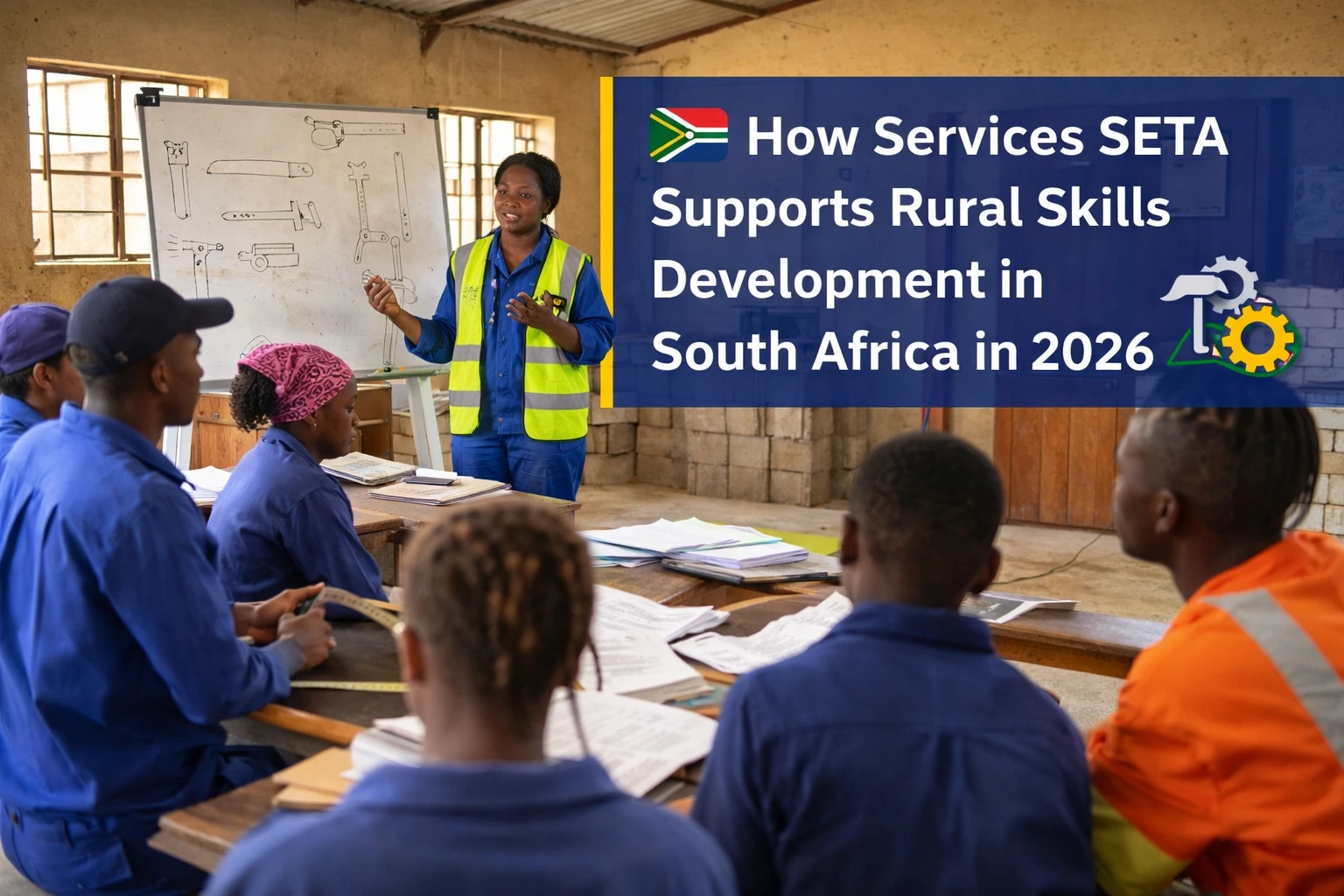
An in-depth analysis of how Services SETA supports rural skills development in South Africa, including programmes, impact, and future opportunities for job seekers.
How Services SETA Supports Rural Skills Development in South Africa
Introduction: Why Rural Skills Development Matters Now
South Africa’s economic future is increasingly tied to how effectively it develops skills across all regions—not just in urban centres. While cities like Johannesburg and Cape Town dominate economic activity, rural areas remain home to millions of people with limited access to education, training, and employment opportunities.
This is where the role of Services SETA becomes critical. As one of the country’s key Sector Education and Training Authorities, Services SETA is tasked with bridging the gap between education and employment, particularly in underserved communities.
Understanding Services SETA rural skills development is essential in 2026 because the country faces a dual challenge: high youth unemployment and a persistent skills mismatch. Rural development sits at the center of both issues. Without targeted interventions, inequality deepens. With the right programs, however, rural communities can become engines of economic participation.
ALSO READ OUR PRIVACY POLICY
How Services SETA Supports Rural Skills Development in South Africa
ALSO READ Bursaries vs Student Loans: Which Is Better for South African Students in 2026?
Quick Facts Box About How Services SETA Supports Rural Skills Development in South Africa
- Closing date: Not stated in the official advert
- Location: Not stated in the official advert
- Duration: Not stated in the official advert
- Positions available: Not stated in the official advert
- Reference number: Not stated in the official advert
- Stipend: Not stated in the official advert
How Services SETA Supports Rural Skills Development in South Africa
Understanding the Role of Services SETA in South Africa || How Services SETA Supports Rural Skills Development in South Africa
To fully grasp the importance of Services SETA rural skills development, it is necessary to understand how SETAs function within the broader skills ecosystem.
Services SETA operates under the Department of Higher Education and Training and focuses on sectors such as:
- Business services
- Cleaning and hygiene
- Real estate and property
- Marketing and communication
- Hairdressing and beauty
Unlike traditional academic institutions, SETAs prioritize work-integrated learning. Their approach combines theoretical knowledge with practical experience, ensuring that learners are job-ready upon completion.
In rural contexts, this model becomes particularly powerful. Many learners may not have access to universities or TVET colleges, but SETA-funded programs can bring training directly to communities. This decentralization of education is one of the most important contributions of Services SETA.
Expanding Access: Bringing Training to Rural Communities – How Services SETA Supports Rural Skills Development in South Africa
One of the defining features of Services SETA rural skills development is its focus on accessibility. Rural areas often face structural barriers:
- Limited infrastructure
- Lack of training institutions
- High transportation costs
- Digital connectivity challenges
Services SETA addresses these barriers by funding community-based training providers and mobile learning initiatives. Instead of requiring learners to relocate, programs are often delivered within rural districts.
For example, learnerships and skills programmes are frequently implemented in partnership with local organizations. This ensures that training is contextually relevant and aligned with local economic activities.
There has also been a growing emphasis on blended learning models, combining in-person training with digital components. While connectivity remains a challenge, gradual improvements in rural internet access are enabling more flexible learning options.
The result is a gradual but meaningful shift: rural learners are no longer excluded from skills development opportunities at the same scale as before.
ALSO APPLY FOR PwC Graduate Internships 2026: Complete Guide for South African Graduates
Learnerships and Work-Based Training: The Core Strategy- How Services SETA Supports Rural Skills Development in South Africa
At the heart of Services SETA rural skills development are learnerships—structured programmes that combine classroom learning with workplace experience.
These learnerships are particularly valuable because they:
- Provide nationally recognized qualifications
- Offer practical, hands-on experience
- Often include stipends to support learners financially
In rural areas, learnerships can be transformative. They not only equip individuals with skills but also inject income into local economies.
For instance, a rural learner participating in a business administration learnership may gain experience in local municipal offices or small enterprises. This creates a feedback loop where skills development directly supports community institutions.
However, the effectiveness of these programmes depends heavily on employer participation. Services SETA incentivizes companies to host learners, but in rural areas, the number of available workplaces can be limited. This remains one of the key challenges in scaling impact.
Addressing the Skills Mismatch in Rural Economies- How Services SETA Supports Rural Skills Development in South Africa
A recurring issue in South Africa’s labour market is the mismatch between available skills and employer needs. This problem is even more pronounced in rural areas, where economic activity differs significantly from urban centres.
Services SETA rural skills development attempts to address this by aligning training programmes with local economic realities. Instead of applying a one-size-fits-all approach, programmes are increasingly tailored to regional needs.
Examples include:
- Training in small business management for rural entrepreneurs
- Skills development in tourism and hospitality in areas with natural attractions
- Service-sector training aligned with local government and community services
This localized approach reflects a broader shift in policy thinking: economic development must be context-specific.
However, challenges remain. Labour market data in rural areas is often limited, making it difficult to predict demand accurately. As a result, some programmes may still produce graduates in fields with limited local opportunities.
The Role of Partnerships and Community Stakeholders- How Services SETA Supports Rural Skills Development in South Africa
No single institution can address rural skills development alone. Services SETA relies heavily on partnerships with:
- Local municipalities
- Training providers
- Non-governmental organizations
- Private sector employers
These partnerships are essential for extending reach and ensuring programme relevance.
Community involvement is particularly important. When local stakeholders are engaged, programmes are more likely to succeed because they reflect actual needs rather than external assumptions.
For example, NGOs often play a role in identifying potential learners and supporting them throughout the programme. Employers, on the other hand, provide the workplace experience that is critical to the learnership model.
This collaborative approach is one of the strengths of Services SETA rural skills development. It creates a network of support that goes beyond formal training.
Challenges Limiting Impact in Rural Areas- How Services SETA Supports Rural Skills Development in South Africa
Despite its contributions, Services SETA rural skills development faces several structural challenges:
Limited Infrastructure || How Services SETA Supports Rural Skills Development in South Africa
Training delivery can be affected by inadequate facilities and resources in rural areas.
Employer Participation || How Services SETA Supports Rural Skills Development in South Africa
Fewer businesses in rural regions mean fewer opportunities for workplace training.
Awareness Gaps || How Services SETA Supports Rural Skills Development in South Africa
Many potential beneficiaries are unaware of available programmes or how to apply.
Administrative Delays || How Services SETA Supports Rural Skills Development in South Africa
Funding and programme approvals can sometimes be slow, delaying implementation.
These challenges highlight the complexity of rural development. Skills programmes alone are not enough—they must be supported by broader economic and infrastructural investments.
What This Means Going Forward- How Services SETA Supports Rural Skills Development in South Africa
Looking ahead, the role of Services SETA in rural development is likely to become even more important. As South Africa seeks to address unemployment and inequality, rural areas will be a key focus.
Several trends are expected to shape the future:
- Increased digital integration: As connectivity improves, more training will incorporate online components.
- Stronger employer incentives: Encouraging businesses to participate in learnerships will be critical.
- Greater focus on entrepreneurship: Supporting small businesses in rural areas can create sustainable employment.
- Data-driven planning: Improved labour market data will enable better alignment of training programmes.
Ultimately, Services SETA rural skills development represents both an opportunity and a challenge. The foundation is in place, but scaling impact will require coordinated efforts across multiple sectors.
For job seekers, the message is clear: these programmes offer a pathway into the labour market, particularly for those in underserved areas. For policymakers, the task is to ensure that these pathways lead to sustainable outcomes.
FAQs- How Services SETA Supports Rural Skills Development in South Africa
1. What is Services SETA?
Services SETA is a Sector Education and Training Authority that provides skills development programmes in various service-related industries in South Africa.
2. Who can apply for Services SETA programmes?
Typically, unemployed youth, workers seeking upskilling, and individuals in specific sectors can apply, depending on programme requirements.
3. Do Services SETA learnerships pay a stipend?
Many learnerships include stipends, but this depends on the specific programme.
4. How does Services SETA help rural communities?
By funding training programmes, supporting learnerships, and partnering with local organizations to deliver skills development initiatives.
5. How can I apply for Services SETA opportunities?
Applications are usually made through accredited training providers, employers, or official SETA announcements.
Final Insight- How Services SETA Supports Rural Skills Development in South Africa
The importance of Services SETA rural skills development cannot be overstated. It sits at the intersection of education, employment, and economic inclusion. While challenges persist, the progress made so far demonstrates the potential of targeted, community-focused interventions.
If effectively scaled and supported, these programmes could redefine opportunity for millions living outside South Africa’s urban centers—turning rural communities into active participants in the country’s economic future.