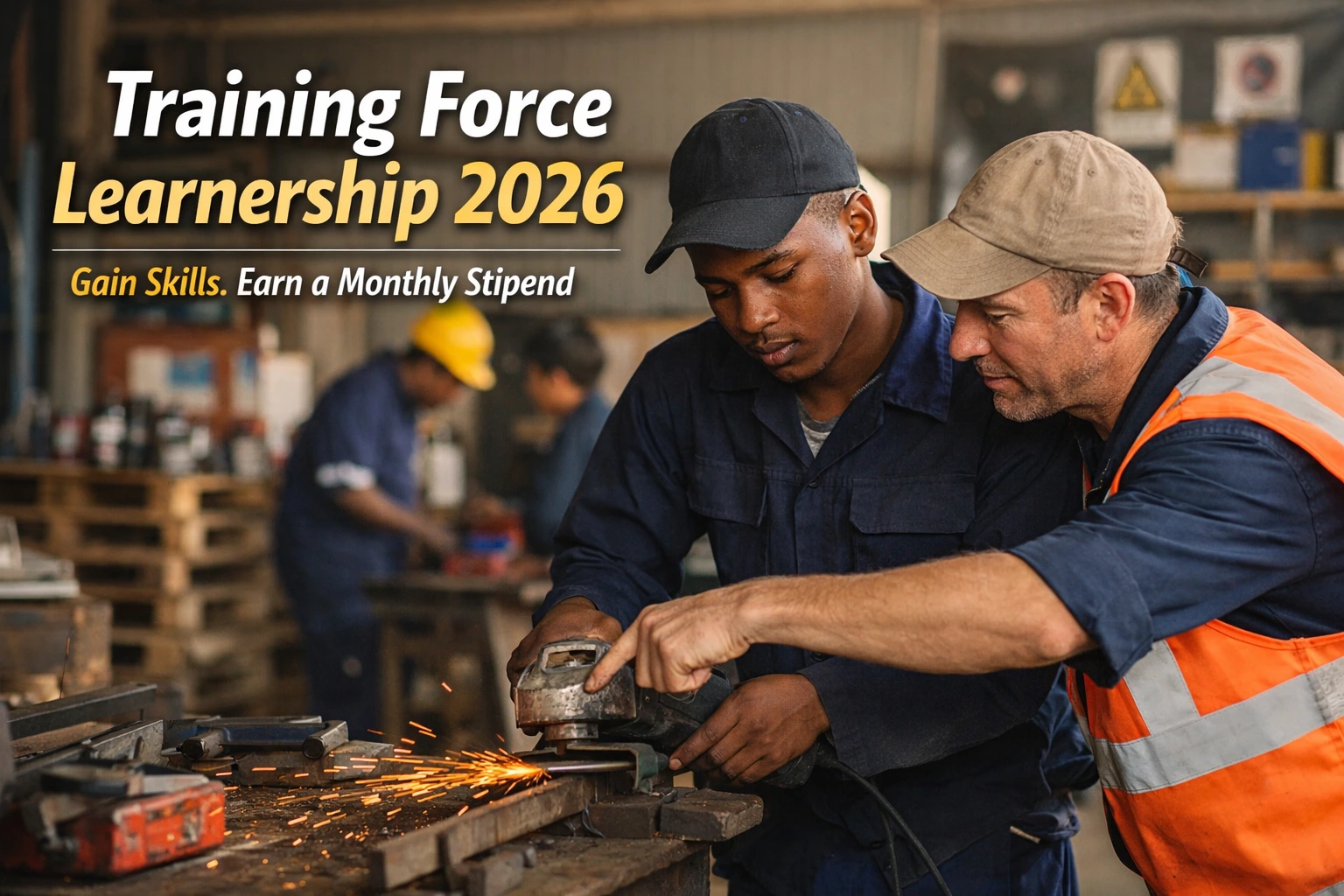
Training Force Learnership Programme 2026 offers SETA-accredited training, a monthly stipend, and real workplace experience for South African youth.
Training Force Learnership Programme 2026: A Realistic Path Into Work for Young South Africans
At 7:30 on a cold weekday morning in Gauteng, a group of young trainees gathers outside a warehouse yard. Some are in overalls, others still adjusting to steel-toe boots they’ve only worn a few times before. There’s a quiet mix of nerves and determination.
This is not a classroom.
It’s the kind of environment where the Training Force Learnership Programme 2026 begins to make sense — not as a concept, but as a lived experience.
For many young South Africans facing long job searches and limited opportunities, programmes like this are becoming less of an option and more of a necessity. They offer something that traditional education often struggles to provide: direct access to real work environments, combined with structured training and a monthly stipend.
Why the Training Force Learnership Programme 2026 Matters Right Now
The Training Force Learnership Programme 2026 arrives at a time when the gap between education and employment remains one of South Africa’s biggest challenges.
Thousands of young people leave school each year with qualifications, but without practical experience. Employers, on the other hand, often prioritise candidates who can “hit the ground running.”
This mismatch is where learnerships step in.
Training Force, working alongside SETAs and industry partners, has built its programmes around one idea: train people for jobs that actually exist.
That might sound obvious, but it’s not always the case in the broader education system. Many courses remain theoretical, while industries like logistics, construction, and manufacturing continue to report shortages of skilled workers.
The result is a paradox — high unemployment alongside unfilled roles.
Programmes like this attempt to close that gap.
How the Programme Works in Real Life
Unlike traditional courses, the Training Force Learnership Programme 2026 is structured around a simple but effective model:
70% practical training, 30% classroom learning.
In practice, this means learners spend most of their time in real workplaces — warehouses, construction sites, farms, or kitchens — depending on the chosen field.
The classroom component still matters. It provides the theory behind the work, helping learners understand safety procedures, industry standards, and technical knowledge.
But the emphasis is clear: learning by doing.
For example, a learner in warehousing might spend the morning in a short theory session, then move straight onto the floor to apply what they’ve learned — handling stock, operating equipment, or assisting with logistics processes.
That immediate application is what makes the experience stick.
The Industries Driving Demand in 2026
One of the most practical aspects of the Training Force Learnership Programme 2026 is its alignment with industries that continue to show demand.
Rather than focusing on saturated career paths, the programme targets sectors where skills shortages are more visible.
Some of the key fields include:
- Transport and Logistics: driving, warehousing, materials handling
- Construction and Engineering: bricklaying, plumbing, electrical basics
- Business and Hospitality: administration, project support, cookery
- Agriculture and Manufacturing: plant production, farming, operations
These are not always seen as “glamorous” careers, but they are essential to the economy.
In many cases, they also offer clearer entry points for progression. A learner who starts in warehousing, for instance, could move into supervisory roles or logistics coordination over time.
What You Actually Gain Beyond the Stipend
The mention of a monthly stipend often draws attention — and understandably so.
For many participants, financial support during training is critical. It helps cover transport, meals, and basic living costs while they build skills.
But the real value of the Training Force Learnership Programme 2026 goes beyond the stipend.
It includes:
- SETA-accredited qualifications that are recognised nationally
- Exposure to real workplace expectations and routines
- Practical experience that can be added to a CV
- A clearer understanding of career paths within specific industries
There’s also something less tangible but equally important: confidence.
For young people who have struggled to enter the workforce, simply being part of a structured work environment can change how they see themselves — and how employers see them.
The Reality Check: What Many Applicants Don’t Expect
While the programme offers opportunity, it also comes with expectations that are sometimes underestimated.
First, it requires full-time commitment.
Learners are expected to attend training consistently, follow workplace rules, and meet performance standards. This is not a flexible or casual arrangement.
Second, some programmes are physically demanding.
Fields like construction, logistics, and manufacturing involve long hours on your feet, manual tasks, and strict safety procedures.
Third, placement is not guaranteed.
Applying to the Training Force database does not automatically secure a spot. Selection depends on available projects, employer needs, and SETA funding cycles.
This uncertainty can be frustrating, but it reflects how closely the programme is tied to real industry demand.
Expert Insight: Why Employer-Linked Training Is Becoming More Important
There’s a growing shift in how skills development works in South Africa.
Traditional education systems are no longer the only pathway into employment. Increasingly, companies are looking for candidates who have already been exposed to workplace environments and practical tasks.
Programmes like the Training Force Learnership Programme 2026 reflect this shift.
By working directly with employers and SETAs, Training Force ensures that its training is not just relevant, but immediately applicable.
This approach has broader implications.
It suggests that future job markets may place even greater emphasis on experience-based learning, where practical exposure becomes just as important as formal qualifications.
For learners, this means choosing programmes that offer real-world engagement could be a more strategic move than purely academic routes.
SEE ALSO: How to Find Legitimate Learnerships Online in South Africa
Who Should Consider Applying?
The Training Force Learnership Programme 2026 is designed for a specific group of applicants.
To qualify, you typically need to:
- Be between 18 and 35 years old
- Be a South African citizen with a valid ID
- Have a minimum of Grade 10 to Grade 12, depending on the programme
- Be currently unemployed
- Be available for full-time training
Some technical fields may also require medical fitness checks.
Applicants must also prepare key documents, including their ID, school results, and an updated CV.
One practical tip that often gets overlooked: location matters.
Because many training projects are site-based, employers often prioritise candidates who live nearby. Including your exact location on your CV can improve your chances of being selected.
APPLY HERE: Training Force Learnership Programme 2026
ALSO APPLY FOR: Learner Pharmacist’s Assistant 2026 Western Cape Programme (EPWP Training Opportunity)
Frequently Asked Questions
Does the Training Force Learnership Programme 2026 guarantee a job?
No, placement in the programme does not guarantee employment, but it significantly improves your chances by providing practical experience.
How much is the monthly stipend?
The stipend varies depending on the specific project and funding, but it is intended to support basic living costs during training.
Can I choose any training field I want?
You can select your preferred field, but final placement depends on available projects and industry demand.
Final Thoughts: A Practical Step Forward, Not a Shortcut
The Training Force Learnership Programme 2026 is not a quick fix for unemployment.
It requires effort, discipline, and a willingness to step into unfamiliar environments. It also demands patience, as placement depends on factors beyond the applicant’s control.
But it offers something that many other opportunities do not: a direct connection between learning and work.
In a country where experience often determines opportunity, that connection matters.
For those willing to commit, the programme can serve as a starting point — not just for a job, but for understanding how industries operate, how skills are applied, and how careers are built over time.
And sometimes, that first step into a warehouse, a construction site, or a training facility is exactly where a long-term path begins.