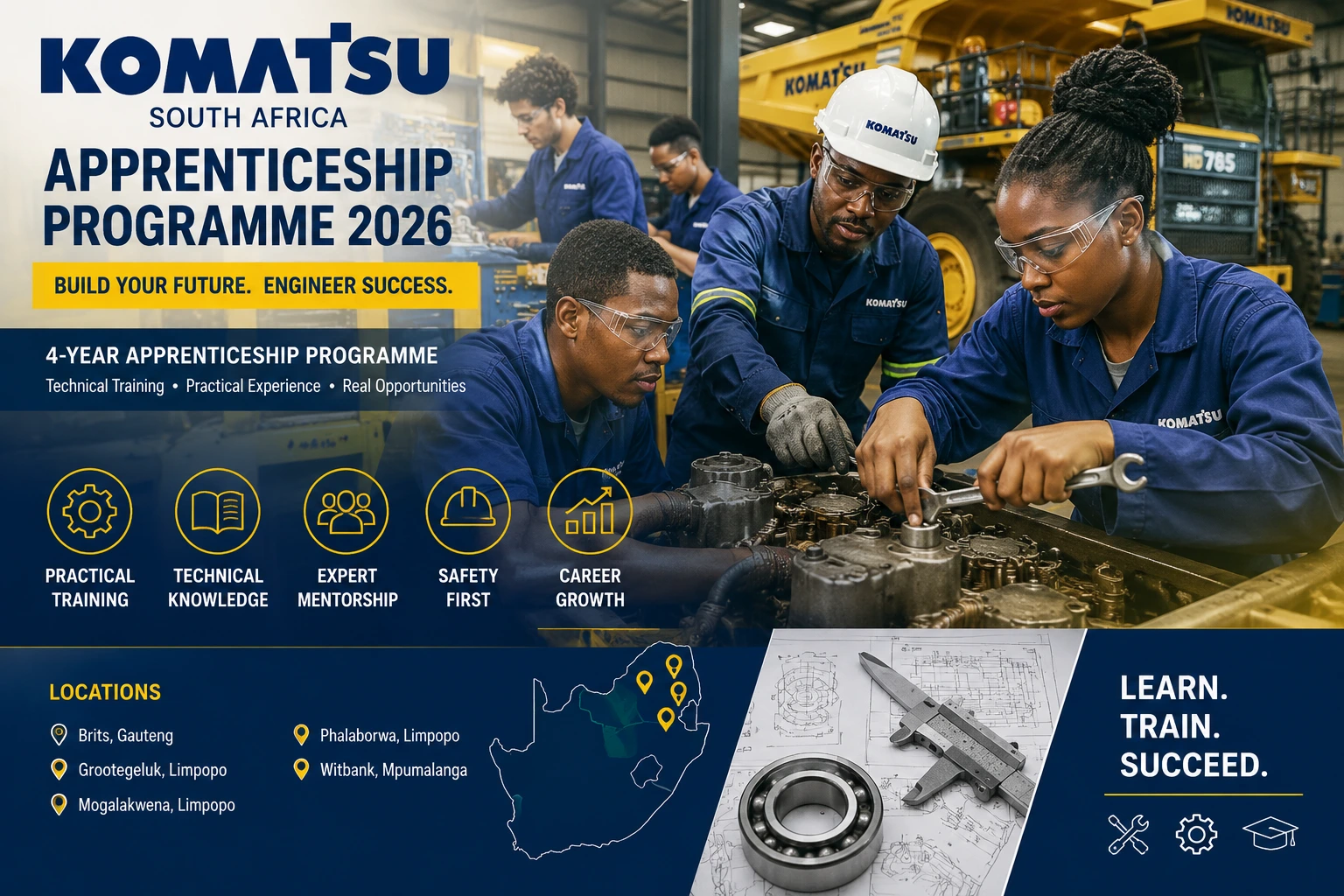
Apply for the Komatsu South Africa Apprenticeship Programme 2026 and gain 4 years of technical training and workplace experience in engineering. Find requirements, locations, benefits and application details.
Komatsu South Africa Apprenticeship Programme 2026: A Strategic Career Path for Young South Africans
South Africa’s unemployment challenge continues to place enormous pressure on young people, particularly those seeking practical career pathways after matric or technical studies. Against this backdrop, the Komatsu South Africa Apprenticeship Programme 2026 arrives at a critical moment, offering unemployed youth an opportunity to access structured technical training within one of the country’s most respected industrial and engineering environments.
For many young South Africans with mathematics, technical science and engineering-related studies, apprenticeships represent far more than temporary training opportunities. They provide a direct bridge between education and employment, equipping candidates with recognised technical skills that remain in demand across mining, manufacturing and industrial sectors.
The Komatsu South Africa Apprenticeship Programme 2026 stands out because it combines practical workplace learning, theoretical instruction and industry-recognised trade exposure over a four-year period. In an economy where employability increasingly depends on specialised technical competence, programmes like this have become essential stepping stones into long-term careers.
ALSO APPLY FOR Deloitte InfinityX Graduate Internships 2026 Now Open: Could This Be the Career Break South African Graduates Have Been Waiting For?
Quick Facts: Komatsu South Africa Apprenticeship Programme 2026
| Details | Information |
|---|---|
| Company Name | Komatsu South Africa |
| Closing Date | Not stated in the official advert |
| Location | Brits (Gauteng), Grootegeluk (Limpopo), Mogalakwena (Limpopo), Phalaborwa (Limpopo), Witbank (Mpumalanga) |
| Duration | 4 Years |
| Positions Available | Not stated in the official advert |
| Reference Number | Not stated in the official advert |
| Stipend | Not stated in the official advert |
| Required Gender | No gender requirement stated |
| Employment Type | Apprenticeship Programme |
Understanding the Komatsu South Africa Apprenticeship Programme 2026
The Komatsu South Africa Apprenticeship Programme 2026 is designed for young individuals who want to establish themselves within engineering and technical trades. Unlike short-term internships that primarily focus on workplace exposure, apprenticeships provide a deeper level of professional development by combining technical instruction with real workplace experience.
Komatsu, a major player in heavy equipment manufacturing and industrial machinery, operates extensively within mining and engineering sectors. This means apprentices entering the programme are likely to gain exposure to highly specialised technical systems, industrial maintenance environments and operational engineering practices.
The apprenticeship follows a structured 4-year learning journey, supported through merSETA apprenticeship modules, which form part of South Africa’s recognised artisan development framework. merSETA plays a central role in developing technical occupations needed in manufacturing and engineering industries, making this qualification pathway especially valuable.
For unemployed youth, this creates a meaningful opportunity to develop practical trade capabilities while working alongside experienced professionals.
Why Technical Apprenticeships Matter More Than Ever in South Africa-Komatsu South Africa Apprenticeship Programme 2026
The growing demand for artisans and technical workers has become one of South Africa’s most important labour market trends. While many industries struggle with graduate unemployment, sectors linked to engineering, mining and industrial operations continue to report shortages of technically skilled workers.
Several national workforce studies have consistently shown that technical occupations remain among the most employable fields because they support critical infrastructure, manufacturing and production systems.
This explains why opportunities such as the Komatsu South Africa Apprenticeship Programme 2026 deserve serious consideration.
Unlike general workplace experience, technical apprenticeships focus on building specialised competencies that employers actively seek. Candidates who successfully complete trade-related training often find themselves positioned for opportunities in sectors such as: Komatsu South Africa Apprenticeship Programme 2026
- Mining operations
- Manufacturing industries
- Heavy equipment maintenance
- Mechanical engineering environments
- Industrial production facilities
- Technical support services
Importantly, technical careers often offer stronger long-term job stability because of the shortage of qualified artisans.
For many young South Africans, this apprenticeship may represent not only immediate training but also a strategic investment in future employability.
Minimum Requirements: Why Komatsu Has Set High Entry Standards-Komatsu South Africa Apprenticeship Programme 2026
One notable aspect of the Komatsu South Africa Apprenticeship Programme 2026 is its academic entry criteria.
Applicants must have:
- Grade 12 or an N3 qualification with Mathematics
- Mathematics or Technical Mathematics at NQF Level 4
- Physical Science or Technical Science
- N3 Electrical/Fitter Trade Theory and/or N3 Mechanotechnology
- Be currently unemployed
It is particularly important that applicants note Mathematics Literacy will not be accepted.
This requirement reflects the technical complexity of engineering-related work. Modern industrial equipment relies heavily on measurements, diagnostics, calculations and technical problem-solving. Mathematical understanding becomes essential when dealing with machinery maintenance, fault analysis and engineering systems.
Similarly, science-related subjects provide the foundation needed to understand concepts involving electricity, mechanics, energy transfer and operational systems.
Rather than viewing these requirements as restrictive, prospective applicants should see them as indicators of the technical quality expected within the programme.
Komatsu appears to be investing in candidates who demonstrate the academic foundation needed to succeed in demanding engineering environments.
What Apprentices Will Actually Learn During the Programme
Many applicants often misunderstand apprenticeships, assuming they involve repetitive workshop tasks with little professional growth. In reality, structured apprenticeships are designed to progressively develop workplace competence.
Successful candidates in the Komatsu South Africa Apprenticeship Programme 2026 will be expected to:
Learn Technical Engineering Processes
Apprentices will observe and develop hands-on technical skills related to engineering operations. This practical exposure is often where classroom theory begins to make sense in real-world industrial environments.
Complete merSETA Training Modules
The programme includes prescribed apprenticeship learning modules, ensuring apprentices gain recognised technical competencies aligned with industry standards.
Develop Workplace Safety Competencies
Safety remains one of the most critical priorities in engineering, mining and manufacturing sectors. Apprentices will likely receive workplace safety training and exposure to operational compliance standards.
Gain Team-Based and Independent Working Skills
Modern industrial workplaces require both collaboration and self-management. Apprentices will be expected to work within teams while also handling technical responsibilities independently.
Maintain Workshop Standards
Keeping equipment functional, maintaining housekeeping and following operational procedures are essential aspects of industrial professionalism.
This combination of technical and behavioural learning often becomes the defining factor that separates employable artisans from underprepared candidates.
The Skills Komatsu Appears to Prioritise in Candidates
The apprenticeship advert highlights several behavioural competencies beyond technical qualifications.
Komatsu seeks candidates with: Komatsu South Africa Apprenticeship Programme 2026
- Technical aptitude
- Professionalism
- Perseverance
- Teamwork abilities
- Willingness to learn
- Responsibility
- Strong safety awareness
These requirements suggest the company values long-term workplace readiness, not only academic results.
Engineering environments can be demanding. Apprentices may encounter physically challenging situations, complex machinery systems and performance expectations that require consistency and resilience.
Candidates who show commitment, reliability and discipline often outperform technically stronger individuals who struggle with workplace behaviour.
For applicants, this means your application should reflect both technical readiness and professional maturity.
Apprenticeship Locations: What This Means for Applicants
The programme is available in multiple operational regions:
- Brits, Gauteng
- Grootegeluk, Limpopo
- Mogalakwena, Limpopo
- Phalaborwa, Limpopo
- Witbank, Mpumalanga
This geographical spread is significant.
Many of these locations are closely linked to mining and industrial operations, meaning apprentices could gain exposure to real production environments where heavy machinery and engineering systems are essential.
For applicants living near these regions, transport and relocation considerations may become an important factor.
At the same time, multi-location recruitment often signals broader workforce planning, which may indicate sustained technical demand within the business.
What This Means Going Forward-Komatsu South Africa Apprenticeship Programme 2026
The Komatsu South Africa Apprenticeship Programme 2026 reflects a wider shift occurring in South Africa’s labour market.
As industries increasingly prioritise practical competence over purely theoretical qualifications, technical training programmes are becoming more valuable.
Young people with engineering interests are likely to benefit from focusing on artisan pathways, especially in sectors tied to infrastructure, mining, manufacturing and industrial operations.
Programmes supported by recognised structures such as merSETA may continue to become highly competitive because they improve employability in industries facing technical shortages.
For unemployed youth with Mathematics, Physical Science and technical training backgrounds, opportunities like this should not be overlooked. While competition is expected to be strong, candidates who meet the academic criteria and demonstrate commitment to technical careers could position themselves for long-term professional growth.
How to Apply For Komatsu South Africa Apprenticeship Programme 2026
Interested applicants should apply for the Komatsu South Africa Apprenticeship Programme 2026 through the company’s official recruitment process once application instructions are published.
Before applying, candidates should prepare: Komatsu South Africa Apprenticeship Programme 2026
- Certified copies of qualifications
- Updated CV
- Certified ID document
- Supporting technical certificates (where applicable)
Applicants are encouraged to apply early once official application channels open, as apprenticeship opportunities within engineering sectors often attract high volumes of interest.
How to Apply For Komatsu South Africa Apprenticeship Programme 2026
Apply Online for the Komatsu South Africa Apprenticeship Programme 2026
FAQs-Komatsu South Africa Apprenticeship Programme 2026
1. Who can apply for the Komatsu South Africa Apprenticeship Programme 2026?
South African youth who are currently unemployed and have Grade 12 or an N3 qualification with Mathematics, Physical Science or Technical Science, plus relevant N3 trade theory subjects, may apply.
2. Does the Komatsu apprenticeship include a stipend?
The official advert does not state whether a stipend will be provided.
Conclusion-Komatsu South Africa Apprenticeship Programme 2026
The Komatsu South Africa Apprenticeship Programme 2026 offers more than technical training — it provides a structured route into one of South Africa’s most important economic sectors. With four years of workplace learning, merSETA-aligned development and exposure to engineering environments, the programme could become a meaningful career-building opportunity for unemployed youth seeking practical skills and long-term employability.
Although the competition is likely to be significant, candidates who meet the requirements and demonstrate genuine commitment to technical work may find this apprenticeship a worthwhile investment in their future.